Saturday, February 7, 2009

Raindrops keep falling on my head

Thursday 5 January 2009
Yesterday may have been a perfect day; today however, is another matter. A battleship grey sky is a prospect for a cool day and no rain – yet?

Maria is still battling the effects from the “Dreaded Batter Pudding Hurler from Barcelona-On-Sea”, and she isn’t prepared to venture too far from the apartment.
However I do, and decide to visit The Museu D’història de Catalunya, which was closed the other day. I have to admire Spanish people, as they certainly have the knack of developing fine museums. I wasn’t disappointed with the stewardship of this museum either.

As the museum is a brisk walk across from where we are staying, I decided to reconnoitre, via the bay area, in lieu of a more direct route. This digression had taken me east along the Ronda Litoral, which is lined with office buildings and parklands. After walking for almost a kilometre, I arrive at the Parc Cascades where the casino is located nearby.
Now, most of the modern buildings are architecturally appealing and designed to suit the environment. However, the casino is another matter.

The architecture in Barcelona is a myriad of styles, reflecting specific eras and locales. The visual appreciation of Antoni Gaudí’s creations is a personal experience. Regrettably, viewing the casino is a regression from the splendour that is Gaudí, to the lifelessness which is just gaudy. Oh well, it must work for the Trustees, as both of the casino’s carparks were full!

Taking the promenade through the Parc Cascades is where I pass by the casino; which is located at the beachfront called Platįa Barceloneta. In the casino’s forecourt, stands a monumental sculpture which appears to be made from geodesic stainless steel with an external bronze coating. I haven’t quite decided whether it is representative of a whale or a sea cucumber? However, I continue with my promenade, west along the foreshore.

Perpetual wind gusts attempt to hamper my progress, including the other wanderers. The foreshore is made up of small beaches, and some show signs of tidal erosion. Apart from the esplanade, the beaches are deserted, which I have no doubt is a different matter during the summer months.

I eventually arrive at the museum, which consists of five storeys each of which is a time capsule of Barcelona’s history. Albeit, the ground level is dedicated to two temporary exhibitions documenting Spain’s’ involvement in two travesties: The Great War and the Spanish Civil War. Regrettably, picture taking was not permitted in these two exhibitions due to the delicacy of the exhibits on display. However, I was permitted to photograph some exhibits from other areas.

After, two hours I returned to the apartment and Maria.
As Maria is still not confident to venture forth, I am sent for some plumbing bog (Imodium) for her, which will hopefully provide relief. (sic. Yes, I finally succumbed – realising that I was not going to be able to get over this without intervention!)
As a consequence I will have to continue to sightsee for the both of us.
Again I set forth for the city; and my first stop is to visit the Casa de L’ardiaca Catedral which is undergoing repairs. I am not religious, so my fascination with cathedrals is aesthetic in lieu of inspirational. This particular medieval edifice is quite imposing with its gargoyles; towers; spires; integrated and flying buttresses. The interior is rather ominous, as it lacks clerestory; however, after my sight becomes accustomed to the low light, the interior is just as imposing as the exterior. It’s compelling through the high
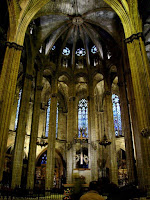
cross-ribbed vaulted ceilings, long knave and a high apse and presbytery. The rotunda and aedicule form the nucleus of this structure, whereby pilgrims can progress, on their missions, by stopping at the multiple chapels aligning the knave!

Leaving the cathedral, I catch a tourist bus and alight at the “Gaudí” corner, to take extra photos of Antoni Gaudí’s creations. Mind you the clouds are becoming denser, and the natural light begins to darken.
After this rendezvous I proceed onto my next appointment, the Museu Egipci de Barcelona which is displaying a temporary exhibition on discoveries from the Valley of the Queens. The exhibition covers the period from early Amana to the XIX dynasty.
Upon leaving the dead, I catch the following tourist bus for the heights to take photos overlooking Barcelona. Shortly after catching this bus – the heavens open and another downpour commences. My chances’ obtaining any photographs has gone down the storm water channels.

Another wet afternoon/evening, so it’s back to the apartment and Maria.

Thursday, February 5, 2009

Today is a new adventure

Wednesday 4 February 2009
“We live in a wonderful world that is full of beauty, charm and adventure. There is no end to the adventures we can have if only we seek them with our eyes open.” Jawaharial Nehru

Barcelona is one of those adventures. This is a city that I could easily live in. It is well planned and well kept. Despite the ever present modern graffit, it is almost contained and seems to meet pre-set high standards! While there is nowhere (literally) to park a car, every available space is given over to Moto parking spots. No wonder you see so many around the City! Today we rejoice in the beautiful sunshine and take to the streets and the roads.

We start out by taking the Barcelona Tourist bus. We have found that these are a great way to get an overview of the locale and to get your bearings with regard to where the tourist sights to see are and how they are placed from each other - and therefore how much you can reasonably expect to do in a set time. We pick the bus at stop 16 at the Monumento a Colón (Columbus Monument) which stands dominating the traffic square. Our two day pass at €27 each seems like a good deal. A through journey is estimated to take 2.5 hours and either passes or goes close to all the major tourism destinations in Barcelona. We take to the top deck and are soon pleased that we dressed warmer than not as the breeze is brisk! Interestingly we are 2 of only 3 people on the bus! Ah, winter - the tourist's haven!!

We wind through the streets of Port Vell to start - taking in views of money well spent (?) with sail and dinghy sitting in the sun, lazily bobbing in the water. One has to question how much wealth you have to have before you can afford a piece of this luxury just sitting there! We hear of the industrial past of Barcelona and see this now pristine waterfront area. Turns out that there have been a number of times when the factories were moved away from this area so it could be better presented - the first was the World Trade Fair in 1929 and then the Olympic Games in 1992. An interesting site is the 'Barcelona Head' sculptured by Roy Lichtenstein for the 1992 Summer Olympics.

Then into the centre of Barcelona and the wonderfully planned wide avenues (as a result of the World Fair) with the uniformly 6-storied but beautifically diverse commercial and residential buildings. You would not believe the amount of redevelopment going on here - mostly in the grand old buildings - all with the facades retained. Here they value their history. Even the newer residential blocks have a certain allure. They surround open parks and gardens and do not have that ghetto look that was more evident in some other areas. We travel up the Gran Via Corts Catalanes and the Avenue Diagonal and pass some of Barcelona's wonderful examples of Antonio Gaudí's architecture. More on them later this week!

We turn away from the City centre as the location of Gaudí's masterpiece La Sagrada Familia is explained - land in the centre of the City was too expensive and there was plenty of land available nearby which coincidently was home to many of the factory workers with whom Gaudí identified and was trying to attract with his new temple. It is as breath-taking as I always imagined. At this point, we just sit in awe as we travel past, knowing that we will be back later today for a detailed look.

It is then a climb up into the Gràcia area and tantalisingly close to Parc Güell - though not enough to see. Then over to the home of FC Barcelona Barça - to those who are interested there needs to be no more explanantion - and to the rest of us, it doesn't matter! Then up through the upper class residential area to the former Olympic site and down through the World Trade Centre (don't know why so many of these centres are seen as areas of interest to tourists!) before we head back into the Port area where we began our tour.

As it is the low season and the number of busses operating is limited, twice we are asked to alight and change to another bus or face a 20 minute wait. Yet despite this we never saw more than 6 other people on the bus - apart from the last bus that did not stop for us when we leaving La Sagrada Familia about 5:50 pm - it seemed chockers!

La Sagrada Familia
This iconic representation of the work of renowned architect/artist Antonio Gaudí is just so much more up close. While you either love or hate it's organic facade, the genius of the man cannot be questioned. Ever since I developed an interest in architecture in high school, this building has held a particlar interest for me. Like almost all significant cathedrals, it is taking more than the lifetime of one man to construct it. Gaudí however, possessed foresight that today is helping to guarantee that his vision is met. This was so important for this church in particular because it breaks so many of the previously accepted norms. The first thing that hits you is the immense size of the building quickly followed by the busyness of its facade. Now this is one of the elements that brings people to a love/hate relationship with the cathedral.

Up close and personal however, the biggest impact is from the human elements. Gaudí used local people and his workmen as the models for the faces. This explains why they are so personable. While the facade generally presents an incredibly busy view, the human forms are simplistic and sleek, allowing them to jump out at you as you stand and look. They all present different periods in the life of Christ. Then you look up - the gargoyles are all animals - gastropods, reptiles and the like and the spires hold elements of flowers and leaves.

Gaudí said that his early life spent with his mother studying nature greatly influenced his later designs. And all this before you even walk through the doors.

Once inside you get a better appreciation of the statement that this project is now only 60 % constructed. While the skeleton of the building is complete and you stand within a vast forest of huge trees when in the area of the main nave of the Cathedral, this is very obviously a work in progress. Stone masons and carpenters are busy within arms reach of visitors, just over the barricades that keep us separated. There is fine stone dust filling the air and water continually drips from the yet to be completed roof. And yet . . .

There is a sense of calm, of light, of warmth. The church is filled with space, open and welcoming; with light warm and enveloping; and quiet cocoons you. You instictively join the shush. All around is evidence of Gaudí's attempt to bring the organic life of nature into this rigid process of architecture and I cannot begin to tell you how successful he has been. He was a leader in the application of geometery and othe mathematical processes to te architectural design process. And in order to make sure that those who followed him appreciated his plans (he had no delusions of gandeur - he knew he would not live long enough to complete this project and planned for others to continue after him) he made intricately detailed drawings and scale (1:10, 1:25 and 1:1) models. These practices continue today - leaving a legacy of historic material for posperity.

Don't have the words to explain further, so Ill let some photos tell the rest. BUT, if you ever get a chance to come and see it, grab it with both hands.

Oh - we caught a lift up one of the pinacle towers and then climbed another two stories by way of (yet another) spiral staircase. The views of some of the roof elements can nly be seen in detail from here and the view across the City is wonderful. But the wind is fierce!

Afterwards we go back to the bus stop to get the bus (unsuccessfully), and head back to the Catedral to get a cab. The fare across town is a mere €6.65 and our cabbie is delightful. He speaks far better English than our faltering Spanish and is enjoyed when he learns we are from Australia - he watches many programs on Australia on TV he tells us. And he takes pains to tell us that in Barcelona it is almost always sunny! Now, there was a salesman!!!

I know it's winter but . . .

Tuesday 3 February 2009

And still the rain comes. This morning is as dark as it was at 10 pm last night. The rain is as heavy as a damp, dank, dark coat. There will be no sightseeing for the moment.

We decide to tackle the healthily growing pile of laundry that comes with living out of a suitcase. The instructions in the manual for the apartment for the use of the washing machine and the dryer are less than clear. After a number of failed attempts, we end up washing the clotes for almost 2 hours and still cannot work the dryer. Now, before you all scoff at our uselessness, please be advised that the washing machine and dryer are one machine, the instructions on the machine are all in spanish and the instructions clearly relate to two seperate machines. In the end, trial and error prevail and we work it out - boy these clothes have never had it so clean (or dry!)

It is now just before 2 pm and the sky is breaking - giving us a glimmer of hope - so we rug up, pack the brolly and set out for a walk. There is certainly nothing like a good downpour to wash away the debris and Barcelona now sparkles. Although it is still overcast, the people come back out into the streets, rushing about their chores, or just catching up with their world at their local café bar.

We wander down different back streets and come across a little chapel to St Christopher - patron saint of travellers, so have to get a photo of that one! At Las Ramblas we are amid the locals and tourists rubbing shoulders - ever mindful of our belongings as we have heard plenty of advice to be wary of pickpockets in this area. The flower markets are doing a thriving trade down either side of the pedestrianised centre of this famous street. We spy the Mercat de la Boqueria (Boqueria Market) and head on over.

Now, as you will see in the attached link to this market, the Chairman of the Vendors Association claims this is one of the best markets in Europe. Even though it was almost 5 pm, the vendors were still hustling and the buyers still being discerning! There was plenty of trade continuing with all manners of fresh produce available. From farm fresh produce (all the way from Peru as we later discovered our asparagus was sourced), to all manners of seafood - try this link for a description of spanish seafood - incuding many we had never seen before). The navaja were particularly interesting to see! And then there was the game store that not only had tins of the ever-present foie gras, but also the raw liver - all yellow and fatty - not a sign of the anticipated dark red, to ducks ready to cook all á la oranged, and furred and feathered rabbits, ducks and fowl still freshly draining their last blood.

For the princely sum of €16.85 we bring home a large bunch of asparagus, half a kilo of strawberries, 2 punnets of raspberries, a handful of mushrooms, a hand of bananas and a layer of the finest, leanest jamon. a feast in the making! We have been trying to cook most nights so that we can get a decent amount of fresh vegetables in to us. We had bought fresh chicken and veal at the supermarket without realising that this market was so close.

Back to the unit via a different route - past lots of Tapas bars and the Cathedral of Santa Eulalia who reportedly was martyred in Roman Times and whose remains are interred in the crypt. One of the most interesting features of this temple are the remains of a former basilica that dates back to 925 AD. This is a stunning example of Gothic architecture that dominates the square in front of it where teens compete each other for daring (stupid) skateboard stunts. The Spanish like many other Europeans love their graffiti - the historic type that is. Graffiti (The term "graffiti" derives from the Greek graphein ("to write"). Graffiti (s. graffito), meaning a drawing or scribbling on a flat surface, originally referred to those marks found on ancient Roman architecture) adorns many of the outsides of the buildings that we pass.

Tonight I make veal with veges and the make a thin egg custard (why o why didn't I buy some vanilla??) and then slice ripe strawberries into it and let them steep in it before adding more strawberries and all the raspberries just before we eat it - yum!

It has been a frustrating couple of days with the weather. Tomorrow promises sun - so we are eager to get out and about!

Wednesday, February 4, 2009

Day Two: That Rain in Spain won’t stay in the Plain.

Monday 2 February 2009

He stood in the doorway, shoulders hunched against the cold; hat pulled down over his eyes and his coat in a tight Harlow grasp. Tendrils of cigarette smoke his only companion. Once more he cursed Shaw, Higgins and Pickering; another dead lead and more blasted rain.
As the rain beat around him; he drew in another breath of the strong Turkish, pushed himself from the doorway, and continued his drudge along Carrer Ruff. Disillusionment was not his companion this day, just the drenching rain. Another day in Barcelona; another day in the corps.

As he pushed on, he heard the haunting sitar playing of Anton Carras; which made him wonder - where was he going to find this third man? He suddenly had to stop, as some cove on a moped cut through his reverie. The Spanish, they love life, the grape, tobacco and mopeds.
He hunkered deeper into his coat, and thought of New York. The Big Apple: a city which never sleeps – except on Sundays. Barcelona reminded him of New York, as a city that never sleeps – but it includes Sundays. The bars and cafes are jumping after 10 at night; those places just bulge. Oh yes, these Spaniards are in love with life.

Get a move on! No wonder every passer by keeps looking at this guy, just standing in the rain – in a dream. He continues to walk, then suddenly remembers his rendezvous - the museum… Huddling into a doorway, he takes out his battered map and realising his chips might be down. In the damp and gloom he traces a route to….what is it called? Pushing his hat upon his forehead with his thumb, just like switching on a light. The Museu D’història de Catalunya – that’s it!

Folding the map, he shoves it into his back pocket, and then heads south along Via Rambla towards the Mirador de Colom. All roads may have led to Rome at some time, in Barcelona the roads eventually lead to Christopher Columbus. Today, however, is not the day to visit the ‘Birdman’ at the Font de Canaletes.

Lighting another Turk, he ploughs his way through the throng of people. Walking along the streets of Barcelona is like a game of constant weaving, veering and running with the ball for touch. People just walk right in front of you; too many destinations and too little time. Upon reaching the Plaça del Teatre, he ducks under a portico to escape another heavy downpour. Idling towards the main street, after the sudden torrent; he stops, and with an intake of breath, he sees another encubierto agente. He flattens himself against the wall.

These coves like to dress-up, talk about not being too conspicuous? He peers again at the figure, which is frozen in silence. Like some character from an H.P. Lovecraft novel, the figure is very ghoulish: horns, talons, unfurled wings and glistening with gold. He watches as some passerby throws it money, as in a tithe to keep the creature at bay. On receiving the hand-out, the fiendish creature opens its eyes and mouth in a macabre gesture; quickly it collapses into its catatonic stance.

Carefully, our fellow slinks past the apparition, and suddenly realises he is surrounded by these frozen forms. These may not be as ghastly as the ghoul, but they too are sentinels of silence.
He makes a hasty dash past the sentries, and hastens towards his destination.

Arriving at the Mirador de Colom, he looks carefully around him, allaying any concern to the presence of other agentes. He quickly crosses the Ronda del Litoral, circuits the Puerto de Barcelona building and crosses the bridge, Rambla de Mar. The Museu D’història de Catalunya is now not far.

Yachts, with erect and swaying masts, like metronomes providing silent pulses to the man’s regular tread, as he nears his destination. There! Over there on the other side! He quickens his pace, rounds the port railings and hastens towards the museum’s entry.

Once again he curses Shaw, Higgins and Pickering; another dead lead… the museum is closed!

“The Rain in Spain Stays Mainly On the Plain”

…….bovina excreta.

Professor Henry Higgins may have used this ‘Id’ altering tongue-twister on Eliza Doolittle, but rest assured the rain in Spain falls everywhere!

It’s Sunday, and with a dense cloud cover issuing an over abundance of precipitation, it’s the type of weather suitable for ducks and mad Australians? Albeit, a new town in a new country cooing at the brave to venture forth. Where to from here?

Maria, with a case of Barcelona Belly, won't leave the proximity of the loo and will start transposing our blog into Corel (ready for printing when we return home). I, on the other hand, decide to once again don hat, coat, storm-stick, and a map of Barcelona, then strike forth into the elements.

Our apartment is located in Sant Marti opposite Port Vill and marinas, and behind us is the area known as Barri Gòtic, that name alone is an inspiration for exploration. Hence, this is the direction I head for – the dark and narrow streets of the unknown.

The area is reminiscent of the Whitechapel area of East London with the exception: Jack doesn’t live here. In fact, this Gothic area may be gloomy but it teams with life. As I proceed through the rain, I hear people singing; passersby greet each other like long lost friends; little estaminets and bars bulging with humanity; locals scurrying through this labyrinth like mice in a Skinner box – yes, folks, there is a verve here, which tremors through my very footfalls.

Through this winding maze of gothic architecture, graffiti, cooking aromas and tobacco, I suddenly venture into one of Barcelona’s many plazas or “plaça”. This small square, called Plaça Centelles, is bordered by rustic residential buildings (which some incorporate ground level cafes and bars), and a church called Sants Just I Pastor. I must add, throughout my walks in Barcelona city every plaça has a church or remnants of one.

Continuing onwards I come across my objective – Infomaćion de Touristé. The tourism office, which is rather modest, is located in a precinct of government offices. I find the Tourism staff most accommodating, and provide me with an assortment of tourist information, and salient advice. As I leave the tourism office, the rain commences to fall more heavily, so I open the brolly and head west along the Carre de la Boqueria towards the Via Rambla, one of the main street in Barcelona.

As I reach Via Rambla, the rain continues it heavy downfall and time to test a local coffee house. So, a short sojourn in Le Primavera for a doble espresso. I must admit, the Spanish do know how to make strong coffee; and after the ingestion of a ‘gorilla’ I’m ready to press on south on the Via Rambla.

Likened to Marseille, Barcelona is a city of ships and those of varying shapes and sizes. Barcelona’s history has basically revolved around the sea, though trade, ship building and warfare.

Let’s just digress here for a moment….
Who founded Barcelona: the Greeks, the Romans, Larry King? Well, if you’re into legends – it was Hercules, four hundred years before the defining of Rome! (Long live the Heroic age!) However, there is another belief that Barcelona was established by Hamilcar Barca, (the father of Hannibal,) around 3BC after he had given the Scippio brothers bloody noses. He then gave the area his family name, ‘Barcino’.

Well, considering the evidence of Roman ruins unearthed over the years, I would suspect SPQR was hitting the charts about 15BC. Then after the Romans had their shot, they were kicked out by the Visigoths, who in turn were usurped by the Moors and finally Charlemagne had his prod around the eighth century, anno domini. Interesting, eh….

As I neared the Passeig de Colom, I noticed the icon of a museum on the edge of the port - yes; it’s a maritime museum - Reials Drassanes Museu Maritim to be exact. This was to prove a most venerable haven to escape the rain.

The museum is not only impressive by the exhibits, but in the manner of the presentation as a chronological tour. It’s not restricted just to Spain’s maritime history; it incorporates the influences from other nations. However, the museum does boast a full scale replica of a 13C galley, and the replica of the submarine, Ictíneo 1, built by the gifted shipwright Narcís Moturiol. The original was built in 1859. To stave any further rambling; follow this link to the museums’ site.

After a couple of hours at the museum, it was time to return to the apartment and Maria. The apartment we have rented has a kitchen; therefore, only home-cooked meals this week, folks. There’ll be no fancy menu to report….well, maybe?