Showing posts with label Lyon. Show all posts

Sunday, January 18, 2009

A stroll through the streets in an illuminated sort of way

Hotel Hotelo is very welcoming and the hosts very pleasant, making our stay in Lyon very easy! Set in renovated building/s, it is at the same time chic and clean, and revealing a little of its past.

With Lyon's history dating back to 50 BC, there is a wealth of interesting history.

We started today by visiting the Institut Lumière that chronociles the development of the moving picture by members of the family Lumière. Meredith and Fliss, you will understand better than most Michael's interest in this museum! Located in the Monplaisir district, we emerged from the Metro into a regular Saturday market set up in the town square (complete with beggar and child sitting on the ground smack bang in the middle of the cross paths!) Here we could see locals buying their weekly fruit and vegetables. Our WHS and food safety people would be horrified - a butcher, fishmonger and delicatessan operating from their vans alongside he produce sellers - however, you must realise that the temperatures here are vastly different to those at home!

This museum is housed in the most beautiful art deco house that was home to the Lumière family. Wealthy from the shrewd and carefully managed development of their industry, the family built this amazing home away from the centre of Lyon (but still accessible by tram) in the rural neighbourhood of Monplaisir where at the time, they had views to the Alps. Entry in to the property was through the impressive porch that still stands. The building itself is amazing - it had the city's first central heating and one of the first internal telephone systems. It is also a remarkable example of art deco decoration.

The focus of the museum is the development of the Cinematograph and its application firstly to the family and their lives and then the commercialisation. Very entrepreneurial this family! It houses numerous artefacts that tell their story through the development and refinement of this technology, as well as a rich collection of their films, including their first ever film. At its height, there was a factory located next to the house where photographic plates were manufactured.

We spent what seemed like a hurried 3 hours here immersing ourselves not only in the interesting development of this technology, but also in to the lives of the Lumière family that they captured so well on film - both static and moving.

Sons Auguste and Louis Lumière also had a keen interest in medicine and pioneered a prosthetic arm, a fabric treatment for burns that is still in use today. Not only entrepreneurial, but also very inventive.

We had needed to keep an eye on the time as we have booked a 2 hour walking tour of Lyon today. We felt the need for some local flavour on the history of the city - and some of the tidbits that only a Lyonaisse could provide! We make our way back to Place Bellecour and the Office d'Tourisme. Our english speaking guide Annalisse gathers her group around her - an eclectic mix from many quarters. In all some 18 of us (including a few french who felt the french speaking group of about 40 was too large).

Off we set across the Place Bellecour. Annalisse explains that this is the only large square in Lyon and as such, is the place for many public gatherings. As we had been waiting, we could witness two such gatherings - protest marches for two very different causes - one with placard wearing families (including young children) protesting the government moves to reduce the number of teachers, thus increasing class sizes - same everywhere huh! I remember such protestations being made while working for Education Qld some years ago. Guess the public purse is feeling squeezed all over the world. The other protest that was considerably more vocal was one against the middle east conflict. This is a big one in Europe right now and nightly the news broadcasts show images of such protests in most large cities.

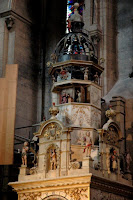
Analisse now takes across the River Saône via the Pont Bonaparte. Our first stop is at the St Jean Cathedral to watch the Astronomical Clock working. By the oohs and aahs, it is obvious that many of our party have not seen such a clock in motion before. This clock is much smaller than the one in Strasbourg and less ornate, though just as intricate in its movements. Just outside the cathedral there are numerous indications of the earlier settlers in this area including parts of earlier churches built on this site and walls from roman settlements in the first centuries.
Lyon has a very strong trade history due to its siting at the junction of the Rhone and Saône Rivers and the history of settlement. The early Governors of the City helped to cement this by abolishing taxes on goods traded during the trade fairs here. This helped to further establish the City. During this time, with the passage of traders, the city's reputation in silk trading and weaving really took hold.

As many of the residential streets were long and public space for squares limited, a series of shortcuts known as traboules (silk workers passageways) developed. These led through magnificent interior courtyards, complete with wells and spiralling staircases to individual houses. We were lucky enough to visit about ten of these.
At a number of points during our walk we came across a hodge podge of musicians playing loudly in the Squares. This annoyed Annalisse as she could not be heard over them - the rest of us hoewever, were busy taking photos! There is something distinctly European (and really quite French) about this type of entertainment.

Our tour continues through the back streets with Annalisse a veritable wealth of knowledge and snippets. We pass Lyon's greatest trompe l'oeil mural - one the side of the wall of one of the best hotels - Le Cour de Loges. This image depicts the traboule that now forms part of the foyer of this hotel. They do not appreciate hordes of tourists just traipsing in to have a look, so this was their answer to satifying everyone! Inventive? Sure!
We finish our walk and make our way back to the Cathedral where we get the Metro back to our Hotel. We get lost coming our of the Metro Station and end up on the other side of the River Rhone. My feet are too sore to continue traipsing and we have decided to stay another couple of days so need to get stuff out of the car as the secure car park is closed tomorrow. Too tired to bother going out for dinner, we pick up a couple of Croques Monsieur to eat at the Station. Then off to the Hotel for a well earned foot rub!

Friday, January 16, 2009

In Lyon, all the streets lead . . .

to yet another small square. A drivers nightmare, the old centre of Lyon is a maze of narrow streets with squares interspersed roughly every 4 -5 blocks. Not all however are straight and so it is easy to lose your way through the cobblestoned back streets that do not appear, let alone be named on the tourist maps.

This morning we caught the Metro to L'Office de Tourisme in Place Bellacour to book a tour on the open bus tour - only to be told that all the main tours (including the river cruise) are closed until the end of January. So be it - we will have to use the shanks pony here!

From here we walked to the Textile Museum and Decorative Arts Museum. These two museums housed in the same enclosed courtyard of buildings were a bit of a surprise. They showcased not only the history of textile making in Lyon and France, but also had textiles dating back to the time barely known from Egypt, Syria and Iran including parts of everyday clothing and ceremonial wear as well as household furnishings. They also had a temporary exhibit on paper pattern-making that included a large range of paper gowns. It was hard to believe that these were paper! No photos were allowed, so I can't show you how spectacular they were - but think of a rich brocade, or the sheerest pleated silk and you can just start to get the idea. Many of them were adorned with beads and threads - again, all paper.

The Decorative Arts Museum displays the trappings of life in the 18th Century all set in time and place in the mansion of rich merchant. Many of the fixtures and fittings however, date back to periods much earlier. This building was reminiscent (for me at least) of many of the ornate National Trust Homes of England and in particular of Leeds Castle. The tapestries were magnificent as were the chadeliers and the huge covered candle chandelier that provided light to all four levels of the staircase. And then there was the china, and the silverware, and the cutlery, and the furniture, and and and!

Then off we went to the Place de Ampere where we stopped at a small corner boulangerie (bakery) where in my faltering French I ordered "Un quiche aubergine, courgette et tomato, un bagette fromage et poulet" only to stumble when in quick french the baker asked if I would like them heated. On explaining that my french was poor, he commented that it was very good, even if it was in a funny accent! We told him we were from Australie at which he became very exicted and in perfect English he said how he would love to visit one day. So out came another card and an invitation to visit us!! We then rounded out the order with "un palmier et un tarte frangipane s'il vous plait". Sat in the square under the watchful eye of Andre-Marie Ampere himself!

Then around to a beautiful little parish church - Abbeye d'Ainay - simple but lovely and very cold as it too is all stone. The double doors that you need to go in through are no to help keep the cold out, but how do they cope with the cold inside??

After all the stairs at the Roman ruins yesterday, my legs are killing me so I opt to go back to the hotel for a little R&R (rest & recovery) while Michael heads out on foot for the Musee des miniatures et decors de cinema.
This museum is dedicated to the works of that master of design
and Special Effects, Dan Ohlmann, but also to other designers of this craft. Ohlmann, who started life as a cabinet maker and sculptor, then later as an interior designer. He soon discovered, he enjoyed designing miniature sets in lieu of the life size sets.
Through his eventual contacts in theatre, Ohlmann eventually lent his expertise to movies such as "The Fifth Element" (Bruce Willis) and "The Perfumery" (Dustin Hoffman), to name a couple. Hence, over the past twenty years or so, Ohlmann has dedicated his time to creating minature settings primarily for the movie industry.
The museum is segmented into four levels; that is, a three storey building, with a storey dedicated to a particular genre. I did say four levels; well, the exhibition commences in the basement!
It's in the basement where the life size sets, created by Ohlmann, for the movie "The Perfumery" have been recreated. These are most impressive, which certainly attest to the work of a master craftsman. The successive levels display other works of Ohlmann, however, it is the contributions of other craftspeople wich are showcased. Oh, and while I made my way throughout the museum, my exploration was accompanied by the music of Benny Goodman and Glenn Miller. The soundtrack was kindly provided by the museum!
Tonight we return to the Rue Victor Hugo and to the Brasserie le Victor Hugo for dinner. Choices:
Appertif: Pastis 51 (thanks Fliss!)
Mains
Gratin de pomme de terre au Reblochon et son assiette de charcuterie (Potato Gratin with a salad of cold meats) Michael
Quenelle de brochet, sauce crustacees (Pike quenelle with crayfish sauce) Maria
Dessert
Profiteroles, Chocolate sauce - Michael
Creme Brulee - Maria.
We argue over who had the nicer meal!

Thursday, January 15, 2009

Théâtres Romains de Fourvière, Lyon

"Ad augusta per angusta." (To high places by narrow roads) - Horace

One truly has to admire the richness of European history; and France is no exception. Where ever I have observed, or explored, there are constant reminders of Roman influence. Whether you admire, despise or have no particular interest in Roman civilisation/expansionism, one has to agree they certainly had style - however eclectic.

Lyon, France is no exception when it comes to absorbing the chronological legacy of the Roman juggernaut which has been permitted to survive.

I cannot describe my initial reaction upon seeing the Antique theatre of Fourvière, Lyon for the first time. I must stress, this is my first contact with any Roman-Greco artefact in situ, other than what I have studied throughout the past decades. Albeit, I was left literally (excuse the pun) speechless!

However, for the benefit of those purists in 'Blogland' I shall add, the Roman theatre (structure) was a direct influence from Hellenistic Greece.

Under the watchful eye of the Fourvière Basilica, this living time capsule returns its stony glare, to remind its descendants of its own greatness. Bunkum?... maybe!

Upon entering the site, the vista before you is one of expanse. The Roman patrons (only those sitting in the dress circle) would have had a stupendous view of Lugdunum (the first name for Lyon given by the Romans) whist watching and listening to those plays by Lucian, Plautus, Novius in the Lyrium (large amphitheatre) or music/singing within the Odeon (small amphitheatre).

You just have to sit, with closed eyes, and indulge in your imagination. Faintly you hear the whisperings; shouts; jeers; heckling, mixed with the onomatopoeic sounds of footfalls. The bartering from the snack-bar in the back area of the theatre, mixed with requests shouted by impatient patrons immersed in their hot baths. Then, a hushed silence, as the acoustics of this masterful Greek design commanded attentiveness. The ingenuity of Roman engineering and design is no less lauded than here at Fourvière.

The amphitheatres are Hellenic; however the infrastructure of adjoining streets, sewerage systems and the incorporation of the flushing and distribution of water via the aqua/viaduct system is very Roman and mind boggling.

The hilled area was not only a theatrical precinct; it was part of the major settlement of Lugdunum, which cascaded towards and across the Saône River into the area of modern Bellecour, Lyon. The view from Bellecour towards Fourvière would have been most impressive, indeed.

The chronology of the site was provided by a myriad of plinths, column segments, stele, epitaphs and announcements in marble. These examples were placed in cordoned areas, and visible to the visitor. There was even a partial pronouncement regarding Caesar Septimus.

This assumption was impressed upon me as I ambled - no, scurried - through the worn flag stoned streets and peering into every nook and cranny! As I hoisted my way towards the summit of the precinct, my effort was rewarded by a magical panorama. As I suggested, the Romans knew how to build with style. However, dear reader, I was yet to once again 'gob-smacked....

When I had reached the summit, (defined by the street where patrons gained entry into the Lyrium) further advancement was prevented by a high fence erected by the museum. This fence separated the existing ruins from what appeared to be excavations taking place. Beyond this boundary lay foundations of additional buildings and exposed underground passages. These passages appear to have been thoroughfares for patrons, to gain access to the amphitheatres from other locations.

Throughout the site lay evidence of exposed viaducts linked as an overall and intricate water conveyance. There was even a water sluice for the dunny, which was indication that both genders had to sit for number 1's!

Folks, I could have spent days here... and I don't know what I am going to do when we arrive at Antalya in Turkey?

I will add one observation, in that it is such a relief to enter museums without having to 'assume the position', bag inspections and the ubiquitous sentinels as in the States!

The museum at Fourvière, (regrettably, photography was not permitted,) was as fascinating and as engrossing as the precinct. Again, time was at a premium so it was absorbing as much as I could in a glance. Immediately, you are made aware of Rome's dedication to expanding the Empire - SPQR - SENATUS POPULESQUE ROMANUS (Senate People Rome).

There were examples of daily life in the form of utensils, funerary artefacts, mosaics and statuary. Architectural styles were also represented in many forms, from the informal to the grotesque; not too dissimilar with modern day interpretations? The floor mosaics, when recovered, conserved and consolidated, are an impressive indictment to Roman life... if one had it to flaunt it! There was even one we could walk over - imagine that - walking the floors that had been trod for thousands of years!

Abundant in the examples of sculpture: Classical and Hellenistic. This is not restricted to the human figure only, also towards sarcophagi and proclamations, such as Bachian and Sapphic celebrations.

I could go on; however, here endeth the lesson. See you in Marseilles!
As a special treat, please take the time to have a look at this video footage - fresh from the old ruins in Lyon! Sorry folks - at 98.5 MB this is too large to add so you will have to wait until I learn how to edit it! Anyone with suggestions, please email me!!

Lyon - City of History and Culture

I have not been feeling fantastic for the last 2 days and have developed a case of Bali belly or something similar ;). Decided to take some of the antibiotics and hopes this settles it down quickly!

So we thought we might have a bit of a quieter day today. In fact, I had thought I might go to bed once we had checked in to our next hotel. We booked the Hotel Hotelo online through the Lyon Tourism and Convention Bureau - very user friendly.

Before we check in, we decide to go back up to the Fourviere area on the hill overlooking the City of Lyon and have a look at the Notre Dame Basilica by day, and to have a quick (yeah, right) look at the Roman amphitheatre ruins.

We arrive at the Basilica and find a parking spot in the small carpark adjacent. For anyone who has ever been to any large French city, you will know that this is akin to finding that elusive gold paved street! Anyway, lady luck was on our side today.

Atop the Fourvière hill, this edifice dominates the skyline of the City of Lyon, where it can be seen from many vantage points. The church is very ornate, while the crypt below is a much simpler design. Fourvière is dedicated to the Virgin Mary, who is said to have saved the city of Lyon from the plague in 1643.

The church is so ornate as to be quite ordinary. I know that sounds contradictory, but there is so much overdone that no one element stands out as special. The entire church is made of stone with the exception of the pews and confessionals in timber. There is so much marble, such rich mosaics set out on the wall as though they are tapestries (including some gilded parts), such ornate plaster and paintwork that you almost cringe. Very impressive for all the work put in to it, but not to our tastes. I just pity the stoneworkers who had to lay all that mosaic - I'll bet there were more than one of them with nightly headaches!

At the roman amphitheatre ruins on the hill of Fourviere above the City just down from the Basilica Michael nearly wets his pants and even I must admit that it is really impressive. These ruins date from 50 BC - yes 50 BC! That makes them 2059 years old. AND they have been contiuously used. AND they still use them today (in the summer months)!

But I won't spoil Michael's fun. He is going to dedicate a special blog today to the ruins!
So much for the quieter day - once we had finished with the ruins, had a quick look at the museum and then found our hotel close to the river, it was nearly 5:30 pm. But I have promised myself an early night! R E A L L Y
So, a plus tard (see you later - sorry, can't so the arettes and accentes in this text!!)

Wednesday, January 14, 2009

It was a white, white day

Today was one of those days that could be quite forgettable. It was a day of white -
White sky, white cloud, white fog, white snow, white sleet, white rain (OK well almost)!

We left Strasbourg as the snow was setting in and at times quite heavy. We had planned to go to one of the museums before we left, but checkout time was 11 am and the museum did not open until 12 noon. With the weather the way it was, we decided to opt out and just hit the road.

Leaving the centre of Strasbourg, we eventually got ourselves going in the right direction for Lyon. Although Google Earth estimated the trip at 4 hrs 32 mins, it actually took us more like 6.5 hours. We only had two breaks - one for lunch and another for the loo - neither of which were very long.

The trip is slow and tiring requiring nore concentration than usual in the snow. The traffic is also heavy with a truck on the road for every car that is travelling. We Australians think that there are a lot of trucks travelling the highways? Think again, you ain't seen nothing! And Gor, they all tailgate - travelling so very close in conditions that are far from perfect!

We arrived in Lyon after dark - not the ideal situation given that we did not have accommodation booked. Parked in a parking station (cos there was absolutely no street parking) and looked through the Lonely Planet Guide for a hotel. Rang one with the now common phrase "Vous Parlez Anglaise?" - thankfully yes (Merci!) to find out they had only one room left and nothing for tomorrow night.

"Where are you now?" I explained where we were and his comment was "O, that is easy. Take a right between the Post Office and the Justice Building and come up the hill." We are still looking for the Post Office!!! And never did find the hostel.

From below, we had seen the most amazing church illuminated high on the hill - the Basilica de Notre Dame de Fourviere. Given we were now at its feet, we thought we may as well take a quick look by night.

Back through the maze of narrow, twisting streets down to Lyon Centre, we look for somewhere to stay. There are so many people around that it is hard to navigate the City streets, let alone find somewhere to park. We spy the Ibis Hotel and figure we may as well try there as it is now close to 8 pm. I have to double park as Michael races in to find out if they have something available. I am in a bus lane, keeping a sharp lookout. Non, no accommodation, but they have tried a few other hotels and the Ibis Lyon Gerland - a couple of kms away - does have a vacancy.

We pull up at the Ibis after 9 pm, thoroughly fagged. Very pleasant receptionist, for whom nothing is too much trouble. The waitress in the restaurant however is frustrated that we do not speak French very well! Our waiter however is bilingual thankfully. I settle for Steak hache de boeuf de Limousin (Minced steak burger served with French Fries) while Michael has the Slow cooked Lamb with Haricot Beans (didn't take down the french sorry). I finish with Carpaccio d'ananas et sorbet fruits de la passion (carpaccio of pineapple with passionfruit sorbet) - prettyordinary pineapple well made up for by the sorbet! Michael has 3 scoops of sorbet cafe de lait (3 scoops of coffee sorbet).

Then up to bed and a frustrating 30 minutes trying to connect to the net. I give up and will finish the blog in the morning. Michael is excited - there are roman ruins, a Gallo-Roman museum, luminaire and film set museums (cinematography) and I am looking forward to the fine arts and textiles museums.


This morning it is grey and damp. We are off to the Tourist Office to find accommodation for another night or two. We will also book the hop on, hop off bus tour that includes a boat trip on the Rhone River near where in meets the Soane River.

See you all later for tonights report on it all!