BUT
today is wet and the wind blowing at 20 knots (that is almost 40 km/h!). As the trip down is all coastal and Monaco is expecting the same weather, we decide that this reportedly pretty principality will have to wait until we find ourselves in France for the start of the Tour de France in July.
So it is another day in Marseille (and a continuation of a grey background). We had wanted to see some of the museums, so we head out for the Musée d'archéologie Méditerranéenne. Trouble is, Michael has the map and for some reason, is having trouble reading it - so w e ended up walking away from where we need to be and end up at the Old Major Cathedral. Mind you, this was easier said than done as the wind blows against us all the way so that we took two steps forward and the gale forced one back! Michael had got the umbrella now, but to have put it up would have resulted in a torn disaster, so its head down and just hurry on.
The Cathedral offers a refuge from the angry weather beating on us from the sea. Byzantine in design, the Cathedral is in darkness when we enter. With no lights on and very little outside light coming through the windows  it presents as damp and dismal as the weather we have come in from. But when you sit and let your eyes become accustomed to the gloom, this is a very beautiful church. Plenty of gilt, but subtle.
The mosaics work is superb and the gold leaf is not overdone - even though there is quite a lot when you look closely. This is a smaller cathedral - not in outside dimensions, but rather in the area set aside for regular masses. There are a number of side chapels that appear to be used. This all creates a feeling of space and openess within the main nave of the Cathedral that is not overdone but rather has a feel of careful  planning. The organ pipes are spaced on two sides of the nave and from the back, well above the congregation. I would love to hear this arrangement and in my minds ear, think that it would sound as though you were being enveloped in heavenly strains. I can just imagine hearing Amazing Grace or the Alleluia Chorus through them.
So back out into the tempest we venture! It is still blowing a gale, although the rain has eased just slightly. Having had a good look at the map, we set out again to go to the museum.
After a few more uncharted twists, we find the museum. What we find is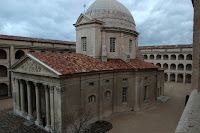 totally unexpected. Everything we have read points to a major facility with some seriously major exhibits. Instead, we find an imposing set of understated buildings that give no hint of what they contain. In fact, the museum is so understated that we cannot even find where to buy entry tickets and manage to see the first exhibit (Prehistoric) without one!
The second exhibit we enter is the Egyptology one. It starts out with a  collection of household items similar to those we have seen in the British Museum collection. There are parts of mummified animals (including Ibis!) And then we are in to the heavy stuff - literally. Granite statues and chunks of sandstone lintels and pieces of hieroglyphic statements picked up by collectors from remote spots where temples lay breached. The whole thing is housed in a
  mock up of a pyramid that looks more tacky than authentic.
Then there are sarcophagi. A number of them. Inner and outer caskets. Richly decorated painted timber ones, others covered in n eat hieroglyphics in ordered rows and columns. There are canopic jars, amulets and all the paraphenalia needed for the mummy to successfully cross into the next world. We are sure that the curators at the British Musuem would have a fit. The two large granite sarcophagi lie out in the open for all
  to touch. Michael reverently and lovingly traces the carved heiroglyphics covering them.
We finally enter the last chamber of the exhibit. This room has been set up as the final burial chamber would have been laid out - complete with sarcophagus, steeles set at the four  compass points, all the trimmings for the afterlife journey, large canopic jar, heiroglyphics describing the life and successes of the dead person. Michael manages to get a few photos (sans flash!)
We finished off looking through the Mexican, African, Americanas and Oceanic exhibits - all which pale into insignificance after the Egyptian one!
Another wander through twisting back streets and down long flights of steps brings us back to the tram line. We have not yet seen much outside the Port and associated old town and decide to ride the tram to the opposite terminus from the one where we are s taying - just to see what could be seen! This takes us into suburban Marseille and only reinforces what we had previously deduced about the working roots of the City. Surprisingly, a beggar with a young girl in tow approaches everyone on the train for coins. She has a bag of just purchased groceries, so is not destitute. When she fails to get anything, she calmly gets off at the next stop and child in hand, walks with the bag of goods into a housing complex.
The architecture is still quite grand with the buildings a uniform 5 storeys high with ornate wrought iron balconies and window grilles. It is after Saturday trade and ground floor shops are generally shuttered. Many have an abandoned look, with roller doors covered in the ever present graffiti, but they are flourishing little enterprises during the working day. So, that discovered we head back to the hotel after 5 pm. Michael has found a laundromat and heads out with two bags and a novel.
Dinner tonight is eaten in. The Suite Hotel doesn't have a restaurant. Instead, it has a fridge well stocked with microwaveable meals, snacks and drinks including foil lidded glasses of wine. We enjoy surprisingly good meals -
Emincé de chou ‘violet’ et jours de porc confites, purée de pommes de terre et saucisson pistaché, pancetta grille sur chutney d’oignons (Cooked red cabbage with preserved pig cheeks, potato puree with pistachio sausages, grilled pancetta with onion chutney) - Michael
Millefeuille de dorade à la foundue de poireaux parfumée à la cardamom, risotto aux asperges vertes, veloute de pomme et celery au cumin (Bream millefeuille with leek and cardamom fondue, green asparagus risotto, cream of apple and celery with cumin) - Maria.
As I finish the blog, Michael is watching Indiana Jones and the Last Crusade. Off tomorrow to Arles and then on Tueday to Carcassonne where we are having our first homestay with some Couchsurfer hosts.


 have recently seen, but the remnants are clearly visible.

 new - opened in 1965. Interestingly though, the cathedral has a Romanesque portico and an unusual feature for a modern Irish church. (...well, I did state it was 'interesting'?)
  its renowned Quadrangle. This is the oldest section of the university, erected in 1849, which originally housed various scholastic disciplines.


 from the sea with the Castle looming out of the very bedrock of the


