 Even though we are spending time in and around Schwäbisch Gmünd, there is still so much to explore.

We began our day today going back to Ludwig Tomas Strasse to Felix and Steph's former home. We can help out doing a few chores that will give them more time on the weekend. While Michael spakfilla's the holes left by nails and screws, I give the house a good sweep out. Its dusty more than anything, and the three rooms in the basement have plenty of evidence of previous spidery residents - although there is only one still there. I guess without the human presence, the eight legged variety lose interest!
 Thought to take this photo as we left - the garage is the iron door and you are looking from the front door through to the back year.

Once done, we went back to Xavier Bader Strasse and the new house - which is really only about 4 blocks away to get changed and go into Schwäbisch Gmünd to have a look at the church being renovated and to have some lunch.

We lunched at Mauritius, which Steph later tells us is a chain restaurant. We were thrilled to find that they make a fresh lemonade, but with limes, so it doesn't quite have the tang of those we had in Romania.

The St Johannis Kirche was just closing when we came in on Monday, but a quick look inside and we knew we had to come back to have a proper look. Turns out that this former church has a tower and for the princely sum of 2 euros, Michael can climb it. This is all the more special as the tower at the Schwäbisch Gmünd Minster has collapsed and no longer exists.

The tower exists over 5 levels and climbs to a base height of 30.36 m - high enough to get those really interesting shots of the rooftops and the layout of the old centre as well as some close-ups looking down on the Munster and the nearby 'Mouse Tower' as well as the surrounding area.

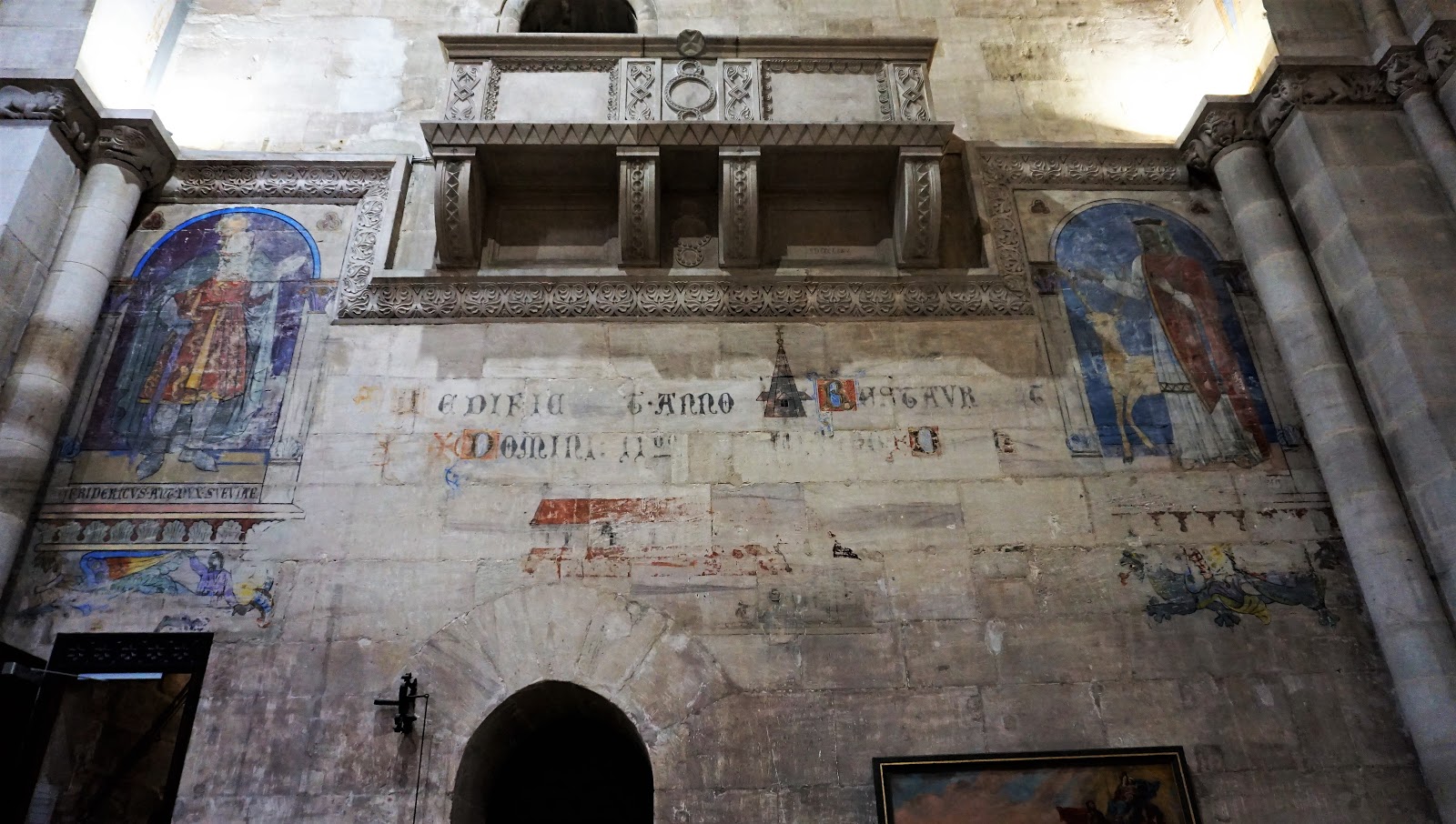
There has been a recorded church on this site since 1210 AD. The current form of the former church dates predominantly to the 15th century when in 1429 the high altar was added to complete the church. In 1706 significant changes saw the church take on a more baroque form and from 1842 it was re-reromanised. It fell into disrepair and has been almost constantly under repair since 2008.

The bell tower dates from the early 13th century and was the first free-standing and tallest structure in the city.

Found under the chancel in 1972 is the 12th century Romanesque Pomeranian, also called Staufische Madonna. This is considered the most important sculpture in the City. The amazing wall and ceiling paintings were re-created in the 1870s and re-make the original. Today, these are all under constant restoration.
 The side ships of the church store the collection of carvings and statuary from this church and the Minster.
They include saintly bodies, characters that would adorn the roof-lines known as grotesques and even the odd green man.
 While looking at these, and during his climb into the heavens, Michael managed to identify three mason marks - they have not stood the weathering of time too well unfortunately.

Surrounding the church and framing Johannisplatz - the square outside the church are some really well maintained examples of early architecture dating back to the 14th, 15th and 16th centuries. These buildings have each been restored over the past century. This square was once a cemetery site, and later was paved as a parade ground for the barracks that were converted from the former preacher's convent.
We finished off our visit back into the City with coffee at Cafe Margrit - too bad we sat in the plaza - Steph tells us that they have the best cakes in Schwäbisch Gmünd - in cases inside!
 Still, didn't matter - it meant that we were ready to eat grilled steak with herbed potatoes, mushrooms and salad that I cooked for dinner tonight. We ate in the balmy night outside and chatted until it was time for Steph to head for bed. Felix had caught up with an old friend in Schorndorf tonight and comes in after 10. We chat very briefly before he heads to bed with us not too far behind him.


Sibiu is a city of superlatives, recording many firsts in this part of Europe.
The first hospital, the first library, the first school, the first pharmacy, the first paper mill, the first book store, the first theatre building, the first museum, the first cast iron bridge, the first mental illness hospital, the first whole Romanian capital bank, the first spring factory, the first beer factory, the first balance factory, the first tool factory, the first hydropower plant, the first Zoo garden, the first open-air cinema in Romania.
The first archives, the first folkloric ensemble, the first printing press in Transylvania and the first book in Ardeal having been printed here and the first newspaper in Transylvania.
The first mountain resort, the first encyclopedia in Romania was published, the oldest lightning protector in South Eastern Europe was installed near Sibiu, the first Museum of Natural History in Romania, the first city in Transylvania with a public lighting powered by electric power and the first electrical means of public transportation. Konrad Haas experimented the first stage rocket in the world near Sibiu. Sibiu proved to be a pioneer, a city with an accentuated innovative spirit due to its people and to the historical context.

So much for the boasting! Sibiu is also a city of beauty, a place to behold. I never get jaded of being immersed in the ages of old!
 As we had arrived in Sibui late yesterday, we could afford a little sleep in - breakfast was not served until 8 am. I am trying to eat lightly, but Michael is enjoying the full array of offerings. This morning it was wurst (like frankfurter) and mustard along with his scrambled eggs and cheese. We are only a few minutes to the old centre, but have trouble parking at first because the streets around here are filled with churches and as it is Sunday, the worshippers are being called to services!
 St Frances doesn't abandon us altogether, and we find a spot between the lower town and the upper town. 4 Lei later (about $1.30) and we have a parking chit to cover us not only for today, but tomorrow also!
 We head for the amazing tessellated spire that we first see when we turn away from the crooked and seemingly part finished roofs of the old town. We find out that this is the Lutheran Evangelical Church - which is closed to visitors for the moment due to the weekly service for locals. And while the service is on inside, there is another preaching happening under the watchful eye of the former Bishop Teutsch! Never mind, we have all day, so will see it on the way back to the car.
 Along a cobbled street, through an arch and we find ourselves in the Piata Mare - the Big Square - oh, and look - there is that international sign the fabulous i. So Michael dashes in to get a map - but no directions! Never fear, Cosmir, a local Police Officer comes to our rescue with some directions and a lovely chat. We tell him how much we are loving Romania in general and our first impressions of Sibiu. He moans that it is a very expensive place to live thanks to the impacts of the year round tourists. I console him with the thought that if you have to pick somewhere to live,it might as well be this beautiful. He wishes us a great holiday and we leave him to his duties.
 He also shares a little piece of information not seen in the tourist literature - the 'Blue House' in the photo above this one was the headquarters for the Gestapo in Romania during WWII. And because of this, there was almost no bombing here in Sibiu - all the architecture survived unscathed. The cost of housing the enemy :(

 "You must see the museums," he said, "they are excellent". And yes, excellent they are. The Brukenthal Museum houses the National Art Gallery and has more than 800 paintings in 13 galleries in this former palace. Remember how Sibiu had the first electric public lighting - well, it began with this building. With parquet floors that creak with every step, there is not a single nail or screw to be seen. There are painted and silk lined walls and crystal chandeliers everywhere - a truly amazing sight. But that artwork - sorry we could not photograph that - it was amazing - much of it religious in nature and dating back to the 13th Century. Still so vibrant and with nuances of light and shade giving such depth and body.
Other displays included one on the "Ball" and the history of Dance Cards, the Plaster Casts display, the Romanian Folk Art Gallery, the Lapidairie Medieval (masonry and capping stones from graves), and Prints and Drawings - truly fascinating.
Back down in the cooler courtyard, Michael pets one of the biggest cats we have ever seen - this one is particularly for you Gen!
 We next turn to the Blue House which dates back to the early 17th century. It now houses offices and workshops for the Brukenthal Museum AND a display on the Bibles owned by Simon von Brukenthal. The oldest one dates back to 1478 and has illuminated capitals - something of which Brukenthal was very proud. He sent his agents to all the book sales of Europe to secure bibles, some costing more than an average person's annual income.

Back out in the Square, its a toss up for a coffee or the Catholic Church - coffee wins! It is almost midday and something light to eat is on the menu. Like yesterday, seating in the shade at a restaurant is a thing to be coveted. Luckily, we spy a party vacating their table and make a bee-dive. And Dani, the poor waiter in our section at 'Monsieur Joban -exceptionalle existent' is run off his feet. We order two iced coffees and a cheese plate to share. I can't help but notice that the owner is in place today and watching with his eyes everywhere. Once we have finished and ask for the bill, he comes over to check that we were happy with our meal. Yes, we really were!

Over to the Catholic Parish Church next, and the smell on incense will always remind me of weekly mass as a child. Almost gagged on it back then, but now it has a reassuring familiarity. This church is built in the baroque style as many in Europe are - a sense of grandeur at a fraction of the cost of the real thing! Its funny how a camera finds light that the eyes can't. This church was much darker than the camera depicts, but every bit as grand.
 Just along the street, Michael makes a visit up one of the gate towers - as he does. The photos over the square and the upper and lower towns are fantastic as usual - gotta love the rooftop shots! And a pigeon and her chicks have taken shelter in one of the gun slits!
 We continue to explore the streets and squares, thankful that it is a little cooler at about 29 degrees. We stumble into Piata Mica (the Little Square) and finally Piata Huet after crossing the Bridge of Lies. We find the tradesmens house - complete with a couple of young tradesmen sitting in an upstairs chamber, on the windowsill in the cool. Beneath them is a sample of the blacksmith's trade.
This brings us full circle back to the Evangelical Cathedral with that amazing roof.
 Again,the camera lies - this church is even darker and danker than the catholic one. And just a little bit creepy. The walls are lined with family plaques - I guess the higher they were placed, the more important the family was! Some are indeed very high. And some were almost too gothic in nature - including this one filled with corpses. Social history at its best! The main aisle has been worn with the foot treads of the faithful over many many years - to the point where it is actually a concave floor that you need to walk in carefully. The pew ends are polished smooth with the hands of the faithful too.
And the best part of all - according to Michael - this one has a tower to climb too - complete with bells!
And the view over the roofs of Sibiu - and the crossed nave of the church below!
 Late in the afternoon, we travelled a mere 54 kms to the Complex Europa Touristica just outside Cartisoara ready to tackle the Transfagarasan Highway tomorrow. With the return of the weekend traffic towards Bucharest, it took us almost 90 minutes! Yes, bumper to bumper like the trip from the Sunny Coast back to Brisbane on a Sunday afternoon.
Simple lodgings reminiscent of a hostel - all raw timber with a stream rushing below our balcony, and the Carpatian Mountains at our backs. The clouds were rolling in as we drove here and as I get ready to post this and go down for dinner, the rain has started. Hope it clears for tomorrow!


It dawns the perfect day for sightseeing. Cool (real cold) and crisp with that beautiful autumn sunlight that so seems to complement absolutely everything you look at. We join the other guests for breakfast where Francine is in control of everything and looking like she has just stepped out of a morning tea - complete with beautiful heeled shoes and a lovely set of pearls. Nothing flusters her and she exudes serenity. Nice. As was breakfast. Good selection of breads and pastries, cold meats and cheese, fresh eggs for boiling just to your liking.

On checking out, they tell us we can leave the car there all day if we want to, but given that we want to start with Beguinage and the Minnewater area that is also known as 'the Lake of Love', we take the car to get over to there. Brugge was cursed after a massacre to keep the 'long necks' (swans) for all time and this area is where they are found. It is a  very romantic area of Brugge - greenery, water and houses combine, pretty in a way that has inspired painters of times immortal.
Beguinages had their origins as places founded something aside from a convent where women lived, not taking vows, but following religious percepts and earning a living in Bruges with looms. When the last of the Benguines died a community of  Benedictine nuns was established here. The homes of these people exist in the open community as a place of peace and tranquility and despite the large numbers of visitors wandering, there is little noise to disturb the calm. After strolling through this beautiful place, and stopping to visit the church that is dedicated to St Elizabeth of Hungary, we head back into the city centre to expand on out quick visit late yesterday.
Bruges is known as the 'Venice of the North' because of its canal system. And along with the canals come boat cruises that burn up and down the waterways (not like the sedate gondolas) and waterside dining spots. And with canals you get...? Bridges of course and this is where the name Bruges is founded.
Frances eventually finds us a parking spot near the Church of Our Lady. We are amazed at the number of people that are here in Bruges today. Being a Sunday it is also surprising to see almost all the shops open for trade. We have just come from Germany where  nothing except some of the petrol stations are open on Sundays. And yes, every second shop is a chocolate shop - truly. I spy a hat shop and being Michael's birthday, we go in to find something special. And we do. His own Deer Stalker hat! (think Sherlock Holmes and you can picture it!) Looks pretty good in it too - don't you think!!!
So, a beaming husband in his new hat by my side, we head for the Church of Our Lady. Now, Bruges has a huge number of churches - seven are know to be monumental and often are on visitor itineraries. The Church of Our Lady is known for two things:
Firstly it is home to the Madonna with Child carved in Carrera marble by a young Michelangelo and secondly as a repository for many other works of art throughout the church and in its museum. But this church is really so much more - it is a church of people (their words) and there are many opportunities for you to participate in the life of this community - least of all, the invitation to write prayers and thanks on sheets of paper and post them into a keeper which is opened each week and read out at the end of Mass.
The church itself is quite austere although the altars are baroque. The tall windows in the body of the church are not lead-lighted and so light floods the building. A community member welcomes you at the door, music fills the space with the echoes soaring to the roof. At the end of the first aisle sitting within a marble altar is the beautiful work by a young Michelangelo 'Madonna and Child'.
The museum within the church is an array of jaw-dropping art. However, it is tastefully arranged so as not to diminish the aura of the structure from being a house of worship. To appreciate the collection, one has to be there to experience this w onder. Albeit, the museum is confined within the apse and presbytery of the church. The confessionals are beautifully carved walnut depicting various saints, as is the choir. There are original works of art which adorn the walls, and in particular is Gerard David's triptych 'The Transfigeration of Christ' (ca. 1520). There is so much I can regale, however space is a premium so I suggest you follow this link.
Back outside we join the ever growing number of people who  are cruising the streets. Ah yes, Bruges on a Sunday sure is jumping. Down small back streets, up narrow lanes. You turn a corner and there you see yet another Madonna. The patron saint of Bruges is everywhere - including a new take in a window of a pub. Many of the churches are now closed as they have finished with their Sunday services, so we just admire them from the outside. And now it is time to return to the Markt and HOT CHOCOLATE - mmmmm. Yep, it is cool and
  getting cooler as we walk in the shadows of the buildings. Everyone is well rugged and girls you should see the fancy and sometimes beautiful scarves that people here are wearing. Again, guided by the locals, we find a cafe to sample some traditional Belgian luxuries - hot chocolate and fresh Belgain waffles (with bananas and chocolate). Yu-um. Michael however is hungrier and opts for a snack of spaghetti carbonara.
The Markt square is impressive. At the ground level it is dominated by the monument to Jan Breydel and Pieter de Coninck who led the revolt in 1302 to rid the city of the French. But it is the imposing  Cloth Hall and Belfry that really dominates the square. At 88 meters high, and including a carillion of 47 bells this is one truly beautiful edifice. And like with all the other towering structures that we have seen, Michael soon makes it his business to climb up the 388 steps to get a view of the city from on high. There is a museum within the Tower that has been used like most of these across Europe, to house the important records of the City.

It may have not been the highest tower I have climbed, but it would be one of the most interesting. To scale the interior one has to negotiate three levels of stairs: lower and middle spiral stairs built in masonry, and the belfry is reached by sections of wooden staircases. The centre section of the tower contains a 'vault' which originally was the city's repository for records and funds. The repository contains two original strong boxes, with one ensconced behind an iron latticed 'curtain'. Before arriving at the belfry, one reaches the musical 'tracker bar' (not too dissimilar to a pianiola roll, but much greater in size)  providing the notes for the carillon. Finally, the belfry is reached and the views of Brugge (and the bells) are quite spectacular. As I was admiring the view, the carillon began to 'chime' - a deafening sound muted to an enjoyable interlude by inserting one's fingers in the ears!
Then its around to the next square that houses even more impressive buildings - the Town Hall, the Basillica of the Holy  Blood, the Court's Office and the Provost's house. All impressive, all ornate and grand and all filled with sightseers! As I said, the place to be on a cool but clear Sunday afternoon is Bruges!
We finally returned to the car and turned for Ypres (Ieper) where as a special treat for Michael on his birthday we are going to the Last Post Service at the Menin Gate tonight. We check in to the Ambrosia Hotel in the drizzle. Owner Vincent makes us very welcome and suggests a restaurant for dinner. I won't name it because for us it certainly did not live up to the recommendation - the food was average and the service deplorable. 
Anyway, before we went to dinner we started at the Menin Gate where The Last Post Ceremony has been conducted every night (except for the German occupation between 1940 and 1944 when it was held in Surrey) rain hail or shine as the Belgians honour those who freed them in WWI. There are a large crowd of people present packed within the arches of the gate and spilling out onto the  surrounding street. Just before 8 pm the local police arrive to effect the road closure and the buglers of the volunteer Fire Brigade and a piper arrive. At the dot of 8, a hush falls and the mournful sound starts. There is a contingent of Adult Scouters from the UK here, all stand at stiff attention, one with tears coursing down his face, and the British flag rests on the ground. You could have heard a pin drop if it weren't for the 3 bus loads of young English high school students. Honestly, they
  are too young to fully comprehend or appreciate what they are witness to. Still, after the Last Post, the laying of the wreaths and the Reveille are played, they quickly find somewhere else to be, leaving this special place to those with memories or respects to pay to linger a while . . . And Michael places the last of our Australian flags at the Diggers memorial at gthe eastern flank of the Gate. It is a most modest memorial with a collection of wooden crosses left by silent pilgrims.
After a little while we go back into the centre to have dinner and then return to the hotel and a warm and welcoming bed - it is now only 2°C!


 Even though we are spending time in and around Schwäbisch Gmünd, there is still so much to explore.
 Thought to take this photo as we left - the garage is the iron door and you are looking from the front door through to the back year.



 The side ships of the church store the collection of carvings and statuary from this church and the Minster.
 While looking at these, and during his climb into the heavens, Michael managed to identify three mason marks - they have not stood the weathering of time too well unfortunately.
 Still, didn't matter - it meant that we were ready to eat grilled steak with herbed potatoes, mushrooms and salad that I cooked for dinner tonight. We ate in the balmy night outside and chatted until it was time for Steph to head for bed. Felix had caught up with an old friend in Schorndorf tonight and comes in after 10. We chat very briefly before he heads to bed with us not too far behind him.


