


Thank god. We have finally managed to make direct contact with Michael's mum. She has been very unwell with the flu and staying with Maria and Robert. It makes it easier for us knowing that they keep such a close eye on her and are so good to her. They will never really appreciate just how much we value what they do for her (and us). Thanks guys - you are worth your weight in gold.
And so today we are off to the mine - not the gold mine unfortunately, the Wieliczka Salt Mine. We start though with the Cloth Market Square in Kraków. The Cloth building is a wonder in itself; architecturally and aesthetically appealing. Seeing this buil ding in the centre of the market square (from up upon high, I'll get to that shortly...) surrounded by throngs of people, one can visualise those artists and artisans, traders and brokers from ages past plying their various trades. It must have been as exciting as Kraków's centre is today. However, the roof line is adorned by sculptured heads in various expressions of mirth or jeers - w
 elcoming passers-by to enter if they dare.
Now, the view of the Cloth Market hall and indeed the rest of the Square is just stupendous. Michael has climbed the City Hall clocktower to get some great views not only of the Square, but beyond to other areas of Kraków as well. You can really appreciate the size of the square and in the minds eye, can see the traders from eons past jostling and shouting, contradicting and trying to out-bid each other as they desperately try to maximise their incomes! Those twin towers you can see are of the St Marys Church.
And what a church this Kosciól Mariacki or Church of Our Lady or St. Mary's Church is! We feel that we now know what the interior of the old churches looked like. All others that we have seen have small pieces of their original wall decorations intact, but most lost. This one is different - it is such a vibrant place, filled with warmth and light - even though it is quite dark. The walls have been maintained since it was constructed in the 12th century. It is almost impossible to describe in words the amazing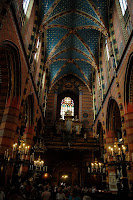 beauty of this place.
There is not one space that is not painted or decorated in some rich fashion - all under a starry blue vaulted ceiling that recalls the starry heavens above. And the crowning glory so to speak is the altar retable - a huge timber construction. This magnificent 15th-century wooden altarpiece is by the master carver Wit Stwosz (Veit Stoss). Incorporating more than 200 carved and painted figures, this huge work of art depicts the Dormition of the Virgin while also showing medieval life in detail. Carved in 1477-89 and about 13 metres high and 11 metres wide, it is the largest piece of mediaeval art of its kind in the world.
It has four wings with the outer two being fixed. When closed, the scenes depict Mary's sorrows. But when the two centre panels are opened, it reveals Mary's joys as well with figures 2.7m high! The altar is opened daily at noon and we were lucky enough to be there when a nun solemnly approached and to a fanfare slowly opened the panels to the collective gasp of us and those all around.
Another major highlight is the lone trumpeter in the high tower, who plays a strange hourly call known as the "Hejnal Mariacki." Ringing out to mark each hour, it breaks off on an abrupt half-note to commemorate an unknown bugler who was struck in the throat by a Tartar arrow as he tried to warn the city of the invaders. As there were queues to buy tickets to have a look at the Church, we almost gave it a miss. Boy, are we glad we didn't - it was one of those rare masterpieces we will never forget.
And today, Michael is collecting the stickers that you buy to permit you to take photos!
Hi ho, hi ho its off to the salt mine we go!
The Salt Mine in Wieliczka is supposedly 13kms and 22 minutes from Kraków, but whoever timed it did not make allowance for the miles and miles of traffic jams. It took us just under the hour to drive those 13 kms! Once there, we paid for our parking (7 PLN for as long as we are there = €1.75). A walk up a gardened hill brings us to the entrance - and another queue for tickets. The wait isn't too long and we begin another wait for enough english speaking tourists to warrant a guided tour beginning. Not long, its only another 10 - 12 minutes and we set out. Many of the l ocals we have spoken to in the past week or so have all told us that we must not miss this mine.
Our guide is the lovely Izabella (yes, with the same spelling as our little grand-daughter!) She explains the WH&S apects to us before leading us down down down. Down an intial and never-ending 378 steps in tight turns of 7 steps. Wooden steps in a shaft (the Daniłowicz shaft) that was sunk in 1635 - 1640! And this just takes us to the first level at 64 m underground. During our trip, we will progress to 135 m underground! Salt was mined here at Wieliczka from the Middle Ages until 1996. Nowadays, this facility is just a tourist operation - one of the best known in all of Poland and with around 1.2 million visitors a year.
I won't go into all the details - if you want to know the history, click on the link above - it is very interesting. But I will tell you a few things. Much of the bracing is original. Huge timber logs lain one on one in a criss-cross pattern that have been here for hundreds of years. And they look like they were laid yesterday. Izabella puts it down to the preserving aspect of the salt that has now impregnated these logs. The air is very dry and is used in the treatment of respitarory and pulmonary conditions (but she explains later is not great for the guides throats!) in a natural micro-climate that cannot be replicated above the ground. Izabella tells us that our visit to the mine today, breathing the beneficial air, will add three days to our lives - so breathe deeply everyone!
But most of us have not come to 'take the airs', but rather, to see the work of the miners who over time have carved out of the solid rock salt, the most amazing statues and chapels. We are constantly reminded that nearly all these works have been done by the miners - not trained artists (and we need the reminding!) There are statues and panels and chapels galore - I guess that the early miners in particular knew how hazardous their jobs were, albeit well paid, and needed to pray for or give thanks for their safety.
And from an organisational perspective the tour has been set up to display the history and workings of the mine and indeed the tools of the miners over time. We see how they went from using picks and hammers, hauling the salt by hand in barrells, then on rails and carts (dog carts because of the 'barking' sound they made when pushed over the timber rails) and then finally using horses that were lowered by straps (and later in timber crates when t he 'lift' system was installed) and spent most of their lives underground. Guess that they must have lived a very long time!!!
We see the primitive but effective timber drains constructed to keep the water that seeps from the surounding sandstone away from the rock salt. We see the huge timber winches that were used to lift first ground salt, and then later, larger and larger blocks of salt to the surface. In times past, salt was as valuable a commodity as gold! One 3 ton block of rock salt was the equivalent value of a village! We see created brine lakes, one of them 9 metres deep, but so clear that you can see the złoty coins o n its bottom that people have tossed in with a wish. (Michael added one too, but won't tell me the wish.)
But mostly, we admire the artistic works of the miners. The most impressive are two:
The Janowice Chamber that tells the legend of the finding of salt in the region; and
St Kinga's Chapel that is dedicated to the patron saint of miners. Now, this is no little chapel that you might peer in to. It is a massive chamber that measures 54 metres long, 18 metres wide and 12 metres high! All carved from the walls of the chamber excavated for salt. The floor is polished to a high sheen - by the feet of the millions of people that have walked over it. And this work is attributed to just three miners, who in succession, over a total period of 70 years carved this elaborate and elegant chamber.
So, 800+ steps and 2½ kilometres and 3 hours later my hip and legs are screaming at me, calling me every name under the sun! But it has been worth every cramping fibre. The work of those miners is inspirational. And really, I am not complaining too much - the early miners carried the salt out in barrells on thier backs up short, narrow little steps that they cut into the rock salt face - NO handrails, no nothing!
And now? Well, now we head for Warszawa (Warsaw), the capital of Poland. A longish drive ahead of us 4:45 hours. Huh! The horror traffic jam we crawled through on ouy way to Wieliczka is still in existence as we leave as this pic shows! Those roadworks just go on for ever and ever and ever. You get a run of full speed for maybe 20 or 30 kms and then we are back to a crawl - sometimes at 40 kph for another 20 or so kilometres. And so, you can imagine what that does to the traffic - it bunches it up, creating even slower stretches.
  Through the edges of some towns, we are lucky to do 10 kph! But believe us, they desperately need to be working on these roads. The ruts from trucks run for most of the trip in the outside lane - I mean real, deep ruts. Its impossible to show with a photo just how bad they are.
At every road crossing, or small town (like every 4 - 5 kms) we have to slow down. Many don't and pay the price. Every second one is equipped with a speed camera, and today every other one has a policeman with a mobile radar waiting for those trangressing motorists. And I am not exaggerating - every other one. And they are reaping in the fine income as though they are printing the złoty bills themselves!
So the trip lengthens, time and time again. It eventually takes us just over 6 hours and we arrive at 10 pm, totally stuffed. We check in to our accommodation at the Castle Inn after parking the car about a block away (phew) and are shown in to the most amazing room. We are on the corner room with three huge windows looking out over the Warsaw New Town Square with the Royal Palace a spit away. Oh wow - so magic!
But no time to sit and gaze. We need to find somewhere to have some dinner. There are a couple of restaurants facing the square that are still open. As we get downstairs, one is closing and so we stop at the first one that is still open - Restauracja Przy Zamku. On enquiring if there was still time to have a meal, the waiter says "Sure!" What luck, we have happened on a really nice restaurant and when we are having trouble deciding (at so late, I am having trouble just putting one word before the other!), Robert, our waiter suggest s that we have just a main. Some more knowledgeable advice and we finish up ordering:
Sola na asparagus łóżko z kurkami, podawana z ryżem (lemon sole in chantrelles and asparagus bed served with rice) Michael
Polędwica ͵͵Zygmunt IIIʹʹ podawana z kurkami duszonymi w śmietanie I ziemniakami opiekaymi (Beef fillet “Zygmunt III” served with chantrelles in cream and deep-fried potatoes) Maria which I wash down with a small (but still expensive) bottle of Châteauneuf de Pape (Domaine Barville, 2005 Grenache, Syrah & Mourvèdre)
The food is delicious - up there with the best we have had on our trip. By the time we have our meals it is almost midnight and closing time, so we skip dessert and just have coffee.
And so to bed . . . another Ab Fab day!
And so today we are off to the mine - not the gold mine unfortunately, the Wieliczka Salt Mine. We start though with the Cloth Market Square in Kraków. The Cloth building is a wonder in itself; architecturally and aesthetically appealing. Seeing this buil
 ding in the centre of the market square (from up upon high, I'll get to that shortly...) surrounded by throngs of people, one can visualise those artists and artisans, traders and brokers from ages past plying their various trades. It must have been as exciting as Kraków's centre is today. However, the roof line is adorned by sculptured heads in various expressions of mirth or jeers - w
 elcoming passers-by to enter if they dare.
Now, the view of the Cloth Market hall and indeed the rest of the Square is just stupendous. Michael has climbed the City Hall clocktower to get some great views not only of the Square, but beyond to other areas of Kraków as well. You can really appreciate the size of the square and in the minds eye, can see the traders from eons past jostling and shouting, contradicting
 and trying to out-bid each other as they desperately try to maximise their incomes! Those twin towers you can see are of the St Marys Church.
And what a church this Kosciól Mariacki or Church of Our Lady or St. Mary's Church is! We feel that we now know what the interior of the old churches looked like. All others that we have seen have small pieces of their original wall decorations intact, but most lost. This one is different - it is such a vibrant place, filled with warmth and light - even though it is quite dark. The walls have been maintained since it was constructed in the 12th century. It is almost impossible to describe in words the amazing
 beauty of this place.
There is not one space that is not painted or decorated in some rich fashion - all under a starry blue vaulted ceiling that recalls the starry heavens above. And the crowning glory so to speak is the altar retable - a huge timber construction. This magnificent 15th-century wooden altarpiece is by the master carver Wit Stwosz (Veit Stoss). Incorporating more than 200 carved and painted figures, this huge work of art depicts the Dormition of the Virgin while also showing medieval life in detail. Carved in 1477-89 and about 13 metres high and 11 metres wide, it is the
 largest piece of mediaeval art of its kind in the world.
It has four wings with the outer two being fixed. When closed, the scenes depict Mary's sorrows. But when the two centre panels are opened, it reveals Mary's joys as well with figures 2.7m high! The altar is opened daily at noon and we were lucky enough to be there when a nun solemnly approached and
 to a fanfare slowly opened the panels to the collective gasp of us and those all around.
Another major highlight is the lone trumpeter in the high tower, who plays a strange hourly call known as the "Hejnal Mariacki." Ringing out to mark each hour, it breaks off on an abrupt half-note to commemorate an unknown bugler who was struck in the
 throat by a Tartar arrow as he tried to warn the city of the invaders. As there were queues to buy tickets to have a look at the Church, we almost gave it a miss. Boy, are we glad we didn't - it was one of those rare masterpieces we will never forget.
And today, Michael is collecting the stickers that you buy to permit you to take photos!
Hi ho, hi ho its off to the salt mine we go!
The Salt Mine in Wieliczka is supposedly 13kms and 22 minutes from Kraków, but whoever timed it did not make allowance for the miles and miles of traffic jams. It took us just under the hour to drive those 13 kms! Once there, we paid for our parking (7 PLN for as long as we are there = €1.75). A walk up a gardened hill brings us to the entrance - and another queue for tickets. The wait isn't too long and we begin another wait for enough english speaking tourists to warrant a guided tour beginning. Not long, its only another 10 - 12 minutes and we set out. Many of the l
 ocals we have spoken to in the past week or so have all told us that we must not miss this mine.
Our guide is the lovely Izabella (yes, with the same spelling as our little grand-daughter!) She explains the WH&S apects to us before leading us down down down. Down an intial and never-ending 378 steps in tight turns of 7 steps. Wooden steps in a shaft (the Daniłowicz shaft) that was sunk in 1635 - 1640! And this just takes us to the first level at 64 m underground. During our trip, we will progress to 135 m underground! Salt was mined here at Wieliczka from the Middle Ages until 1996. Nowadays, this facility is just a tourist operation - one of the best known in all of Poland and with
 around 1.2 million visitors a year.
I won't go into all the details - if you want to know the history, click on the link above - it is very interesting. But I will tell you a few things. Much of the bracing is original. Huge timber logs lain one on one in a criss-cross pattern that have been here for hundreds of years. And they look like they were laid yesterday. Izabella puts it down to the preserving aspect of the salt that has now impregnated these logs. The air is very dry and is used in the treatment of respitarory and pulmonary conditions (but she
 explains later is not great for the guides throats!) in a natural micro-climate that cannot be replicated above the ground. Izabella tells us that our visit to the mine today, breathing the beneficial air, will add three days to our lives - so breathe deeply everyone!
But most of us have not come to 'take the airs', but rather, to see the work of the miners who over time have carved out of the
 solid rock salt, the most amazing statues and chapels. We are constantly reminded that nearly all these works have been done by the miners - not trained artists (and we need the reminding!) There are statues and panels and chapels galore - I guess that the early miners in particular knew how hazardous their jobs were, albeit well paid, and needed to pray for or give thanks for their safety.
And from an organisational perspective the tour has been set up to display the history and workings of the mine and indeed the tools of the miners over time. We see how they went from using picks and hammers, hauling the salt by hand in barrells, then on rails and carts (dog carts because of the 'barking' sound they made when pushed over the timber rails) and then finally using horses that were lowered by straps (and later in timber crates when t
 he 'lift' system was installed) and spent most of their lives underground. Guess that they must have lived a very long time!!!
We see the primitive but effective timber drains constructed to keep the water that seeps from the surounding sandstone away from the rock salt. We see the huge timber winches that were used to lift first ground salt, and then later, larger and larger blocks of salt to the surface. In times past, salt was as valuable a commodity as gold! One 3 ton block of rock salt was the equivalent value of a village! We see created brine lakes, one of them 9 metres deep, but so clear that you can see the złoty coins o
 n its bottom that people have tossed in with a wish. (Michael added one too, but won't tell me the wish.)
But mostly, we admire the artistic works of the miners. The most impressive are two:
The Janowice Chamber that tells the legend of the finding of salt in the region; and
St Kinga's Chapel that is dedicated to the patron saint of miners. Now, this is no little chapel that you might peer in to. It is a massive chamber that measures 54 metres long, 18 metres wide and 12 metres high! All carved from the walls of the chamber excavated for salt. The floor is polished to a high sheen - by the feet of the millions of people that have walked over it. And this work is attributed to just three miners, who
 in succession, over a total period of 70 years carved this elaborate and elegant chamber.
So, 800+ steps and 2½ kilometres and 3 hours later my hip and legs are screaming at me, calling me every name under the sun! But it has been worth every cramping fibre. The work of those miners is inspirational. And really, I am not complaining too much - the early miners carried the salt out in barrells on thier backs up short, narrow little steps that they cut into the rock salt face - NO handrails, no nothing!
And now? Well, now we head for Warszawa (Warsaw), the capital of Poland. A
 longish drive ahead of us 4:45 hours. Huh! The horror traffic jam we crawled through on ouy way to Wieliczka is still in existence as we leave as this pic shows! Those roadworks just go on for ever and ever and ever. You get a run of full speed for maybe 20 or 30 kms and then we are back to a crawl - sometimes at 40 kph for another 20 or so kilometres. And so, you can imagine what that does to the traffic - it bunches it up, creating even slower stretches.
  Through the edges of some towns, we are lucky to do 10 kph! But believe us, they desperately need to be working on these roads. The ruts from trucks run for most of the trip in the outside lane - I mean real, deep ruts. Its impossible to show with a photo just how bad they are.
At every road crossing, or small town (like every 4 - 5 kms) we have to slow down. Many don't and pay the price. Every second one is equipped with a speed camera, and today every other one has a policeman with a mobile radar waiting for those trangressing motorists. And I am not exaggerating - every other one. And they are reaping in the fine income as though they are printing the złoty bills themselves!
So the trip lengthens, time and time again. It eventually takes us
 just over 6 hours and we arrive at 10 pm, totally stuffed. We check in to our accommodation at the Castle Inn after parking the car about a block away (phew) and are shown in to the most amazing room. We are on the corner room with three huge windows looking out over the Warsaw New Town Square with the Royal Palace a spit away. Oh wow - so magic!
But no time to sit and gaze. We need to find somewhere to have some dinner. There are a couple of restaurants facing the square that are still open. As we get downstairs, one is closing and so we stop at the first one that is still open - Restauracja Przy Zamku. On enquiring if there was still time to have a meal, the waiter says "Sure!" What luck, we have happened on a really nice restaurant and when we are having trouble deciding (at so late, I am having trouble just putting one word before the other!), Robert, our waiter suggest
 s that we have just a main. Some more knowledgeable advice and we finish up ordering:
Sola na asparagus łóżko z kurkami, podawana z ryżem (lemon sole in chantrelles and asparagus bed served with rice) Michael
Polędwica ͵͵Zygmunt IIIʹʹ podawana z kurkami duszonymi w
 śmietanie I ziemniakami opiekaymi (Beef fillet “Zygmunt III” served with chantrelles in cream and deep-fried potatoes) Maria which I wash down with a small (but still expensive) bottle of Châteauneuf de Pape (Domaine Barville, 2005 Grenache, Syrah & Mourvèdre)
The food is delicious - up there with the best we have had on our trip. By the time we have our meals it is almost midnight and closing time, so we skip dessert and just have coffee.
And so to bed . . . another Ab Fab day!


 to the promise of our waitress last night. It was fabulous and such a feast compared to the last couple of motels. There were cereals and juice and yoghurt and fruit to start, then a full range of cold meats, cheeses and salads, then hot dishes - scrambled eggs, sausage and a polish sausage in cabbage and the PANCAKES (crepe style). Ooh, now I am really full!


