We've had a few problems with our technology.
The computer wouldn't connect to the web here at Steph and Felix's new house.
The camera disk won't download the photos.
Guess the 'equipment' is saying "enough already - give us a break!"
So, I did.
But tonight the laptop has connected first try when I plugged it in to a power outlet that actually has power connected to it (there are some issues with a couple of outlets and lights here at the new house - they should be sorted this weekend). Blasted SD card still won't download directly - but where there is a will, there is a way - and I am nothing if not determined - put it back in the camera and downloaded through the camera!

 It was great getting back here to Schwäbish Gmünd. Steph and Felix had moved in the first week we were gone, and they are now almost settled in to their new home. They have actually had the house since April 2016, engaged an architect and set about making it their own. The former owner had lived here almost all her adult life and had raised her family here. Now, she has passed on and her children with teenage children of their own, have sold the house to a new family. They replaced the roof and pretty well gutted the interior, opening to a more open plan, put in new kitchen and bathrooms and are now putting the finishing touches.
We arrived home to have Steph cooking the selection of fish that Felix had bought for dinner in her new steam oven - very nice. Would love one if it was a little earlier in our lives! Very quick and combined with her induction hotplates, it is as good as gas! And veges - so nice to have veges.
 Since arriving back, we have been trying to help around here a little - Michael spent two days cutting out hedges and hedges of diseased buxus. Four trips to the green waste bin to get rid of it all - and one to go! Tomorrow we will go back to their former house and spakfill the holes where paintings were hung, and sweep up and wipe down after the kitchen was removed - yes, they sold the kitchen that they had put in in the rental - it is not considered a fixture here!!
But it has not been all work and no play.
We spent Tuesday afternoon exploring part of the Schwäbish Gmünd Munster and marketplace.
 It was nice to become re-acquainted with the Munster - we did visit it during our 2009 trip, but we spent more time delving into its history and secrets this time. There are some amazing stained glass windows and Michael happily discovered a number of Green Men in the carvings above doorways.
 There is so much history in the churches. Makes you look on their role in a whole new way.
Now, the icon for Schwäbish Gmünd is the Unicorn and we see unicorns in lots of places around town. But there are other quirky little things - like the bright orange plastic armchairs that are chained in place to provide seating for those weary from their expeditions in to town.
There is so much history in the churches. Makes you look on their role in a whole new way.
Now, the icon for Schwäbish Gmünd is the Unicorn and we see unicorns in lots of places around town. But there are other quirky little things - like the bright orange plastic armchairs that are chained in place to provide seating for those weary from their expeditions in to town.
 And there are stunning examples of engineering, of architecture and of a community that has learned well, the art of bringing the old into new times, of mixing today's life with yesterday's heritage.
 The fountain that was under its winter cover on our last visit, is happily providing drinking water to all who need the refreshment - and doesn't discriminate between beast or man - it as happily lets the pigeons drink as it does the local man filling his child's water bottle. The surrounds of the fountain tell the stories of the various coats of arms associated with the city and a multi-sided statue has the complete holy family watching over the users and the town square in general.

 The main Marketplace is living history with a range of architectural styles showing how the city has changed over time. The buildings in the centre of the photo below (brown and white ones) are some of the earlier and date to when tax was paid on the footprint of the building - so the ground floor was smaller and each additional floor added width to the building! The Rathaus (Council chambers) is the pink building on the left. These always have beautiful displays of flowers and usually have a chiming clock - the one in Schwäbish Gmünd is particularly nice with some chimes that play a number of classical pieces.
Finally it is nice to see that the old buildings find longevity in new uses and that these communities of old have happily found ways to allow the old and the new to sit comfortably side by side in a new millenium.
The main Marketplace is living history with a range of architectural styles showing how the city has changed over time. The buildings in the centre of the photo below (brown and white ones) are some of the earlier and date to when tax was paid on the footprint of the building - so the ground floor was smaller and each additional floor added width to the building! The Rathaus (Council chambers) is the pink building on the left. These always have beautiful displays of flowers and usually have a chiming clock - the one in Schwäbish Gmünd is particularly nice with some chimes that play a number of classical pieces.
Finally it is nice to see that the old buildings find longevity in new uses and that these communities of old have happily found ways to allow the old and the new to sit comfortably side by side in a new millenium.
 After a few hours wandering and wondering, we come home to Steph and the kids, to pretzels and fresh seed rolls, to ham and salami and joy of joys to amazing cheeses that are SO cheap at the local supermarkets here!
Nite one and all - I'll tell you all about our trip to Ulm today, tomorrow.

As we already had our bus tickets, we did not rush to breakfast this morning. The breakfast at Hotal Adria is quite ok with 'fresh' (caterers pack) blood orange juice, good coffees, croissants and rolls with jams and cheese spreads. Once we have kitted up the backpack for the day we set off, just missing the No 7 bus into Venice. Bugger, a 20 minute wait. Oh, hang on, here is another one! The bus is very full and its part way before I can get a seat. The day is bright and very warm, and that bus is getting hotter and hotter. Again, we play dodge the pedestrian, the scooter, the car, other buses and lots of limos as we arrive on the island.
Helen has postcards to post so heads for the post office while we suss out the best way over to Murano. Poor Helen has a long wait in the queue at the post office, moving well down the line before realising that she needs a ticket for service - and then watches while the locals ignore the number system and just pu.jpg) sh in. To make matters worse the service clerk is not only disinterested, he is quite abrupt and rude.
sh in. To make matters worse the service clerk is not only disinterested, he is quite abrupt and rude.
Finally she is out and we head for the long route ferry to Murano. This takes us around the outside of the island stopping at a number of jetties before heading out across Laguna Morta firstly to the Cimitero Island and then Laguna Veneta to the much smaller island of Murano. .jpg) As we arrive, we actually see our first example of the plight that faces all of Venice - the tide is high and as the ferry docks, the water is washing well across the pavements - we have to dodge not only the puddles, but the waves of water as they come forward and then ebb, time and time again!
As we arrive, we actually see our first example of the plight that faces all of Venice - the tide is high and as the ferry docks, the water is washing well across the pavements - we have to dodge not only the puddles, but the waves of water as they come forward and then ebb, time and time again!
We are hoping to see venetian glass and in particular the .jpg) Millefiore glass being made. Its not long before our hopes are dashed - while there are plenty of glass shops, the factories closed on the weekends. Bugger bugger bugger. One of the retailers draws comparisons to factories in Australia, to car factories and anything else he can think of - they are all closed on the weekends - and he obviously gets asked the same question plenty of times.
Millefiore glass being made. Its not long before our hopes are dashed - while there are plenty of glass shops, the factories closed on the weekends. Bugger bugger bugger. One of the retailers draws comparisons to factories in Australia, to car factories and anything else he can think of - they are all closed on the weekends - and he obviously gets asked the same question plenty of times.
We do the rounds of the shops along the main Rio dei Vetra, the.jpg) main canal that leads from the ferry pier. There are amazing sights and wondrous things to peruse. We see lots of ornaments and jewellery and chandeliers and vases and more. Much of it is very similar from shop to shop, although each one does seem to have one or two items that are fairly unique. Helen has been looking for presents and texts her sister with a question about whether her mum had a piece of Murano jewellery. Back came the answer, "Save your money, but if you can find a hatpin . . ." Gosh that was not something we had seen to date but at the very next shop we enter we find the perfect gift!
main canal that leads from the ferry pier. There are amazing sights and wondrous things to peruse. We see lots of ornaments and jewellery and chandeliers and vases and more. Much of it is very similar from shop to shop, although each one does seem to have one or two items that are fairly unique. Helen has been looking for presents and texts her sister with a question about whether her mum had a piece of Murano jewellery. Back came the answer, "Save your money, but if you can find a hatpin . . ." Gosh that was not something we had seen to date but at the very next shop we enter we find the perfect gift!
We stop for cold drinks before continuing to graze up the street .jpg) - yep, I do mean that, we buy little mementos at various shops. My eye is drawn to a shop that sells Venetian Glass miniatures - oh, they are so intricate and beautiful! And oh so expensive! We are working our way to the next islet where the Museo del Vetro (Glass Museum) is housed in the Palazzo da Mula over a footbridge. Ha ha,it is closed - for lunch. Like many other things here in Italy. We want to see more of Venice itself and so decide not to wait the 1½ hours until it re-opens.
- yep, I do mean that, we buy little mementos at various shops. My eye is drawn to a shop that sells Venetian Glass miniatures - oh, they are so intricate and beautiful! And oh so expensive! We are working our way to the next islet where the Museo del Vetro (Glass Museum) is housed in the Palazzo da Mula over a footbridge. Ha ha,it is closed - for lunch. Like many other things here in Italy. We want to see more of Venice itself and so decide not to wait the 1½ hours until it re-opens. .jpg)
One of the collection of photos that I have been gathering during our trip has been that of the windows and window boxes of Europe. And I was not about to miss this one on Murano where the flowers are - GLASS of course! Blown glass, just like the collection I have in the bathroom at home!
On the way back we get the fast ferry which makes two collections on Murano and deposits at the railway station and the main ferry terminal. And of course, as luck would have it, we realise as we go sailing past them that there were indeed a couple of factories open to demonstrate for the tourists. Bugger again. (although they were not the main factories).
Our aim when we return to Venice today is to get the ferry right down to the other end of the Island so we can visit the Piazzetta Di San Marco with the Loggetta, the Clock Tower and St Mark's Basilica and the Doge's Palace. Unfortunately the ferries that ply the Grande Canal stop at least at every other pier, so it is a 20 minute trip. We are amazed at the dexterity of the ferry captains, and the frenetic passage of water craft up the canal. I keep having to remind mself that this is the equivalent of a road network, complete with buses (ferries), trucks (barges) family cars (boats) and those out for a Sunday Drive (the gondolas)!
At last we arrive at the San Marco stop and alight. Across a small bridge and we are on a wide (for Venice) foot avenue where artists have their easels set up and paintings for sale out. These are balanced out with the 'trash and treasure' sellers that seem to be found everywhere today with the same mostly junky items that are mass made. Unfortunately, these are always the more aggressive sellers who turn the tourist off when it comes to buying.
.jpg)
We continue to walk ahead and then all of a sudden, there is the amazing sight of the Piazza San Marco with the Doge Palace, the Basilica Di San Marco with it's Campanile, the standards of the City with the statues of Saint Mark, the patron saint of Venice and the winged lion (Griffin) and the extravagant shopping arcades that surround the square and the restaurants that spill out .jpg) into this lively place. The Basilica San Marco is an amazing building. It is not really a beautiful building in terms of symmetry and harmony. Quite the opposite in fact. It is a busy, sometimes jarring combination of various styles of building that brings the most major example of Byzantium to Venice and Italy. There are domes above the Greek cross layout and the arches that face the square are filled with amazing mosaics on golden backgrounds.
into this lively place. The Basilica San Marco is an amazing building. It is not really a beautiful building in terms of symmetry and harmony. Quite the opposite in fact. It is a busy, sometimes jarring combination of various styles of building that brings the most major example of Byzantium to Venice and Italy. There are domes above the Greek cross layout and the arches that face the square are filled with amazing mosaics on golden backgrounds.
.jpg)
We sit in the Piazza San Marco in the shade of the colonaded shopping malls at the Caffe Florian contemplating their menu. When finally we attract the attention of our waiter, he tells us there is a €6 music charge per person - hmm, do we have any choice? We are sitting out on the piazza and life doesn't get much better. The menu is not huge, but there is enough to .jpg) appeal to each of us. Which is good, I guess, because the prices do not really appeal to anyone, but what the heck, we are only in Venice for today and the setting is like a fairytale. So we sit with a coffee and dessert while watching the world go by and just embracing the ambience. However, Michael is unable to contain himself as he dashes off in an attempt to reach the summit of the Campanile. Oh, well, it appears his coffee and
appeal to each of us. Which is good, I guess, because the prices do not really appeal to anyone, but what the heck, we are only in Venice for today and the setting is like a fairytale. So we sit with a coffee and dessert while watching the world go by and just embracing the ambience. However, Michael is unable to contain himself as he dashes off in an attempt to reach the summit of the Campanile. Oh, well, it appears his coffee and .jpg) dessert will have to wait....
dessert will have to wait....
The Campanile di San Marco is the bell tower of St Mark's Basilica in the Piazza San Marco, Venice. It stands 98.6 meters tall and is the centre piece in the piazza opposite the Basilica. Built initially during the 9th century upon Roman foundations, it original use is believed to have been as a watchtower or lighthouse for the port and an observatory. The Campanile has been the inspiration for the design of other towers throughout the world; this includes the Brisbane City Hall, Queensland, Australia. Over the centuries the Campanile has undergone various stages of restoration as it had been subjected to several collapses due to the weakening of its superstructure. Today, however, it stands as the beacon to the port of San Marco.
Visitors to the Campanile can enjoy virtually uninterrupted views of .jpg) Venice from the belfry. The five bells in the belfry are now silent, although, each had a specific purpose. The largest bell 'Marangona' was rung at the beginning and end of each workday. Of the smaller bells: 'Nona' was rung to signify midday; 'Trottiera' was rung to call Council Members to meetings; 'Mezza Terza' rang to herald the session of the Senate; finally, 'Renghiera' (or the 'Maleficio') was rung to announce executions!
Venice from the belfry. The five bells in the belfry are now silent, although, each had a specific purpose. The largest bell 'Marangona' was rung at the beginning and end of each workday. Of the smaller bells: 'Nona' was rung to signify midday; 'Trottiera' was rung to call Council Members to meetings; 'Mezza Terza' rang to herald the session of the Senate; finally, 'Renghiera' (or the 'Maleficio') was rung to announce executions!
However, my interest in the Campanile lay in the initial telescopic observations made by Galileo Galilei which inspired him to write his brief treatise entitled 'Sidereus Nuncius' ('Starry Messenger'). I.jpg) t is Venice in 1609, where a short and stocky man with red hair, heard of the new Flemish invention - the telescope. The news electrified the fortyfive year old Galileo, inspiring him to construct an example of the 'spyglass'. In one night he stepped up the magnification which rendered the device's amplification equal to the of an opera glass. Racing up to the top of the Campanile to test his telescope, Galileo was not satisfied with its magnification.
t is Venice in 1609, where a short and stocky man with red hair, heard of the new Flemish invention - the telescope. The news electrified the fortyfive year old Galileo, inspiring him to construct an example of the 'spyglass'. In one night he stepped up the magnification which rendered the device's amplification equal to the of an opera glass. Racing up to the top of the Campanile to test his telescope, Galileo was not satisfied with its magnification. .jpg) Making new and larger lenses and increasing the focal length to the tube of his new telescope - he soon discovered the magnification was increased three fold. He now had a real telescope.
Making new and larger lenses and increasing the focal length to the tube of his new telescope - he soon discovered the magnification was increased three fold. He now had a real telescope.
Uses for this invention were profound and no less than for military use; which would have been more beneficial to the Brokers of the Rialto. However, Galileo turned his invention towards the heavens and in particular - the moon. Galileo's 'Starry Messenger' and his later volume, 'Dialogo Sopra i due Massimi Sistemi del Mondo' ('Dialogue Concerning the Two Chief World Sy.jpg) stems') would bring him into direct conflict with the Catholic Church and the Roman Inquisition. In 1632, Galileo was tried by the Inquisition, found guilty under the suspicion of heresy and forced to recant. He would spend the rest of his life under house arrest. On the day Galileo died, 8th January 1642, Isaac Newton was born.
stems') would bring him into direct conflict with the Catholic Church and the Roman Inquisition. In 1632, Galileo was tried by the Inquisition, found guilty under the suspicion of heresy and forced to recant. He would spend the rest of his life under house arrest. On the day Galileo died, 8th January 1642, Isaac Newton was born.
Michael returns on a high and just beaming after his rendezvous .jpg) with the bell tower. As he returns to our table, he excitedly blurts that he stood at the very spot where Galileo Galilei tested his telescope. Yes, and Michael has taken a photo of the marble plaque attesting to Galileo's contribution to astronomy - oh, well....
with the bell tower. As he returns to our table, he excitedly blurts that he stood at the very spot where Galileo Galilei tested his telescope. Yes, and Michael has taken a photo of the marble plaque attesting to Galileo's contribution to astronomy - oh, well....
And as we finish up in the Piazza, we take one last stroll past t.jpg) he up-market shops to be found around the square, marvelling at the artistic skill on show in the beautiful glasswork pieces. Then its back up the Grande Canal to catch our bus back to Mestre. Gosh, there was still so much that we didn't get to see on Venice. You could spend a lifetime here wandering the back lanes and canals, making all sorts of interesting little discoveries along the way. But time is marching and other locations in Italy beckon . . .
he up-market shops to be found around the square, marvelling at the artistic skill on show in the beautiful glasswork pieces. Then its back up the Grande Canal to catch our bus back to Mestre. Gosh, there was still so much that we didn't get to see on Venice. You could spend a lifetime here wandering the back lanes and canals, making all sorts of interesting little discoveries along the way. But time is marching and other locations in Italy beckon . . .
Things that make Hel laugh - sirens and burping irons that sound like growling lions! What a laugh huh! She was ironing her jeans when she came out with that little gem. Not a big brekky today - gosh, we were still full from the cheese last night - no, make that earlier this morning!
Planned for a big day today - over to the Arc de Triomphe travelling by metro and then down the Champs Elysee. Hels is not a fan of the underground rail system - whether it be the RER or the local metro. She finds it grubby and smelly and crowded - not good for someone who can get a little claustrophobic at times. All of a sudden I realise that she has never spent any significant time in anywhere with an undergound rail system - unlike Michael and I who commuted in Sydney for years and years. Now I am thinking that I should plan our trips around the bus network, but she insists she is OK - very brave of her (I am not being condescending).
You emerge from the subway onto the Champs Elysee facing the  Arc de Triomphe - and what an awesome sight it is. Helen had no idea how big it was - I think I felt the same the first time I saw it. And the traffic that rushes around it put her hearth in her mouth just like it did mine! You hold your breath thinking there is going to be one huge pile-up, but there isn't. It is just so crazy and frenetic. There are a couple of German girls from near Stuttgart of all places trying to get a photo and I offer to take one for them. And they are more than happy to reciprocate. They are excited - they leave the for the US tomorrow and I can't resist giving them a little advice to make dealing with the entry requirements a
  little easier.
Last night the American couple we met had given us their tickets for one of the open bus tours - the tickets are valid for 2 days and they were leaving today. As luck would have it, the correct bus was sitting at the bus stop at the Arc. Now, Michael and I have used these buses in many cities - some are great, some are very ordinary. I wasn't sure if Helen would be happy to do a tour  - it limits you to the main sights route - according to someone else. But no, she suggested that we use the tickets.
It was the best thing we could have done. With the limited time that we have in the City of Light, this was a great way to see all the major sights - and especially those that we knew we are not going to have time to visit seperately. And it gives you a bigger look - you are off the ground and can get a clearer impression of the siting and impressiveness of a place this way. She moved from awed silence, drinking in the atmosphere and the magic of this place and verbal excited chatting. I am so glad that I have her here in Paris with me. I really don't think that there is another person on this globe who sees so close to what I see (and then some I suspect).
When I was downloading the photos we took today (733 between us - her 440 of them!), we have unknowingly taken so many the same or similar in terms of the style, subject and perspective of a photo. Wow, thats my friend, mon ami!
You know there was so much to take in. Helen more than me was in visual overload and I am so glad that she has so many pics because she won't really be able to process them mentally until she is back at home in Australia and over her trip. Been there, happenend to me too. So, what did we see?
So, we left the Arc de Triompe and headed bravely across the intersection where there are up to five lanes of traffic, no lines and almost no rules. But as I said to Helen, the bus is bigger than the rest of the traffic, so we are pretty safe! 
The route we follow is:
- down the Champs Elysee, into Winston Churchill Avenue to the Grand and Petit Palaces
- across the Seine to the back of the Trocadero then crawled slowly past so that we could all get a photo with the Eiffel Tower in the background 
- around the front of the Trocadero and across the Pont d’Iéna to outside the Eiffel Tower where today there are thousands of people queueing for tickets
- through the Champ de Mars looking on one side back to the Eiffel Tower and on the other to the Ecole Militaire
- around to the Musée du Louvre where we are going tomorrow, admiring the space and use of architecture 
- onto the Ilse de Cité to the Notré Dame
- down the Rue Lille to the Musée d'Orsay where the statues on the outside of the building are amazing
- around pass the stunning Opera House with all its gilded statues atop the corners that gleam in the sun
before we turn back onto the Champs Elysee for the journey back up to the Arc de Triomphe. It was quite a journey and the  fact that we took so many photos is testament to the amazing sights that the City of Light provides.
By the time we got off the bus a couple of hours later we needed to make a comfort stop. We are passing McDonalds on the Champs Elysee and off Helen trots to join a pretty long looking queue. I didn't expect her back any time soon. After quite a while, she comes out all  flustered - she had been stuck, locked in the toilets in Maccas! Hot ladies room, dark walled loos and my poor claustrophobic friend. Gosh, why did it have to happen to her. Anyway, we leave and get her some air outside and look for a nice open cafe to have a coffee. A little further down the Champs Elysee we find it.
We sit inside at the Cafe George V (little tip guys, terrace or pavement orders  cost considerably more and I am sure the waiters knowingly encourage tourists to sit outside!) We even managed to order and repsond to our very obliging and engaging waiter in understandable French (wow, I am impressed with us!). We ordered Cafe au Lait and Crepes - mine with Grand Manier and Helen's with Creme Marron - both with Chantilly cream - yu-um! He very kindly offers to take a photo for us as soon as we have the camera out! But it paid off - he got a nice tip!
Cross the road to get a better photo of the Arc de Triomphe at  the top of the road and find the banks are all on this side of the street - hurrah, we can replenish our dwindling cash! Then it is back across the road to go to the Virgin MegaStore so we can pre-buy our tickets for the Louvre tomorrow and so avoid the queues - we pay a tiny bit more, but well worth it. Continue down to get photos of the amazing gardens at Franklin Roosavelt Avenue - even though it is now winter and the blossoms are past their best, but the gardens are still stunning.

Then its on to the Metro to go back and have a look at Notre Dame and get there literally 5 minutes after they have closed. Helen had her first encounter with Gypsies around Paris today. Merv (the travel agent back in Maryborough) had warned her about the Africans selling souvenirs near the Eiffel Tower. But the Gypsies are another thing altogether. They are persistent and niggly - they invade your 'space' and here, the opening line is "Speak English?" so if you look dumb, don't make eye contact and just keep walking, the soon lose interest. I have been told by people in a number of cities as we have been travelling that the clever ones can bank up to €2,000 a week!
Afterwards we had a very ordinary dinner at Quasimodo Notre Dame. Guess that close to the Cathedral they serve a-la-tourist food - quick to cook, quick to serve. Get em in, get em fed, get em out!

So what stood out today? Gosh, what a stupid question - we are in Paris for gods sake! But the monuments and fountains are amazing as is the Paris skyline in general. And the Iron Lace on balconies gives the Parisian buildings a look of not only completedness, but also of eternal elegance. It does not matter that it differs from building to building. Because it all follows the same line, they look seamless. Absolutely fabulous!
We see the tunnel where Princess Diana met her death and remember where we were on that day. We hear the bells of the Cathedral chime out across the City.
The dinner cruise boats on the Seine are unbelievable. I mean there are boats running up and down all day long, but those at night have these incredibly strong lights that are directed to the shore. From the Eiffel Tower the other night they are so strong that when the are passing, you lose all your night vision. And when we are in the apartment, they light up both sides of the riverbank. I am so suprised that the powers that be have not legislated against them. It is the arrogance of the tourist industry and visual pollution at its very worst.
So a huge day and we get home knackered. Helen goes to bed early and will no doubt be up halfway during the night! Another big one tomorrow with the Louvre planned.
Its so nice staying in a local building with windows that you can open for a fresh (and brisk) breeze! None of this 'locked-in-a-hotel-airconditioned-room-that-could-be-anywhere-in-the-world' if we can help it!
We wake with the city waking around us. The sounds of everyday life - a garbage truck, cars rushing on the cobblestoned street below. The building door shutting and a car starting - oh damn, he has forgotten something and rushes back inside briefly. And as we have our  breakfast, a local resident is raking the leaves up from the lawn below our balcony. No matter where we are, life progresses just the same. Reassuring really!
First on the agenda this morning is a stroll through the Old Town. Once we manage to just drive into an empty parking space (thank you Frances), we first visit what is locally called 'the Parish Church'. Its full name is Kościół Farny Sw. Stanisława Biskupa (Parish Church of St Stanislaus) and it is known as one of Poznań's most impressive historic monuments. It was created as a Jesuit temple in the 17th century and has works of art by the  best roman baroque artists. What is surprising is the interior space that although surrounded by typical heavy baroque works, retains its openness and airiness. And the colour is warmer than we have found in most of the baroque churches we have seen thus far - pinks and rich browns. And never ever believe it when a local tells you that their city is not a tourist destination - just as we arrive at the church, not one but two tour groups also arrive - one French, one German, with their respective guides trying hard to be heard over each other. And there are lots of smaller family groups too. And lots of locals inside, in reflective prayer. Yes, Poland is safely and staunchly Catholic.


Next it was over to the market square. Now this is one really big square - but with a bit of a difference - there are a series of buildings in the centre of it! Right in the centre is the Town Hall with a highly decorated facade and a magnificent clock tower. We are told that there is a great show at 12 noon daily once the clock has struck, so we will be back to have a look. Around the perimeter of the square today you find cafe after restaurant after bar. All have tables  under large market umbrellas set outside their shops so that the square is ringed by people at tables looking inward to the people in the square. Many of these buildings are covered with intricate sgraffito and many too have fancy shingles hanging from their walls. We have enough photos of shingles to dedicate a whole book to them!
Beside the City Hall there are a couple of other buildings in the  square centre. One must have once been the market hall as it is surrounded by an arched arcade. Maybe the buildings above these once housed the merchants. Michael demonstrates just how narrow some of these houses are. Bit too cramped for my liking I must admit!
And the Square is filled with statues and monuments - there are five fountains that house major statues -  most of them from the classics. There are even elaborate statues on the top of the City Hall and a couple of the other buildings facing in to the Square.
So we wander, gazing into the shops and marvelling at the work of artisan craftspeople of days past. There is a Military Weapon Museum in one of the buildings in the centre of the square too. Unfortunately its not open today (whew I silently breathe!) so Michael must be content to look at the display boards set up that focuses on the Polish Independence Day declared in 1919 as an aspiration for Polish independence fro m Prussia at the time. The parade of the army camped nearby must have been stirring to say the least which was followed by a huge field Mass. The dislay also shows people of note from the Poznań area. As we walk back around to the face of the City Hall, we see one of those moments that belongs in some old slapstick movie - there is this building that is being renovated and on the scaffolding on four levels there are four workers, each identically dressed in dark blue overalls and bright yellow safety helmet. They all stand directly above one another, leaning on the railings, looking down. Ah, its ok - they are passing further scaffolding materials up each level to the top - but gee, it looked so funny!
Its now 11:40 am and if there was a single tourist in Poznań today, then they have all made a bee-line for the Square outside the Town Hall. Now, the show isn't until 12 noon, but no-one wants to be late! There are those French and German groups and they are joined by a smaller Japanese group, there are mums and dads with their kids, there are young lovers, and older couples too. The place heaves with people. Right on the stroke of twelve, everyone looks skyward to the set of doors just above the clock face. And once the bells have tolled the magical hour, those little doors open and two bucks (male goats) emerge slowly from their housing  until they are fully on show, at which point they turn to face each other and promptly begin to butt heads - twelve times exactly! They then recede back into the safety of their little enclosure and just as quickly as it congregated, the crowd heads off to other places.
And then there is the guy who is just hanging around! From a  huge bra!! I think it must have something to do with advertising the fact that the band Radiohead are coming to a festival in Poznań in a few weeks as it hangs between two posters. Hmm local curiosity I hope - doesn't do much for me, but as you can imagine it got Michael laughing!
Next, we are off to Biskupin - a drive of about 100 kms to the north-east. Both Chris and Gosia have told us that this is somewhere really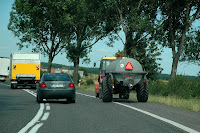 worth a visit. And they were very right. We program Kate to take us off the motorways and so get to see a bit more of rural Poland. This is open wide and flat country and the farmers are busy harvesting and baling hay, ploughing the land and applying that stinking liquid fertilizer from the back of tankers pulled by tractors. And the towns we pass still exhibit the influence of the former socialist government in the form of those
  drab apartment blocks.
Once we arrive at Biskupin and park the car where the lass taking the money spoke no English, and us no Polish (it's OK, a hand holding up 5 fingers is easily interpreted correctly as 5 złoty), we decide to eat before exploring. Again, it was all dutch to us all, but shaslick is the same in both languages and they were good. Very delicious!
Now, Biskupin is one of those  treasures that would have been lost for all time were it not for the keen eye and keener will of a local person. This is the recreation of an old settlement - a very old settlement. Discovered in 1939 by a local teacher who wondered what a regular line of poles sticking out of the marshes could be, Biskupin recalls the human habitation on this small peninsula that juts out into a lake system that dates back ten thousand years with the
  remains of a deer hunter's camp. Then there is a Neolithic Age house belonging to the first farmers - complete with a nearby inhumation burial, and an Early Bronze Age Kraal - a large settlement surrounded by a series of ditches. All these hae remnants remaining.
But by far the most significant site is a settlement from the early iron age. Fortifications, roads and  buildings were incredibly well preserved in a form of peat which slowly built up over the settlement once the humans had left. It allowed for an amazingly accurate recreation of the a portion of the settlement to be done. After a range of dating tests over a period of seventy years, this settlement has been conclusively dated. The oak timber for the buildings was cut down between 747 and 722 BC but over half the trees were felled in the course of one winter -
  738-737 BC! So yes, it is old.
The iPod audio guide is excellent and offers much more information. The reconstruction is amazing - using only simple tools as the original builders would have access to. Some of the features uncovered from the marsh included the original gates into the  complex as well as remnants of buildings, part of the wall rampart and the road. The impression of the town remained buried deep in the murky earth - there were 13 long houses each containing between 3 and 9 seperated and identical dwellings and it is estimated that up to 1,000 people could have lived here at a time. Oh yes, our early ancestors were much more sophisticated than we give them credit for!
And in the museum attached to the settlement are relics found on site during the numerous excavations - including the skeletons of a number of people found in various burial positions. Yes, the actual skeletons, not moulds. They were a little shorter than us and probably died in the 40s to early 50s. There is evidence of weaving looms, and sewn clothing, of beautiful jewellery and religious icons as well as the anticipated arrow heads and cooking pots.
What a truly amazing site.
From here we head to Wenecja to have a look at the narrow guage railway museum. The museum itself was closed, and the rolling stock on show was fairly minimal and in desperate need of some tlc (tender loving care). But as Michael said, the cost of main taining such is enormous.
Then to the Gąsawa to have a look at the Church of St Nicolas. Now, this is a true cultural gem. Built in the 1600's of larch wood, local officials asked the regional Prussian government to allow the church to be dismantled and build a new one when it was in bad repair in the 1850s. They only gave permission to  overhaul the building when wall paintings were covered with a layer of reed and ordinary plaster, and forgotten for some 150 years. The interior of the church has been cleaned and today the beauty of the paintings is very obvious. The local custodian is very proud and despite us telling him English only, he chose to excitedly chat to us in - German! Still, we got the gist of what he was telling us!
The afternoon is barrelling along so we keep moving, going  through Strzelno to have a look at the Church of St Prokopus - a round brick building that dates back to the 12th century on the hill next to the St Adalbert's Hill with its baroque Basilica where the 6pm bells are calling the faithful to worship. And come they do - quite a lot of them. They must get some big masses here because it is broadcast outside. I won't go in because we don't want to stay too long. We drive via Żnin before turning to head back towards Poznań.
  But there is one last stop we want to make at Gniezno to take a closer look at the Cathedral we had seen from a distance on our way out this morning. This twin-towered edifice can be seen for miles. Unfortunately it is closed by the time we get there, so we don't get to see the famous 'Gniezno Doors' - one of the most valuable romanesque monuments in Europe with their richly engraved bronze doors of 18 panels showing the life of St Adalbert (popular guy, huh!) dating back to the 12th century. Oh well.
And as we return to Poznań we see a new temple in the form of the Galleria Malta. Gosia reckons that it is a great shopping mall - the newest in town, but honestly , seen one, seen em all! You could be in any shopping mall in any city - although open for business, trade tonight is quiet. We buy some cakes and them stop at a chemist to re-stock on bathroom essentials. By now it is after 8:30 pm and we struggle to find somewhere to get dinner. We are both tired and can't be bothered cooking or going into a restaurant in town. We take a fruitless search for a pizzeria and end up with the dreaded Maccas. Oh well, predictable - we knew exactly what we were getting! It tastes just like their cardboard food at home!!!
Still searching for accommodation in Berlin - wish us luck.


 It was great getting back here to Schwäbish Gmünd. Steph and Felix had moved in the first week we were gone, and they are now almost settled in to their new home. They have actually had the house since April 2016, engaged an architect and set about making it their own. The former owner had lived here almost all her adult life and had raised her family here. Now, she has passed on and her children with teenage children of their own, have sold the house to a new family. They replaced the roof and pretty well gutted the interior, opening to a more open plan, put in new kitchen and bathrooms and are now putting the finishing touches.
 Since arriving back, we have been trying to help around here a little - Michael spent two days cutting out hedges and hedges of diseased buxus. Four trips to the green waste bin to get rid of it all - and one to go! Tomorrow we will go back to their former house and spakfill the holes where paintings were hung, and sweep up and wipe down after the kitchen was removed - yes, they sold the kitchen that they had put in in the rental - it is not considered a fixture here!!


 It was nice to become re-acquainted with the Munster - we did visit it during our 2009 trip, but we spent more time delving into its history and secrets this time. There are some amazing stained glass windows and Michael happily discovered a number of Green Men in the carvings above doorways.
 There is so much history in the churches. Makes you look on their role in a whole new way.
 The fountain that was under its winter cover on our last visit, is happily providing drinking water to all who need the refreshment - and doesn't discriminate between beast or man - it as happily lets the pigeons drink as it does the local man filling his child's water bottle. The surrounds of the fountain tell the stories of the various coats of arms associated with the city and a multi-sided statue has the complete holy family watching over the users and the town square in general.
 The main Marketplace is living history with a range of architectural styles showing how the city has changed over time. The buildings in the centre of the photo below (brown and white ones) are some of the earlier and date to when tax was paid on the footprint of the building - so the ground floor was smaller and each additional floor added width to the building! The Rathaus (Council chambers) is the pink building on the left. These always have beautiful displays of flowers and usually have a chiming clock - the one in Schwäbish Gmünd is particularly nice with some chimes that play a number of classical pieces.
 After a few hours wandering and wondering, we come home to Steph and the kids, to pretzels and fresh seed rolls, to ham and salami and joy of joys to amazing cheeses that are SO cheap at the local supermarkets here!


.jpg)
.jpg)
.jpg)
.jpg)
.jpg)
.jpg)
.jpg)
.jpg)
.jpg)
.jpg)
.jpg)
.jpg)
.jpg)
.jpg)
.jpg)
.jpg)
.jpg)


.jpg)

