Showing posts with label memorial. Show all posts

Wednesday, March 7, 2018

The rain is not only in Spain


So again I am sitting down to write the blog.  Just like every other day on this trip.

As we arrived in Christchurch, so we come back.  The weather here at the moment is damp and cool.  Today was a top of 17⁰ but the wind made it feel much cooler.  Summer here, it seems, is about as warm as winter back home!  We are told that after New Year it
actually got into the mid 30's.  I know I was looking forward to the cooler weather here before we left, but now, I'm craving the warmer weather back home.  Just as well we are leaving tomorrow.  We began our day down at the bus terminus getting ready to travel up to Mt Cavendish via the Christchurch Gondola.  En-route we see more and more of the public art offerings that artists were asked to contribute straight after the 2011 earthquake when the Art Gallery was damaged.  There are all sorts of offerings from raspy graffiti styled works to extravagant offerings that have contemporary themes.

It was brunch time and the offerings were pretty slim.  We settled on Japanese - Pork and Garlic Chive dumplings and Chicken Yatsu to share.  Really fresh and prepared in front of our eyes.  Yummy as!

We had checked out the bus times and finish our meal just in time to get the bus as it pulls in to the bay.  The Bus Terminus is fairly newly finished and really well laid out.  All buses pull in to a bay meaning that no matter what the weather, passengers get to board in the dry.  Seems to work like a dream with 13 gates available and buses coming and going literally every couple of minutes.

We have had to plan our day a bit better as we are now relying on public transport.  The bus to Lyttelton ends up at the Christchurch Gondola station - very convenient and takes about 20 minutes from the centre of town. Its interesting to have the opportunity to travel through the suburbs and get a bit of an overview to life in the Christchurch residential areas.


The Christchurch Gondola has a route that rises 445 m above the base station over a route of 1 km - almost fully vertically up (or so it seems to me).  Not for the faint-hearted and by the time we actually reached the summit, I was starting to feel it!  Still, the views are certainly worth the little bit of acrophobia felt.


You look out over the Mount Cavendish Scenic Reserve, Lyttelton Scenic Reserve, Mount Pleasant Scenic Reserve and Tauhinu-Korokio Scenic Reserve down over Lyttelton Harbour and across to Otamahua (Quail) Island.  Down over Christchurch city and out to the Pacific Ocean.  It truly is quite a vista.

Michael indulges his sweet tooth with a Cookies n Cream cheesecake while I enjoyed a date scone with my coffee.
Following this little sustenance, Michael set out to walk one of the trails while I explored the Time Tunnel that explained the history of the region. Their souvenir shop was surprisingly affordable - too bad that I have already bought my fill.

The Canterbury Plains are stunning and we are told that on a clear day you can see across to the Southern Alps, but not today.  As we are leaving, the gondola operator tells us that yesterday the weather was so bad that you could not see Christchurch until after the fog lifted about 4 pm, so I guess it is better that we came today.

We followed our trip up the Mountain with a foot trip through the streets of Christchurch finding more of the artworks and some new buildings that are brave and bold in timber and metal and now limited to 6 stories to limit future problems with any more seismic activity.  Buildings now are rated for earthquakes and although we are only on the second floor, I'm grateful the Ramada has a A1 rating! 

The famous Container Mall has been all but totally dismantled now that the inner city Malls are again taking shape.  It is interesting as when you ask where the City Centre is, the common response is that it is changing day by day.

The last remnants of the Chinese New Year celebrations are still up - you need to understand the incredible number of Chinese people who came to New Zealand when gold was discovered.  And as we have found during our stay, NZ is a very popular destination for Chinese tourists these days.


Our last stop for the afternoon was the Transitional Cathedral otherwise known as the Cardboard Cathedral.  The Evensong Service was underway and so I sat in, allowing the choister boy voices to lift my spirit into the cavernous void above us. 

I calculate that the seating as set out can accommodate about 340 people - significantly less than the 1,000 that the former Anglican Cathedral could house. 
Although this building is 'temporary', there is definitely a feel of persistence and permanence. 

After the service, we are told that the decision has just taken to re-build the former Cathedral, although there is not yet an appeal underway.


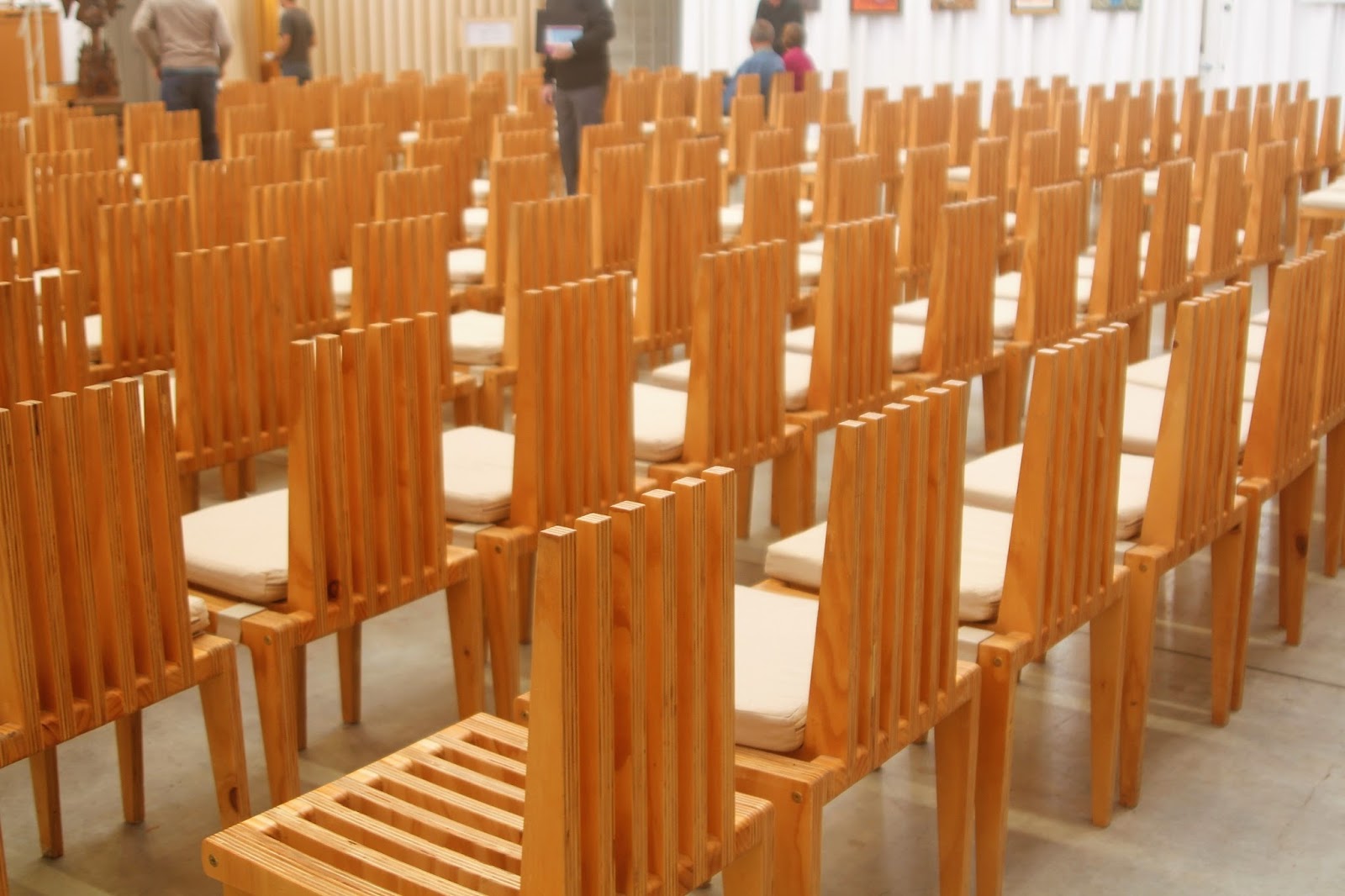
And nearby is probably the most poignant art installation, the 185 Empty Chairs memorial dedicated to the number of lives lost in the 2011 earthquake.


Back to the hotel just a few blocks away - they have a combined washing machine / dryer so we can do all our washing before we leave for home. It is getting darker now and much cooler. Time to be indoors.

And now, if only the broader weather patterns will behave themselves - we arrived on the coat tails of TC Gita.  Not at all interested in being blown home by TC Hola currently out in the Pacific - or any other one that our home messages are warning of.

Tuesday, November 10, 2009

Ickham not Wickham!

all the leaves are brown
a
nd the sky is grey
I've been for a walk
on an autumn day
Yes, California dreaming is playing on the local radio station - very fittingly! There is nothing so miserable as when it is 4:30 pm in the afternoon and totally dark with all the street lights on.

After a lazy morning we set out from
Wingham for a bit of a drive around the area. And it really is no coincidence that we are staying here - there is a Wingham in the Taree area on the central north coast of New South Wales - so we came to see if there was any resemblence. And you know, there is - lots of cattle and rolling hills! And they are of a like size.

First stop is the small village of Ickham that is a mere 2.5 kms away by road, but a million miles away in terms of how different it is. Wingham is located right on the very busy Canterbury Road, while Ickham is caught in some time warp on a small back road. Just outside town we pass fields that are being beseiged by geese - lots of geese, hundreds of geese - and as Michael gets out to take photos, their brief reprieve on the ground from the journey south for the winter is interrupted as the take flight again.

From here we turn towards the north coast of this part of the UK towards Sheerness and the Isle of Sheppey. As we travel along we see signs to the Spitfire Museum at Manston and would you believe Michael's luck - our route takes us right past it. Go past? Never! So off he goes and I pick up my book.

"Fighter trail etched white on blue,
Bomber Captain, Seaplane Crew.
Like gods, these men, though wrought as we,
Are brushed with immortality.
Their youth not lost to as years go by,
But grandly, in a moment souring high,
Through conquered sky."
- Harold Balfour

With it's memorial garden overlooking the Manston aerodome and the singular bronze statue of an RAF pilot, the museum is more of a memorial to Airforce personnel of all nationalities. However, on entering the building you get the distinct impression it's dedicated to the Supermarine Spitfire and the Hawker Hurricane and the respective crews.

The museum is quite small but full of memorabilia, including a restored Spitfire XVI and a Hurricane II and displays of ordinance carried by both aircraft. There is an impressive array of uniforms belonging to aircrew and which have been donated to the museum. A selection of aviation art is also displayed which mainly concentrate on the Battle of Britain. Whether a visitor has any interest in aviation is immaterial, this is a memorial and museum which has been tastefully designed.

So from Manston we follow the coast around to Herne Bay. This historic town is on the southern estuary of the Thames River as it empties in to the North Sea. Known for its old pier and it's impressive clock tower there is also a solitary statue of a Coast Guard statue patiently and vigilantly out to sea - making sure that all are safe, and ready to jump into action if anything goes awry out to sea.

We are still not at Sheerness despite it only being 60 kilometres from Herne Bay. You see we are averaging about 30 kph! Where there are not small towns end to end, there is farming land - marshy land that now supports sheep grazing. And there is only one narrow road that goes right through this area. And time after time we find ourselves in a bottleneck of traffic as we come up to temporary traffic lights around roadworks. It is well dark now, and not quite 4:30 in the afternoon! There is no point going any further so we make the decision to turn back for Wingham. All in all, the last couple of hours has been frustrating to say the least. And as if to add insult to injury, we hear regular traffic updates on the local radio that seems to put us in the very middle of the jams! Wait? Is that them in the car behind us??? Could be as we pass just in front of the landmarks they name time and again!!

We eventually get back to the Dog Inn and a well awaited Cider. Austin our chef has promised us Steak and Ale Pies for dinner even though they are not on his menu for the night. That menu has surprised us a little. While it is always great to find great food in the most unexpected of places, we really did not expect to find a chef of his calibre in a small town miles from where the major restaurants lie. He explains that not only is he the chef for the restaurant here, he is also head chef for the group of hotels owned by the owners. And although we are really looking forward to our pies, when the waitress gives us the menus to choose entrees, we groan at the other choices we might have had. (Pardon the shadows on the menus please)

Still, we had asked for the pies and we are looking forward to them. For our entrees tonight we decide on:
Pan fried tiger prawns, chorizo and plum tomato (Michael)
Homemade lemon and coriander fishcakes, garlic tartar (Maria)
Our mains were those amazing pies - heavy with succulent chunks of tender beef in a deliciously rich ale based gravy and topped with the cleanest, crispest shortcrust pastry - mmmm
"Dessert menu?" she asked. "Oh yes please" was Michael's reply (even though we probably didn't need it!)
Plum Clafoutis with raspberry coulis and the ripest red strawberries (Michael)
Warm apple, sultana and calvados pancake with creme anglais (Maria)

Ah the day has been redeemed! Onya Austin!!!

Sunday, August 30, 2009

And in Fromelles, the Aussies fell

This morning is bright and sunny and a little warmer than the last two days have been. The bed was comfortable, as were the pillows and we both slept soundly.

Hels has been safely set on her journey by the family. I see that she is online this morning and think that in her rush she has forgotten to sign off her account on the computer - but wait, what is this? Ah, she IS online - in the Sydney International Airport terminal! So it is a quick chat before we head off for Fromelles this morning. Oooh - so exciting.

We go in to Béthune so that I can try to get my rail ticket printed. A month ago I made an internet booking and I have been trying unsucessfully every day for the past two weeks to print the ticket. Unhappily for me, the rail office cannot print an internet ticket either. So all I can do is buy another one and argue it out with TGV (the rail operators in France) later - I mean, I really MUST be in Paris tomorrow to meet Hels - heaven forbid if I am not!!! Not happy because this ticket was €39 for a second class seat instead of the advance purchase special of €16 for a first class seat that I had paid earlier.

And so, off towards Fromelles. Passing bunker after bunker, abandoned to the elements, a constant reminder to the locals of battles waged and lives lost. We pass through the town of Beuvry where in the church yard amidst the community's dead lies the other reminder - the town memorial to their own sons, lost in the battle for their lands. Our next stop was at the Gorre British and Indian Cemetery just outside Beuvry where the only thing littering the manicured lawns are dead and dying oak leaves fallen from shading trees, as though they were weeping tears for those beneath them.

The tombstones stand as silent sentinels - row after row after row. Every so often you see two or three headstones much closer together and the only reason I can think of is that they fell together. And there is a single lone white cross with a bronze plaque. It belongs to the only Frenchman in this cemetery.

What can we say about Fromelles. A quote at the Cobbers Memorial Park at Fromelles sums it all up:
"We thought we knew something of the horrors of war but we were mere recruits, and have had our full education in one day." Lt. R A McInnes 53rd Bat. AIF writing of the Battle of Fromelles.

The aim was to seize a 4,000 yard stretch of the German front line (and so stop them from advancing) but it was a disaster. Although the Australian forces initially succeeded, the Germans re-took the space and on the morning of 20th July 1916 we had to withdraw to the original lines. That attack on the single night of 19th-20th July cost the AIF 5th Division 5,553 casualties (wounded and dead). The 60th Unit AIF suffered the greatest loss - at roll call on the evening of 20th July, only 106 men were present of the 887 who went into battle one day before.

In all, Australia sent 180,000 men to the Western Front - three times the number we sent to Gallipoli. One third of these men died because of this war and our commitment to it - 43,000 in the fields and 17,000 as a result of their wounds. Why so many? Well, we were ill-equipped and ill-prepared but mainly because of infection. After all, they were fighting in farmlands where animal excrement littered the soil and turned the most minor of wounds into septic messes.

Then another car with British plates pulls up (our has GB rego plates as well). A couple in their mid 30s get out. "Hi, where are you from?" asks the man. "Australia" I reply. "I can see that" he answers. (Of course, Michael is wearing his Akubra.) Der, the accent is an Aussie one! Turns out they are Australians from Geelong and Melbourne living and working in London and down for the weekend. "Maryborough" I reply, hastening to add "Queensland, not Victoria!" Yes, it is a small world and is kind of fitting - as the men we come to visit are from all over our large country - strangers till fate threw them together in this hell.

Now, it is overcast with a stiff breeze blowing. Not unpleasant, but you know that autumn is on the way. Most of the fields around the memorial have been recently harvested and re-ploughed sort of simulating the churned earth of the battlefields. (My imagination is in overdrive as well you can see!)

Then it is on to the VC Corner Memorial. This remembers the 1,299 men who died in the battle of 19-20 July 1916. 410 of these corpses could not be identified as their dog tags had been removed to send home to family. But the names of all 1,299 men are inscribed in the marble wall that provides the backdrop for the lawn. Tombstones were not erected here because so many of the bodies could not be identified. Instead, 2 simple large white marble cross lie in the lawn each framed on three sides by straight garden beds [+ +]. Filled, not with poppies, but with fragrant red roses, the colour of freshly spilled blood.

Bugger. The battery in the camera just died and the spare is also flat although Michael is sure we charged it. Bugger, bugger, bugger.

Finally we call in at the Anzac Cemetery and opposite, its counterpart, the Canadian Cemetery. There, a wind break of firs thickly planted on two sides shelters those in their eternal rest. And it does not matter that we have seen hundreds and hundreds of the white headstones, the last is as sad as the first.

For those who want to read in greater detail click this link. Chapters XII and XIII deal with Fromelles in some detail. Here endeth the lesson, pray God we have learned from it.

With the camera now well and truly dead we decide to return to the hotel. And what a blasted pity we can't take photos! Lost opportunities on the way home include:
-
First: how now, one brown cow leading 30 - 40 creamy Charolais ones down the edge of a fence;
- Second: the fair around the sale of the onions and garlic freshly harvested at Locon where it seems that every home in town has a table outside selling braids of garlic that look just like a young girl's hair and everyone from miles around has parked on the side of the road and is walking back, chatting with the sellers. Onions in large bags are being hauled away by everyone - from the strapping young man with his girl on his other arm to the old lady, with her older mother shuffling behind her;
- Third: AgroTrend a la France (in true Nord-Pas-de-Calais regional style), complete with live machinery demonstrations and crawling traffic - whether you wanted to enter the filled-to-the-brim parking lot, or like us, just wanted to pass.

Actually, an earlier return to the hotel suits me just fine. I still have to pack my neat new little suitcase for the next four days in Paris and my emotions are just a little jaded.
Helen is now en-route to Tokyo where she hopes to find an internet terminal so we chat before her next leg to Copenhagen. I, on the other hand will travel by train to Paris to wait for her.

Saturday, August 29, 2009

In Flanders fields the poppies grow

Iepres (Ypres) is a name that lives in the collective memory of Australia.
Like many of the other town names from this corner of Europe where Belgium and France meet, where the battle for a free world was waged just out of the time of our personal memory - but in that of many of our forebears.

You know, it is a pity that we have this history with this town in so many ways. It is a delightful place that goes back to ancient times when it was the heart of a very prosperous linen trade - particularly with early England. In fact, the town is mentioned in Chaucer's Canterbury Tales!

It was going to be a hard day - I knew that.
One million dead.
Despite the larger numbers that we have so recently experienced, this one for us is perhaps more horrifying. This is our kith and kin. We lost the hopes and dreams and aspirations of generations as part of this loss by the Commonwealth - fighting for a cause not directly theirs, in a land so far from the comfort of home.

We arrived in Iepres about 11:30 am from Kortrijk. Parking was not a problem - there seems to be plenty of street parking and affordable too. Francis, bless her, finds us one less than a block from the Cloth Market in the street facing in to this impressive building. As we cross the market square, we admire the work of the modern artisan - because as old as this building looks, we know it is a reconstruction as the city of Iepres was almost totally levelled in the dying days of WWI.

We walk through the passage in the centre of the Cloth Market and out the other side to see St Martins Cathedral again standing proudly just beyond. We choose to have a look here first, knowing that if we leave it till later, there will be no time. The original church was built in the 13th century and at the end of that century nearly lost to a fire. Rebuilt, it was reduced to a pile of rubble, a few pillars and parts of the walls, when, like the Cloth Market, this building too was burned to ruins by the Germans in WWI.

Totally rebuilt to the original plans but with a few modifications (spire on tower, changes to entry doors), it is now a cavernous space of stone. Cool but not cold. A little aloof but bearing the scars of the horror of its people honourably and meekly. A memorial covered with paper poppies is the busiest spot in the whole church.

Some of its arts works were saved by a quick thinking dean, but its statues were not so lucky - most have sustained severe damage. All that beauty, destroyed at the hands of a force without thought. This new old church is quietly beautiful. There are stained glass windows in the old style next to very modern ones - and it is a pleasing marriage, neither dominates the other. There are frescoes in porticoes, and tombstones reassembled and laid in a dignified and reserved space that we can only view through glass.

I light a candle and leave a message in their memorial book. Oh God, what loss. What waste.

The Cloth Hall now houses the In Flanders Field Museum and the Visitor Information Centre. It is connected to the City Hall, now again, as it always was. You come in to the museum from the central passage and through one of two identical long courtyards. So the Cloth Hall from the air looks a bit like a squared off figure 8.

Inside the In Flanders Field Museum your senses are accosted in almost every sense of the word. Not just by the descriptions and the photos, nor just by the movies or the stories. But by the sounds of an exploding shell that rings in your ears for minutes after. And by the approaching and then receeding sound of British troops marching gaily to take on Fritz. But mostly it is the personal accounts of the experiences - the snapshots. the poetry, the letter to a loved one. And while the museum has been established to tell of the City's unwitting involvement in the war, it too pays homage to those naive men from all sides who started with such patriotic fervour and who finished broken and forever harmed, often unable to recall their own names in the moments after a shell.

There are signs of the humanity that shone through - like the Christmas truce (for which a Belgian Leiutenant was sent back to the ranks for allowing) on Christmas Eve in 1914 and the unwritten rule that shelling stopped at breakfast and tea time - for some. During the Christmas Truce men from both side left their trenches and they met in no mans land to exchange pleasantries and small tokens of friendship.

Michael has to duck out and feed the meter more euros. Two hours just isn't enough. He isn't gone long though.

And then there was the last exhibit.
I died in hell.
They called it Passchendaele

With a grim warning about the simulation posted at the entrance, I wondered whether I could even keep my emotions, aready at the brink, in check. But how could you not go in - in the safety of sight and sound when so many paid the ultimate price in this horror. You sit in a large room, glass panels in the floor light to reveal the churned mud underfoot. A piece of human body here. A bloodied helmet there, half sunk. There is a post in the centre of the room around which barb wire, rusted, is looped. Then two screens come to life.

Each show different footage and as you struggle to concentrate to keep the plot of each together, you realise that in this battle, there must have been so much happening all the time that the concentration of those poor souls must have been shattered. A yell here, a grenade there, gas wafting across the field, a mate lying dead beside. Its a wonder that any of these men returned capable of anything functional.

The large model under dim light, of the city of Iepres at the end of war in 1918 bears almost no likeness to the medieval three dimensional relief that was on display behind the glass in the cathedral. It is a flattened ruin surrounded by a wasteland that to this day continues to spew out its horrors when freshly dug.
As we are leaving, we are stopped by a young lass who is undertaking a survey. "Do you plan to see any of the other WWI sites in the area?" she asks. "Yes" says Michael. "Which ones?" "All of them." I on the other hand reply - "No, I'm going to Paris - I can't take any more."

In Flanders Fields
In Flanders fields the poppies blow
Between the crosses, row on row,
That mark our place; and in the sky
The Larks, still bravely singing, fly
Scarce heard amid the guns below.

We are the dead. Short days ago
We lived, felt dawn, saw sunset glow,
Loved, and were loved, and now we lie
In Flanders' fields.

Major John McCrae 1915

We leave the carnage of WWI to its bed and head back outdoors. I just want to sit in the sun with something nice. I just want to feel human again, not inhuman.
We stop at a local pattiserie where I buy six des petits gâteaux dans la fenêtre s'il vous plaît (six of the small cakes in the window please). These are works of art in their decoration and I am sure that later we will find that they are culinary works of art as well. Boxed and bagged we are ready to go. We were going to try for some lunch (at 4:15pm) but the kitchen at the closest restaurant is closed. Bugger. Back to the car.

Then as we are driving away, we realize that there is another restaurant still serving food - and with a car space outside! We don't want anything heavy and so settle for a Croque Monsieur avec une petite salade (ham and cheese toasted sandwich with a small salad) and a Croque Madame et oeuf sur le plat (ham and cheese toasted sandwich with a fried egg). They were fresh and tasty. And Michael's coffee came not only with the standard small biscuit, but also with a shot glass of the smoothest, lightest chocolate mousse you can imagine - yep, I ate most of that!!!

While we are sitting there watching the passing parade of Iepres, I wonder where the wealth of today is coming from given that the cloth trade never recovered after the blockade of trade route during the 100 years war in the 14th Century. But there is evidence that the City has regained some of its former wealth all around us. From the restaurant prices, to the fashionable clothing outlets and the exclusive boutiques, to the fashion and jewellery of the women walking by and to the high end cars driving through the market square.

Michael goes to have a look at the Menin Gate Memorial while I check out the Belgian confectioner's pralines and buy a box to share with Hels in Paris. Yes, I need some nice things in my life. The shopkeeper assured me that they would keep - "After all, it is not so hot now madame!" Michael has also found someone who has been able to give him directions to Hellfire Corner. Turns out it is just next to the roundabout that we came in to town through. I have a conversation with the rooster and hens of Hell Fire Farm while he goes to reflect and get a photo.

So we leave for today. Michael hopes to return to Iepres in the coming days to further explore the Iepres Sallient and the Yorkshire Trench and Dugout amongst other areas. We head further west and back in to France along the back country roads to an area just outside Béthune where I will get a train from to Paris on Monday.

Tomorrow we head for Fromelles. This is how the Australian War Memorial describes it:
"The worst 24 hours in Australian history occurred 90 years ago at Fromelles. Not the worst in Australian military history, the worst 24 hours in Australia's entire history. The Australians suffered 5,533 casualties in one night. The Australian toll at Fromelles was equivalent to the total Australian casualties in the Boer War, Korean War and Vietnam War put together. It was a staggering disaster."

Another day to wear at the emotions.
And then Paris. Hels leaves tomorrow (today her time) and I am so seriously in need of bright, happy and gay company after this weekend! Can't wait.