 Iepres (Ypres) is a name that lives in the collective memory of Australia.
Like many of the other town names from this corner of Europe where Belgium and France meet, where the battle for a free world was waged just out of the time of our personal memory - but in that of many of our forebears.
You know, it is a pity that we have this history with this town in so many ways. It is a delightful place that goes back to ancient times when it was the heart of a very prosperous linen trade - particularly with early England. In fact, the town is mentioned in Chaucer's Canterbury Tales!
It was going to be a hard day - I knew that.
One million dead.
Despite the larger numbers that we have so recently experienced, this one for us is perhaps more horrifying. This is our kith and kin. We lost the hopes and dreams and aspir ations of generations as part of this loss by the Commonwealth - fighting for a cause not directly theirs, in a land so far from the comfort of home.
We arrived in Iepres about 11:30 am from Kortrijk. Parking was not a problem - there seems to be plenty of street parking and affordable too. Fr ancis, bless her, finds us one less than a block from the Cloth Market in the street facing in to this impressive building. As we cross the market square, we admire the work of the modern artisan - because as old as this building looks, we know it is a reconstruction as the city of Iepres was almost totally levelled in the dying days of WWI.
We walk through the passage in the centre of the Cloth Market and out the other side to see St Martins Cathedral again standing proudly just beyond. We choose to have a look here first, knowing that if we leave it till later, there will be no time. The original church was built in the 13th century and at the end of that century nearly lost to a fire. Rebuilt, it was reduced to a pile of rubble, a few pillars and parts of the walls, when, like the Cloth Market, this building too was burned to ruins by the Germans in WWI.
Totally rebuilt to the original plans but with a  few modifications (spire on
 tower, changes to entry doors), it is now a cavernous space of stone. Cool but not cold. A little aloof but bearing the scars of the horror of its people honourably and meekly. A memorial covered with paper poppies is the busiest spot in the whole church.
Some of its arts works were saved by a quick thinking dean, but its statues were not so lucky - most have sustained severe damage. All that beauty, destroyed at the hands of a force without thought. This new old church is quietly beautiful. There are stained glass windows in the old style next to very modern ones - and it is a pleasing marriage, neither dominates the other. There are frescoes in porticoes, and tombstones reassembled and laid in a dignified and reserved space that we can only view through glass.
I light a candle and leave a message in their memorial book. Oh God, what loss. What waste.

The Cloth Hall now houses the In Flanders Field Museum and the Visitor Information Centre. It is connected to the City Hall, now again, as it always was. You come in to the museum from the central passage and through one of two identical long courtyards. So the Cloth Hall from the air looks a bit like a squared off figure 8.

Inside the In Flanders Field Museum your senses are accosted in almost every sense of the word. Not just by the descriptions and the photos, nor just by the movies or the stories. But by the sounds of an exploding shell that rings in your ears for minutes after. And by the approaching and then receeding sound of British troops marching gaily to take on Fritz. But mostly it is the  personal accounts of the experiences - the snapshots. the poetry, the letter to a loved one. And while the museum has been established to tell of the City's unwitting involvement in the war, it too pays homage to those naive men from all sides who started with such patriotic fervour and who finished broken and forever harmed, often unable to recall their own names in the moments after a shell.

There are signs of the humanity that shone through - like the Christmas truce (for which a Belgian Leiutenant was sent back to the ranks for allowing) on Christmas Eve in 1914 and the unwritten rule that shelling stopped at breakfast and tea time - for some. During the Christmas Truce men from both side left their trenches and they met in no mans land to exchange pleasantries and small tokens of friendship.
Michael has to duck out and feed the meter more euros. Two hours just isn't enough. He isn't gone long though.
And then there was the last exhibit.
I died in hell.
They called it Passchendaele
With a grim warning about the simulation posted at the entrance, I wondered whether I could even keep my emotions, aready at the brink, in check. But how could you not go in - in the safety of sight and sound when so many paid the ultimate price in this horror. You sit in a large room, glass panels in the floor light to reveal the churned mud underfoot. A piece of human body here. A bloodied helmet there, half sunk. There is a post in the centre of the room around which barb wire, rusted, is looped. Then two screens come to life.
Each show different footage and as you struggle to concentrate to keep the plot of each together, you realise that in this battle, there must have been so much happening all the time that the concentration of those poor souls must have been shattered. A yell here, a grenade there, gas wafting across the field, a mate lying dead beside. Its a wonder that any of these men returned capable of anything functional.
The large model under dim light, of the city of Iepres at the end of wa r in 1918 bears almost no likeness to the medieval three dimensional relief that was on display behind the glass in the cathedral. It is a flattened ruin surrounded by a wasteland that to this day continues to spew out its horrors when freshly dug.
As we are leaving, we are stopped by a young lass who is undertaking a survey. "Do you plan to see any of the other WWI sites in the area?" she asks. "Yes" says Michael. "Which ones?" "All of them." I on the other hand reply - "No, I'm going to Paris - I can't take any more."
In Flanders Fields 
In Flanders fields the poppies blow
Between the crosses, row on row,
That mark our place; and in the sky
The Larks, still bravely singing, fly
Scarce heard amid the guns below.
We are the dead. Short days ago
We lived, felt dawn, saw sunset glow,
Loved, and were loved, and now we lie
In Flanders' fields.
Major John McCrae 1915
We leave the carnage of WWI to its bed and head back outdoors. I just want to sit in the sun with something nice. I just want to feel human again, not inhuman. 
We stop at a local pattiserie where I buy six des petits gâteaux dans la fenêtre s'il vous plaît (six of the small cakes in the window please). These are works of art in their decoration and I am sure that later we will find that they are culinary works of art as well. Boxed and bagged we are ready to go. We were going to try for some lunch (at 4:15pm) but the kitchen at the closest restaurant is closed. Bugger. Back to the car.
Then as we are driving away, we realize that there is another  restaurant still serving food - and with a car space outside! We don't want anything heavy and so settle for a Croque Monsieur avec une petite salade (ham and cheese toasted sandwich with a small salad) and a Croque Madame et oeuf sur le plat (ham and cheese toasted sandwich with a fried egg). They were fresh and tasty. And Michael's coffee came not only with the standard small biscuit, but also with a shot glass of the smoothest, lightest chocolate mousse you can imagine - yep, I ate most of that!!!
While we are sitting there watching the passing parade of  Iepres, I wonder where the wealth of today is coming from given that the cloth trade never recovered after the blockade of trade route during the 100 years war in the 14th Century. But there is evidence that the City has regained some of its former wealth all around us. From the restaurant prices, to the fashionable clothing outlets and the exclusive boutiques, to the fashion and jewellery of the women walking by and to the high end cars driving through the market square.

Michael goes to have a look at the Menin Gate Memorial while I check out the Belgian confectioner's pralines and buy a box to share with Hels in Paris. Yes, I need some nice things in my life. The shopkeeper assured me that they would keep - "After all, it is not so hot now madame!" Michael has also found someone who has been able to give him directions to Hellfire Corner. Turns out  it is just next to the roundabout that we came in to town through. I have a conversation with the rooster and hens of Hell Fire Farm while he goes to reflect and get a photo.
So we leave for today. Michael hopes to return to Iepres in the coming days to further explore the Iepres Sallient and the Yorkshire Trench and Dugout amongst other areas. We head  further west and back in to France along the back country roads to an area just outside Béthune where I will get a train from to Paris on Monday.
Tomorrow we head for Fromelles. This is how the Australian War Memorial describes it:
"The worst 24 hours in Australian history occurred 90 years ago at Fromelles. Not the worst in Australian military history, the worst 24 hours in Australia's entire history. The Australians suffered 5,533 casualties in one night. The Australian toll at Fromelles was equivalent to the total Australian casualties in the Boer War, Korean War and Vietnam War put together. It was a staggering disaster."
Another day to wear at the emotions.
And then Paris. Hels leaves tomorrow (today her time) and I am so seriously in need of bright, happy and gay company after this weekend! Can't wait.
Hotel Marjani where we stayed last night was remote - on the outskirts of Wennigsen with the only other enterprise that had any sort of life being McDonalds! And the kids in their souped up vroom vrooms also found it late at night. But thankfully, not for too long!
We both slept like logs. Last night we were both busy planning for the first week of September - Michael for his time on the Western Front sites and me for Paris with Hels. Gosh, today it is only 3 more sleeps for her - and i think that she is as excited as me!! There is so much to see and do in gay Paree - we'll have out work cut out for a n exhausting 4 days methinks!!
Today will be a quieter day. Leaving Wennigsen for Köln, we don't plan to do too much and hope to arrive earlier in the afternoon. But not before we travel back the wa in came in for a couple of kilometres to have a look at a windmill we could see yesterday from the motorway. We can see it as soon as we turn on to the side road that I thought would leads us to it. This one is on private property and obviously not working - its sails are broken. Nevertheless, it is old and as astructure, still commands the landscape around it. Makes for some nice photographs as well! Later we pass others dating from the same period, that are still in use.
So we turn on Kate and head for the west. And despite our dislike of the motorways, today we are just wanting to get to its Köln and as the motorway option is a 3 hou r trip and the non-motorway is a 5 hour trip we choose the former. Pity because the slower route would take us across a river - oh well, another day! Still, the day in a pleasant 23°C as we head out, so all is good in our world. We are making good time, travelling through some really scenic areas. This is still rural farming land, but there are more and more forested areas between the towns that are now a couple of kilometres apart.
We are back in the land of the steep tiled roofs - an indication  that they can get quite heavy snowfalls here in the winter. The villages and towns seen from the distance and the isolation of the motorway present a postcard view. Wooded hills behind them, church steeples and terracotta tiles, large barns, fruit trees and the patchwork of farming lands - some harvested, others not - make it so. Its the sort of postcard view that you could have been sent in the 1950s with the tones in sepia before the advent of the digital camera.
We see castles and chateaux in the hills, but none really close enough to get a good photo. And then this monument comes in to view - or maybe I should say starts to come into view. It is MASSIVE. I mean REALLY really huge. So now the question is, do we leave the motorway to go have alook or not? In repsonse to my question, Michael says "If you want to" - huh! Thats all the encouragement I need! So away to the right down the exit I spin. At the bottom, I tap Kate looking for "Places of Interest near you - Tourist Attractions". This is a really handy in-built tool, with the only drawback being that it is in the local language. I never studied German, so it is a bit of a guess. I tap one and realise straight away once she computes the route that it is the wrong one - she wanted me to turn away from the monument that now towers above us high on the nearby hill. Ah, maybe this one as I tap Kaiser-Wilhelm-Denkmal an der Porta Westfalica - yep, thats it!

The Kaiser Wilhelm monument stands as big as the man himself, who benevolently holds his hand out over (part of) the area that he governed. He was known as Wilhelm the Great. And the monument is 88 m high with the statue standing under a canopy of sandstone. It was built in 1892 - 96 at the phenomenal cost of 830,000 goldmarks! In todays terms, 1 goldmark is equivalent to  9.86 euros!
And the setting is at the top of a graded forest walk up the last 350 m to the top of the hill. Nice and cool to walk up through, and when you get to the top - there the monument is, towering heavily above you. The views from the top courtyard around the former Prussian province of Westphalia are stupendous. Ah yes, over this land and much more I held  power. Following the death of Kaiser Wilhelm an order went out through the country for monuments to be built and this one in Westphalia is the result of a competition. As a school group of young children arrive Michael hurries to get the last photos so we can head off before we are bothered by them! Ah, and the autumn colours are beginning to show - it will be lovely to see them considering that in Queensland most of our trees are evergreen!
Back on to the motoray and it turns out that we may as well have taken the longer non-Motorway route. The traffic is abominable. It seems that there are major roadworks around every other bend - most prevalently near the exits to major cities. EVERY DARN ONE OF THEM! We lose almost an hour to them over the course of the  journey this afternoon. Road rage is unheard of though - I mean you could vent all you want, but you are still trapped on an eight lane divided road going no-where, slowly! So, we just leave the car in first and crawl along with the rest of the ants.
We arrived in Köln and finally find the Hotel Friends - Kate had initally directed us to another outer  very rural suburb and we couldn't find anything resembling any sort of accommodation. Eventually we reach the correct area after travelling through the surrounding area of the ChemPark - yep, we are on the fringe of a large industrial complex where there are huge chemical plants. Names like Bayer and lots of power
  plants, phospphorus processors etc. We get checked in and then prepared to catch up with another of our ‘extended’ (read exchange student) family. We were off to Königswinter to visit Felicitas and meet the rest of her family for the first time.
It is a 40 minute drive to Königswinter from here - mostly back on the motorways. They criss-cross the country at huge clover leaf and peel away intersections that make anything we have back in Australia look puny and insignificant. There are many times when on a longish journey, that you switch from one to  another to another again. As we come off the motorway into Königswinter, we are greeted by the view of the Schloß Drachenfels and the ruins of an earlier castle of the same name. We had fogotten that there was a castle here. The light is fading, and against the wan evening, they look amazing. And maybe even more amazing is the Hotel Petersburg on a facing hilltop. Check out the article for the story on this beauty - (thinking; hmmm wonder if we can stay there?)!

We turn down towards the river (The Rhine) and then up a narrow street to get to their house. It is amazingly beautiful and we think that maybe we should be staying here in Königswinter instead of Köln - its a bugger that we only have a year and have to make such choices :(
Felicitas and her mother Martina and father Matthias greet us warmly. Felicitas and her dad speak good English and her mum some English, but she understands more. With Felicitas translating we have a great night. A tour of their home also shows us how much work they have done since Gen was here - it is large by European standards and has lots of open airy spaces - so nice. The house itself dates back to the early 1800s. 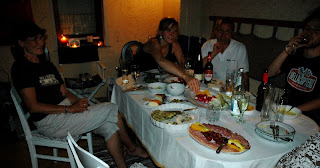
HOME COOKING - can't beat it. While we love the great restaurant food we are having, there is nothing better that having a home-cooked meal in a family home. And the ladies have prepared a veritable feast. We have spinach quiche and one with sausage and cheese, tomato and mozzarella with the yummiest balsamic sauce, lots of fresh vege sticks (celery, khol rabi, carrot, spring onion, capsicum) with a variety of dips, a plate of cold meats that the Germans do so well, cheese and fruits and breads. Felicitas' good friend Bastion turns up later. Gen has met him when she was here all those years ago.
We drink bottle after bottle of their neighbour's white wine - gosh it is so easy to drink. Encouraged by Bastion, I even taste the local Köln beer Kölsch - and it really is not too bad at all - maybe I could get used to this one! Light in taste and not too bitter. We show them the latest photos of the family including the most-beautiful-little-girl-in-the-world, and photos of our house - we had not realised just how much work we have done to it since Felicitas left 6 years ago -my god, where has that time gone!
Finally, knowing that they all have to work tomorrow, we make our goodbyes just before 1 am promising to try to get back before we leave for home. Felicitas and Bastion are off to Tanzania on Saturday for two weeks to visit a good friend. I will pass on my brothers address to here in Ofcolaco in South Africa as well - they are looking to do a bit of travel in the area and have a real humanitarian take on life. Felicitas has just completed her dissertation for university - her studies are in the area of disabled children and her thesis is based around Thalidomide and needs. So now it is 2 am and I need to get some sleep. Believe it or not, Michael is already asleep and snoring soundly behind me. Goodnight!
Or - Timber and steam all the way to Germany. We are sure that Poland  provides most of the world's hay. There is so much of the country around here being harvested at the moment - and the yield they are getting is amazing, so we see thousands and thousands of large rolled bales - some still drying throughout the fields and some stacked. Every couple of days when we speak with Gen, she begins with hey hey hey, so I couldn't resist the title today!!
The Poznań Tourist Bureau puts out  a series of information guides that are based around trails or routes of the best things to do in the area. We followed one the other day when we went to Biskupin and today as we head away from Poznań for the last time we are going to follow another - 'The route of wooden churches and buildings' before we make one last stop in Poland at a town called Wolsztyn and then turn west to Germany and 'Western Europe' once again.
We have left Fancy House in Poznań and already miss it. A home away from home, which, when you are travelling for a long time is not always easy to find. Thanks to Gosia and Kris for such a wonderful time. You have some new long-term friends who will w ait for you to visit Australia some time.
We are following the one tour of the 'Wooden Churches and Buildings' route that does not take us too far from the route that we must follow to get to Berlin from Poznań. Except that we are following it in reverse of the suggested direction. We start with the Church of St Martin in Granowo, arriving just after 10 am  when the morning sky is still a rich deep blue. The timbered church stands out starkly, but in such wonderfully sharp relief against this background. And there is a rather fancy bell tower adjacent to it. At first we don't think that the church is opened - but we eventually find a door that will open. Inside, the body of the church is grated, but we can see in to a rather plain church, with some baroque fittings but not with walls painted like the
  one we saw recently.
And so on we push. Now, the towns on this route are typically 15 - 20 kms apart, so we are able to get to see a few in the few hours we have. Next in line was Grodzisk Wielkopolski. At first we can't find it and instead have a look at their old market square with the town hall at its centre and a much later baroque church with some wierd dude atop its rotund tower. Then, as  we are about to leave town we realise that the car is facing into the street with the timber church. But even the gate into the yeard is heavily padlocked. A pity really - the Holy Spirit Church is very plain and angular outside, but is the oldest on our trip today - dating back to 1633! A timber chuch that is still standing after almost 400 years.
Ruchocice is our next stop. Just off  the 'main' street, St Ursula's Church is very nicely kept and in a beautiful garden of trimmed fir trees - the healthiest I have ever seen. It is obvious that this church, built in 1730, is still in regular use, but again we find the doors firmly closed. Hmm, maybe the locals don't like to share! There is not anything else to see here apart from some old barn buildings. The settlement is quite small.
In Rakoneiwice it is not a church  we have come to see. Well, it is not a church any more! Instead, it issues deliverence from a different sort of hell. Once an Evangelic Protestant church (boy, they weren't taking any chances!) built in 1763, this building is very different to the others we have seen this morning. It is of post and beam construction and inside boasted two storied balconies. But we will never know whether it was as plain as we find the interior or whether it had been richly decorated. For today, the building houses the
  Museum of Fire-fighting in Rakoniewice!
You know, sometimes the quirky and different hide lots of little gems. And this one is no different. We enter, unable to find anyone and just start to walk around. The architecture of this once church is quite stark. But now, it gleams with polished brass of a very different nature! In this building there are fire engines that date back to 1786 when terrified horses were used to get water to the seat of a fire. Can't help but imagine that there were not too many fires that they would have reached in time!! Banners from the brigades of past hang from the two balconies -  never to flutter in the breeze again.
This unique museum is this quiet little Polish back town has also got equipment from states and cities far away including Germany, Denmark, The Netherlands, Lithuania, Belgium, Hungary, Ukraine and Russia. Wow - what a collection so far from anywhere. By now, I am back in the car (sorry, there is only so  much fire fighting stuff a girl can take - I think its another of those bloke things) when finally a young man working for the museum comes in. I don't think that they get too many visitors, so he is keen to show Michael personally around their collection. Thank you Hubert Koler - your generosity was really appreciated.
The other thing that Rakoniewice has are four colonnaded  houses that look into a large market square. In the late 1700s the market square was surrounded by wooden arcaded houses that were characterized by two-tier peaks with beam ceilings. The majority of them burned down is the 'dangerous fire' of 1927 and today only four remain. Guess they are safe now that the Museum of Fire Fighting is within spitting distance of all four!
At this point we had planned to turn west towards Berlin, but there is a hamlet called Śmigiel that we can detour through that will only cost us an extra 15 - 20 minutes. So, why go here? Well, the church here is a composite design - part timber and part post and beam. BUT, somewhere around here are timber windmills supposedly so characteristic of this landscape. Despite our best efforts though, we don't see any. In the 18th century there were 3,500 of these windmills, but today there are only a few hundred - and darn we can't even find one! There are supposedly two, but - where? The poet Boleslaw Leśmain described them perfectly enough for us to see them in our imagination:
Rising above a fallow plain
A windmill, opened to all the world around
Creaks its wooden hoopskirt in a dance,
And throws a devil-like horned shadow on the grass...
And so we turn for the west. Each small town we pass through is built around the market square - not a bad thing at all - as this is where the local population would congregate, trade and exchange their news. Some are lovely and shady while o thers have b
 ecome more functional place - areas of hot tarmac that provide handy parking! There is one town we go through where the speed limit is 20 kph - we soon learn why though - they have not tarred over the cobblestones like most others have done and to drive over them faster would certainly mean the death of at the least, your car's suspension! And then we come around a corner and see the most amazing sight. Now, to put this in context, we a
 re out in rural rural Poland - well off the beaten track. And right here in front of us is the remnants of a palatial mansion and all the surrounding glory of what must have once been a very impressive estate. This was all once a private estate of the Kurnatowscy family and is only 100 years old. Very definitely it has seen much better days. The local young woman walking with her children could not have been more pleasant as she offers first Michael and then me a warm Cześć (hello in Polish).
Wolsztyn is famous because this is the last town wit h schedul
 ed rail services that are operated under steam locomotion. As we drive around looking for the station or the Round House (not a turntable as Michael corrects me), we see lots of other interesting things, but not what we seek. So we decide to go back into the one
  way cobblestoned and chicaned town centre to the Visitor Information Centre for - well, information. And as I turn the corner to head back that way, there they are (Michael almost wets himself). 12 steam locos all in a line - shunted end-to-end, from tender box to nose. AND there are more in the Round House. The smell of the piles of coal in huge boxed pits in the yard takes us back years and if we listen really hard, we can hear the echo of a steam whistle, once blowed.
And the information? Turns out that those scheduled services ar e only on weekends and special days. And it turns out that our visiting their town is not a special enough occasion!
Before we leave, we have ice creams that we are dubbing the Salisbury Spires - with 14 tight swirls high above the cone (and more to the base of the cone), there is none of this loose Mr Whippy stuff. And it lasts long enough for you to eat it, not slop up quickly melting drips!
Westward we go, travelling where we can on the back roads. We are so over the motorways with big sound barriers erected on both sides. We continue to  travel through small towns, observing a slice of the history of this region, and of the lives of the people today. And it is not all easy. You don't want to be a roadworker anywhere here - you risk your life every day with the only protection being the bright orange clothing you wear. And there are a couple more of those working ladies who face even greater risks I fear!
As we near the border with Germany, we have to re-join the highway. This would be a remainder from the days of border controls through non-EU countries. So it is raining lightly. One car dashes out from a service station on the other side of the road, cutting it fine between trucks hurtling past him and into our lane. Almost loses it - hea ding into a tailspin. Everything seems to go into slow motion, giving him time to recover control over his vehicle before once again we all rush. Boy, it was close - very close. But that was not the last example of the aggressive driving of the Polish. We are on a two laned busy road. But there are very wide verges. We soon learn that if an impatient fellow wants to overtake you, you head into the verge lane, pulling as far to the right as possible. And if you think this photos is bad, there was a worse example when we have one car overtaking us, and in the other direction a car is passing a truck that is overtaking a car - and all racing towards us! Egad!!!
Before we know it we are over the border and back into Germany. All of a sudden, the architecture has changed. More substantial buildings, smaller farming plots. We are headed for a suburb of outer Berlin on the eastern side called Köpernick where we managed to get accommodation. The roads are an absolute mess and the traffic horrific as we get near about 6 pm. The hotel has changed (ungraded???) our booking without consultation or advice - not sure whether we are happy or not, the room sure doesn't present as an upgraded one! But we have to remember that this is a part of the former East Berlin, and so is likely to be of a lower standard. Dinner is OK, a Schnitzel Buffet - try to imagine that. A variety of schnitzels, pork breaded schnitzel and chicken schnitzel in a mushroom cream sauce served with späetzle noodles and mashed potato with a salad bar that had shredded cabbage salad, shredded carrot salad, sliced tomato and potato salad that the Germans do so well. Who cares - we are just glad we have arrived!


 Iepres (Ypres) is a name that lives in the collective memory of Australia.
 ations of generations as part of this loss by the Commonwealth - fighting for a cause not directly theirs, in a land so far from the comfort of home.
 ancis, bless her, finds us one less than a block from the Cloth Market in the street facing in to this impressive building. As we cross the market square, we admire the work of the modern artisan - because as old as this building looks, we know it is a reconstruction as the city of Iepres was almost totally levelled in the dying days of WWI.
 proudly just beyond. We choose to have a look here first, knowing that if we leave it till later, there will be no time. The original church was built in the 13th century and at the end of that century nearly lost to a fire. Rebuilt, it was reduced to a pile of rubble, a few pillars and parts of the walls, when, like the Cloth Market, this building too was burned to ruins by the Germans in WWI.
 few modifications (spire on
 tower, changes to entry doors), it is now a cavernous space of stone. Cool but not cold. A little aloof but bearing the scars of the horror of its people honourably and meekly. A memorial covered with paper poppies is the busiest spot in the whole church.

 personal accounts of the experiences - the snapshots. the poetry, the letter to a loved one. And while the museum has been established to tell of the City's unwitting involvement in the war, it too pays homage to those naive men from all sides who started with such patriotic fervour and who finished broken and forever harmed, often unable to recall their own names in the moments after a shell.
 r in 1918 bears almost no likeness to the medieval three dimensional relief that was on display behind the glass in the cathedral. It is a flattened ruin surrounded by a wasteland that to this day continues to spew out its horrors when freshly dug.

 restaurant still serving food - and with a car space outside! We don't want anything heavy and so settle for a Croque Monsieur avec une petite salade (ham and cheese toasted sandwich with a small salad) and a Croque Madame et oeuf sur le plat (ham and cheese toasted sandwich with a fried egg). They were fresh and tasty. And Michael's coffee came not only with the standard small biscuit, but also with a shot glass of the smoothest, lightest chocolate mousse you can imagine - yep, I ate most of that!!!
 Iepres, I wonder where the wealth of today is coming from given that the cloth trade never recovered after the blockade of trade route during the 100 years war in the 14th Century. But there is evidence that the City has regained some of its former wealth all around us. From the restaurant prices, to the fashionable clothing outlets and the exclusive boutiques, to the fashion and jewellery of the women walking by and to the high end cars driving through the market square.
 it is just next to the roundabout that we came in to town through. I have a conversation with the rooster and hens of Hell Fire Farm while he goes to reflect and get a photo.
 further west and back in to France along the back country roads to an area just outside Béthune where I will get a train from to Paris on Monday.


