Showing posts with label North Sea. Show all posts

Sunday, September 8, 2019

Dogs on trains . . .

The Scandic Crown Hotel in Göteborg is huge.  Seven floors and 338 rooms.  So breakfast is a frenetic, noisy affair.  It is surprising to see the number of Swedish families staying here.  We guess that they come in for a weekend in the City.  We had missed out on the pancakes yesterday and were determined to have some this morning.  Got down to the buffet breakfast about 9 am and true to form, plenty of food.  No pancakes.  Doesn't help when there is a male sports team there and some of those 'growing boys' were taking 6 pancakes or more - each!  We could see however that the staff were in the process of refilling and so, waited at a nearby table.  By the time more were delivered there was a queue waiting with 11 people ahead of us.  Thankfully the boys had had theirs and we managed to get two each this time.  Lovely crepe style pancakes, not the stodgier fatter ones.  Maple syrup, cream and jam did the trick!

We had not bought a ticket for Copenhagen as there is a train every hour - even on a Sunday - from Göteborg.  A short walk to the station and Donna goes from the Tourist Office, to the booking Office to the local Pressbyrån convenience store where she was told it was cheapest place to buy them.  Cost us the princely sum of $83.10 for each ticket - for a journey of 3 hours 38 minutes.

It is interesting to journey by train because it allows you to do a few things.  You can watch the scenery and compare how it changes over distances.  You can people watch - and in this instance, also dog watch.  Yep, we were accompanied by six dogs at various points along the journey an in this one carriage alone in this train of 13 carriages!  Once seated with their owners, they were all well behaved, but the gauntlet was thrown down by two as others passed them.  Takes a bit of getting used to.

The land between Göteborg and Copenhagen is flat.  Much of it is under crops, and there are plenty of wind turbines being farmed as well.  We see corn and strawberries, wheat and hay, just-ploughed fields, and others lying fallow.
There is the North Sea coastline, locks and canals and channels.
And dotted right along the coastline there are lots of caravan and camping areas, small hamlets that appear to be holiday homes, parklands and well serviced beach areas - everything that you would expect coastal areas to have.


We cross a bridge that is 8 kms long that crosses the Øresund Strait that is the border between Sweden and Denmark. It's hard to get photos between the pillars, but we manage a few.  And as we near Denmark there is a sight that I've only seen once before in northern Scotland - a sea-bound wind farm.  


Obviously in this area of the Strait, the coastline is well protected - otherwise you would have to question the investment in significant rail infrastructure that hugs the coast - and I mean hugs it.  There are times when there is nothing between the train line and the water other than about a 20 metre strip of sandy grasses.

We needed to be on our wits as this train does not terminate at Copenhagen.  Needn't have worried as there were lots of people getting out here.

The Station is a beautiful piece of engineering with exposed iron beams supporting a predominantly glass domed roof.

It sits across the road from the Tivoli Gardens and our taxi driver insists that even if you do not want to partake of the amusement rides, that it is worth a visit for the gardens.  We'll see.

Our hotel (hostel) is a little way from the railway station - too far to walk with the luggage in tow on cobblestones, but it is very central to much of what we want to see.  Copenhagen is one of those cities where you could spend a year and still not see all that is on offer.  The driver gives us tips on where to eat and see and take tours.  It sure helps to chat to the locals.

And finally, we have access to a full laundry.
We were starting to get sick of recycling our clothes after airing, and of washing smalls in
bathroom sinks. Donna makes four trips to make sure that everything in our suitcases is washed and dried - what a trooper!

So tonight we rest because tomorrow we hit the ground walking again.  It has done my poor feet a world of good having a quieter day today without too much cobblestone pounding.

Ciao.  See you all soon!


Saturday, August 24, 2019

71°10' 21" - The North Cape


Yesterday when we got in from our excursion to Tromsø, there were Certificates in our names certifying that we had crossed the Arctic Circle yesterday aboard the MS Kong Harald. So it is official! Mind you, we have now crossed the 70.26 degrees north latitude and 21.6 degrees east.

Last night was interesting as we ventured into the true open sea waters across the top of Norway about midnight. The motion of the ship has increased markedly and I am glad to going to bed to be 'lulled'. I was just glad that Donna or I didn't fall out of bed!


We woke this morning to hammering and other welding type noises. "Hope that they're not trying to fix a hole in this bucket", says Donna and now I can't get the words of the damn song out of my head! We are sailing up through the Strait of Magerøya toward Magerøya Island. This island is the furthest north that you can travel by road in Norway and the North Cape is the most northern tip of mainland Europe.

Honningsvåg is the most northern city in Norway. The North Cape has been a beacon for adventurers from around the world for centuries. Today we were given a unique and unforgettable insight into the incredible way of life in this isolated territory, far above the Arctic Circle. We are now at 71°10' 21" north of the Equator and at the end of the northernmost road in Norway. The
landscape is rugged and bare with not a tree to be seen outside of the gardens in Honningsvåg. I am surprised that on this trip we have not seen much wildlife. Plenty of birds, but no whales, or seals, or porpoises, no foxes or martens or even rabbits. Today however we do see reindeer in their natural habitat and we are told that every house in Honningsvåg has a cat to deal with the only rodents on the island - the plentiful mice!

Our guide tells us that Honningsvåg averages one fine day each two weeks, so we are lucky that today is clear but cloudy. As this is the end of summer (in a week) and rain is forecast for the next three weeks, it was their last fine day this summer. It is also

unseasonally warm at 8 degrees, although the wind chill makes it feel colder.
So far, this is the first day we have resorted to beanies and really that was to keep or hair from whipping across our faces!
Methinks that we might have over-packed on cold weather gear - although it appears that we might be glad of them tomorrow both literally and metaphorically when we take a bus trip to the Russian border!

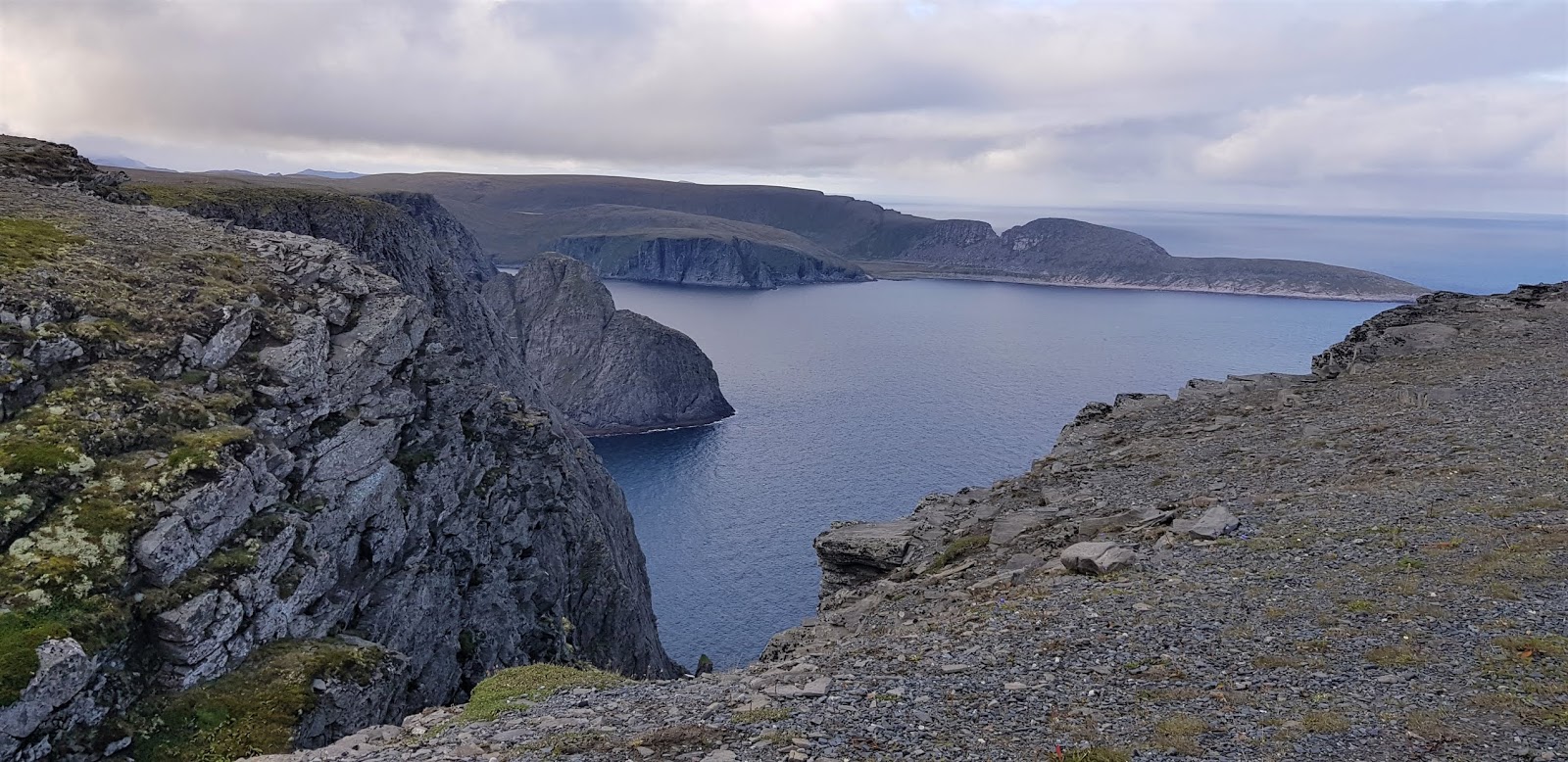
The North Cape Plateau soars to 307 metres almost vertically above the Arctic Ocean. The iconic globe sculpture has become the symbol of the North Cape. At the North Cape Hall we viewed a panoramic film about Magerøya Island through the seasons and 'experienced' the northern lights in a light
tunnel. Took a photo with the globe at the top of the earth and another at the marker for the International Hiking Trail from Italy to North Cape - inspired by Francesco Negri an Italian priest who first did this expedition in 1664! Wonder who he was trying to avoid!!In those times, there were no roads (first constructed in the 1950s) and early explorers would have travelled by boat and then scaled a near vertical cliff. Mad or what?

The reindeer are herded by the local Sami people - the indigenous peoples of the Finnmark (across the top of Norway, Sweden, Finland and Russia). Each year in winter they herd the reindeer to the mainland for feed and then at the start of summer they transport them (by ferry) back to the island. Reindeer are mottled colours in the summer, and have a white coat in the winter. There are some reindeer that have white coats year round - these are albino and have red eyes, and wait for it - red noses! Hello Rudolph!!


There is a Post Office (box) here and you can send postcards stamped with the North Cape - we didn't worry about that.

In 1988, seven children from across the globe were invited
to the North Cape for one week to produce a monument to the 'Children of the Earth' - a symbol of cooperation, friendship, hope and joy.

Sadly the Kysten Restaurant is closed tonight so we have to resort to eating at the buffet bistro. Not that there is anything wrong with that, it is just that our two experiences at the Kysten have been so memorable. On the menu tonight was local Salmon, Reindeer strips in a cream sauce served with mashed potato and
a berry mouse with hazelnut crunch for dessert. These were the three regional specialities for us to try. Of course there was plenty else on offer as well - prawns, crab claws, various cold roast meats and salads. Both Donna and I are so full. We have resorted to two meals per day and still feel like we are over-eating.

Tonight's meal is finished with cheese plates and a sample of the Norwegian Akevitt
(Water of life) which is made from distilled poteter.  This is a harsh liquour with a distinct flavor from a variety of different spices and herbs.  Caraway is by far the most popular, but dill, cardamom, cumin, anise, and fennel are typical ingredients as well. Akevitts vary in color from clear to a light and even caramer colored brown. Some akevitt is aged in oak casks, which give it a brownish hue. The longer it is stored in the oak casks, the darker the hue will be. Norwegian akevitt is aged in oak casks for anywhere from 1-12 years. Clear akevitt is known as “taffel.” Not to everyone's taste.

We have to re-pack our bags now andhave them ready to be off-loaded at the port of Kirkenes in the morning. Wish us luck - they are getting fuller by the day.

Riikka and Runo and the boys are getting excited as we get closer. Tomorrow we will try to arrange a hire car for our trip to Helsinki and we hope to reach Riikka's home in Jyväskylä by Wednesday night.

Thursday, August 22, 2019

"Nice to see you Australian's like your mead"

Description
I didn't sleep all that well last night.  Before I had got into a deep sleep we had docked at one of the overnight ports where the Hurtigruten vessels pull in to collect daily food supplies and make freight deliveries.  Our cabin is very close to the gangways - both passenger and freight and for some reason, last night seemed noisier than previous nights. Still, little price to pay for being close to the excursion exit points - literally just outside our door.


When ships pass in the night (and in the day), there are three horns sounded from each vessel. Before you realise this, as the horns sound you start to count, waiting to hear for the evacuation alarm.  Must admit, the first time was a bit alarming as we got to the sixth horn, until you realise that the second round of three blasts sounds different to the first three.  Phew, no need to get wet!


The ship is in and out of open waters at the moment.  You can immediately feel the change without even looking out the window.  When we hit open waters, unprotected from islands, islets or rocks, the swell increase is quite noticeable. 

We are back into the exploring today with two excursions.  Firstly, we are headed for Bodø - the second largest town in northern Norway and home to 70,000 people. 
Bodø lies just north of the Arctic Circle. It is also the end of the line for the Norwegian rail system.


Bodø was bombed in 1944 and assistance was provided by the Swedish government to rebuild parts of the ruined town. In return, the city now has a sector dubbed the Swedish quarter. Today, Bodø is a very fast growing town. There is very little manufacturing. Rather, it is a city of communications, access, tourism and learning. The 'high school' was granted university status a couple of years ago and is now home to 7,000 students. 
There is a very noticeable amount of building and roadworks happening with new civic and private investment happening. Its a nice mix of traditional timber homes and modern high-rise apartments.  

After our whirlwind drive through the streets of Bodø, we leave to drive 30 kms north to the point where we can observe the effects of the Saltstraumen current. 
Our driver and guide Michael was obviously very proud of his home. As we boarded the bus, he handed out samples of Arctic Salt in rather unique little tins. This salt is harvested at Saltstraumen where the ocean currents rush into the fjord.


The Saltstraumen is the strongest tidal current in the world with water speeds reaching up to 22 knots. Up to 400,000,000 cubic metres of seawater forces its way through a 3 km wide strait every 6 hours! The Saltstraumen has existed for about 3,000 years.  Depending on the conditions, there can be up to a 1 metre difference between the level of the seawater and that of the water inside the fjord. Today, we have arrived about halfway in to the turn of the tide and the Saltstraumen is just beginning to develop. If you look very closely, you can see eddies forming at the edge of the current. Too bad we are not 2 hours later when it would beat its peak.  We are told of the maelstroms that can occur and the loss of life over the years. Michael was saying that only yesterday a small ship was pushed on to the rocks when it lost its engine. Both the crew and the ship were saved.


The scenery en-route is a little ho-hum - just kidding! Like the rest of the Norwegian coastline to now, it is a mix of towering mountains that plunge to the sea, small lakes and streams dotted with rocks and rocky outcrops and glacial plains that are farmed and settled. 
The high mountains, like in other parts of the world are the cloud nurseries and we see clouds forming high in the mountain valleys. At times, they tumble over the ridges and cascade down the mountainside.

Out at sea,we can see squalls where it is raining in one view and in the next there is bright sunlight reflected so sharply that we need to squint while looking out the windows.

Back on board we have missed the lunch service.  We could have had an early lunch, or
packed something to take with us, but all we seem to do is eat, so we chose not to have anything after a good breakfast this morning of eggs,sausage, pancake (pikelets) with jam and sweetened whipped butter, yoghurt and fruit.  Instead, we head up to the cafe for a hot drink and the obligatory cake - today's afternoon delight! There are a number of points on board where you can have instant coffee or tea for nought, but personally, would prefer to pay and have the real deal!

We rug up a bit more for our next excursion - an evening journey for a taste of Viking life on the Lofoten Islands.
This trip we journeyed from Stamsund to Borg before continuing to the Lofotr Viking Museum. We are met at Stamsund by our guide Christian, dressed in Viking garb. He tells a good story in preparation for our visit to the local Chieftan's house - a fully restored full sized reconstruction of a traditional Viking home. Chieftan Olaf and his wife Olsen met us at the door. They then introduced us to some of the other members of the household including Olsen's sister - alive for 18 winters, and their slave who had been found by a local farmer as a baby and given to the chieftan when her own family came along. Picture a flamboyant Baldrick and you have him in one!

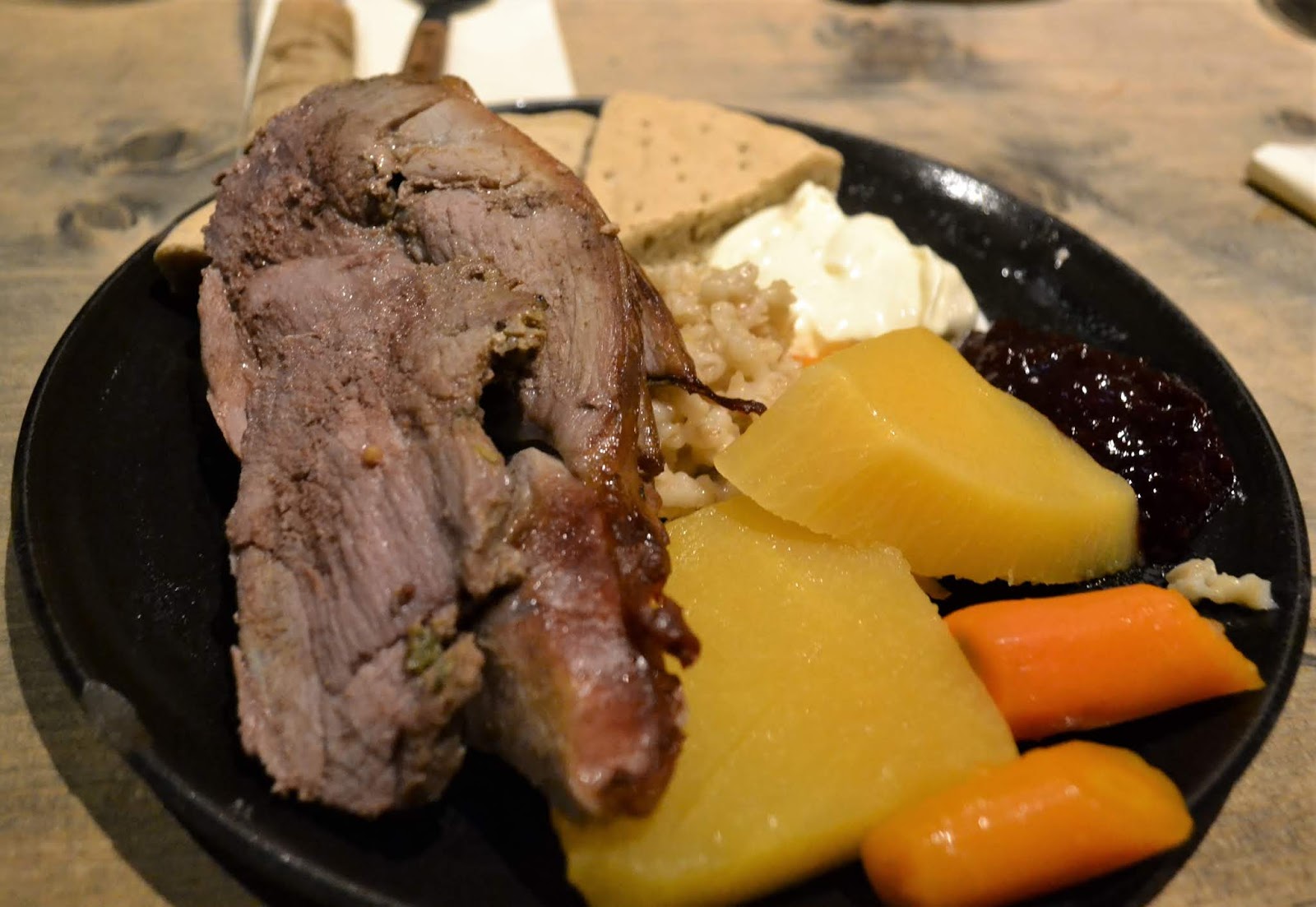
Into the banquet hall we file where we feasted on a traditional Viking meal of Lamb roasted on the fire, swedes, carrots, barley gruel, 'bread', sour cream and ligonberry conserve. The meat was cut with a knife, but the meal was eaten for the most part with your fingers - much to the chagrin of some of our fellow travellers! Served with goblets of mead and water.  Every time something significant was said, it was time for a toast - a reverberating 'Skul' - and
then a hearty swig of the mead. They generously refilled the goblets of all those who partook a generous swig. True Aussies in style, we celebrated with the chieftan with gusto.  Donna was one of the lucky ones who got to join in the dance at the end of the meal.

All too soon our visit was at an end. The ship had sailed on and we drove for just under an hour to reach it, now docked in Svolvær.

Tonight we are promised something special on the outside deck just before midnight - we are sailing in through the Trollfjord and in this narrow channel, you can almost reach out and touch the cliff walls on either side of the ship!  Coupled with a moon hanging high in the sky over open water, it certainly made sitting up worth it. Too dark for a photo,but forever in our mind's eyes!


Another memorable day in a very memorable part of this beautiful world.

Wednesday, August 21, 2019

Food Glorious Food

Today we had a quiet day. We could have taken a walking tour of Trondheim, but instead had decided to just do our own thing. Trouble was,when we docked we then learned that it is a 20 minute walk into the centre of town. Bugger that after such a full day yesterday. We rolled over and went back to sleep. Missed breakfast - but believe us, that is no problem- all some people seem to do is eat!

Had a lazy morning, washed hair etc. Last night Donna had taken the clothes to the laundry and didn't actually get into bed until late.

Lots of people were off boat today,so it was easy for us to make the first sitting for lunch just after 12 noon. The food on board is really good. Even the smorgasbord would rate a mention in a foodie mag.

Lunch today consisted of fresh tomato soup - the sort that still has colour and substance and taste, followed by salads, salmon, pork neck and smoked ham, didn't have hot dishes, desert was lemon sago cream pudding, lots of berries and brownie.
As we leave the bistro, we decide to upgrade to the a la carte restaurant option tonight, a decision that we later are pleased to have made!

This afternoon we spent a bit of quiet time up on one of the viewing decks, learned that we were soon to pass one of Norway's more unique lighthouses and for the first time, leave the safe waters of the fjords and the island channels and head out into the open water of the North Sea.  And yes,you could tell the difference!  The swell increased almost immediately that we cleared the last bit of land.  Good time for a nanna nap before dinner. The lulling and rocking a little more determined than before!

Tonight we have booked dinner for 8 pm. We get down to the Kysten Restaurant which only has a few diners left inside. We are shown to our table by the very attentive Malin - wow, this girl knows how to provide excellent service.
We are given a menu to peruse. Choices, choices, choices, although Malin provides guidance as needed thankfully.


So, these were our choices:
Starter - Maria - King Crab Ravioli in Reindeer bouillon with root vegetables.
A combination of clear, cold waters, a cold climate and careful,individual handling, provide Norway with outstanding King Crab all year round. The giant red King Crab was discovered for the first time in Norway in the Varanger Fjord in 1977 and today, it is a permanent part of the marine ecosystem in norther parts of Norway. Even though it's invasive and tends to displace other species, it has become a highly-appreciated element of modern Norwegian cuisine and an important export product. Consuming it supports the fishing industry and helps to keep the stock and its spread somewhat reduced.
This dish was originally created for the re-opening of the renovated Svalbard Hotel "Funken Lodge", located in one of the world's most remote populated areas. This small but ambitious Arctic hotel was originally built as an accommodation and dining area for employees of the Store Norske Spitsbergen Coal Company. Today, Funken Lodge is a small but ambitious hotel with modern comfort in historic surroundings.

Starter - Donna - Norwegian Scallops from Frøya with Cauliflower variation with fennel and chorizo from Tind in Stranda.
Given a solid green light from the World Wildlife Fund's list of endangered species, the Norwegian Scallop is a perfect combination of exclusivity and sustainability.  the delicious mollusc, with its tender texture and mild oceanic flavour, can be found along the vast stretches of the Norwegian coast, where they thrive tremendously well in the fresh, cold clear-blue water. Norwegian scallops are fished by hand by divers directly in their natural habitat and the environment footprint is therefore negligible.
The cautious, agile mollusc is, for many, regarded as the utmost delicacy of the sea. You really should try them!

Main - Maria - Tenderloin Beef from Trøndelag with fried savoy cabbage, tomato confit, tender mushroom, red wine sauce and victory onion pesto.

Cattle are of great socio-economic importance, but not only for their milk and meat. Grazing cattle also guarantee versatile habitats. Ecological diversity and a varied  ecosystem is a prerequisite for a nature in balance.
Norway has a vast coast and impressive mountains, but it is also a grassy country.  Grass that is left to grow without interference slowly loses its ability to bind carbon dioxide and after a while becomes a hostile environment for important insects such as pollinating bumblebees, as well as their coexisting plants. Cows grazing the green fields of Norway ensure open and thriving landscapes.
In Norway, legislation decrees that every cow, without exception, must be assured a minimum of eight weeks of free grazing every summer, with each cow having its own personal health certificate card. It is a fact that Norway has the lowest rate of antibiotic use in livestock production in Europe. These laws were created to ensure that every cow is recognized for its natural need for movement, and that the general stock stay healthy and sound in a sustainable long-term perspective.

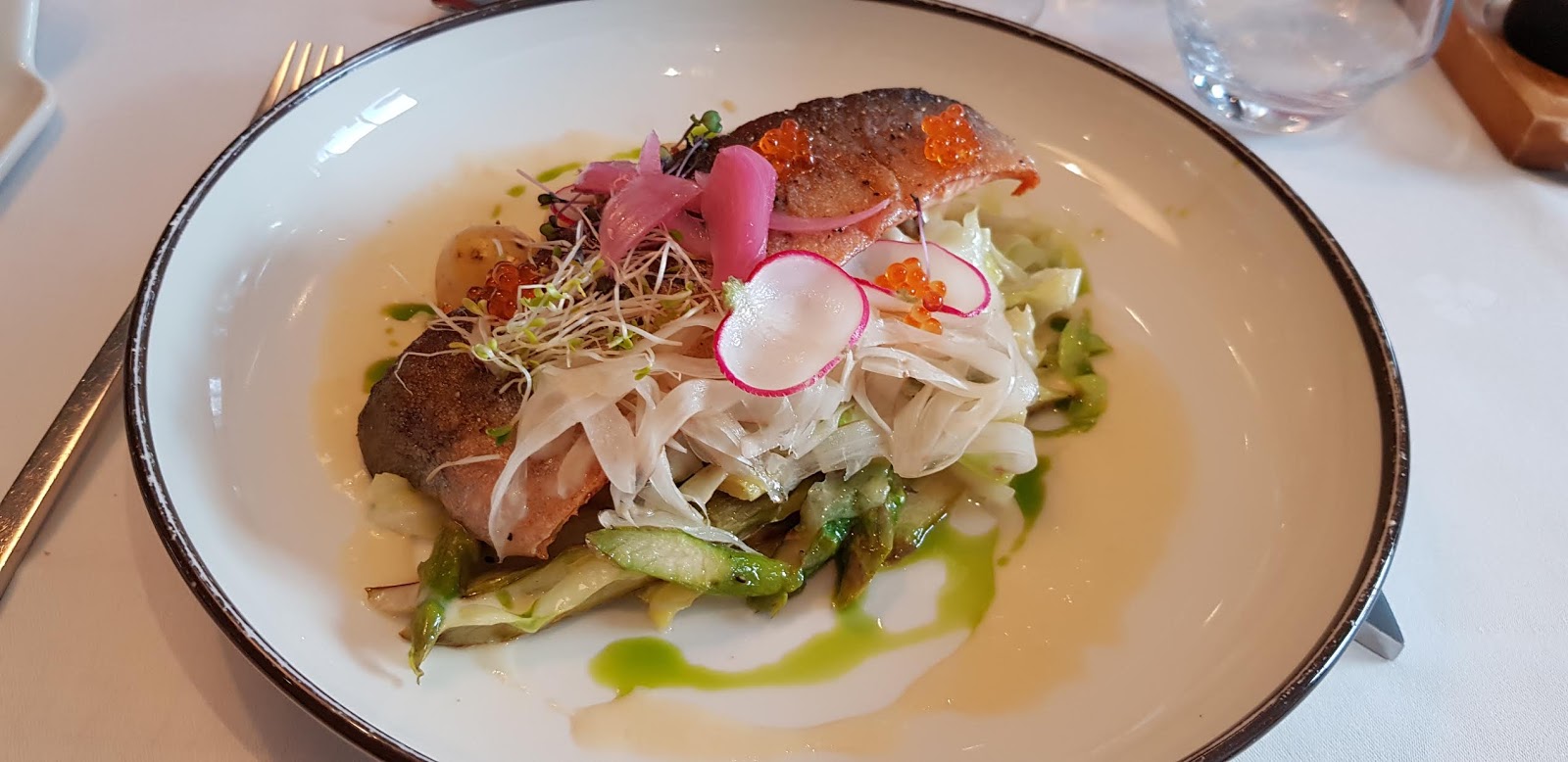
Main - Donna - Arctic Char from Sigerfjord with cabbage, asparagus, raw marinated fennel and white wine sauce.

The Artic Char is only found in Arctic waters and was one of the first fish to populate Norwegian waters after the last Ice Age. Through its lifecycle, it migrates from fresh water to sea water, giving the meat a unique taste, texture and colour.  While most of you are sleeping, we dock at Sortland every time we pass by and pick up fresh Arctic Char from Sigerfjord.  The water systems of Vesterålen, with their cold, deep waters and rivers, are perfect for these diadromous fish.

While we wait for our meal, we get a chance to look around. The ambiance is discreet and very tasteful - timber abounds including the lightshades and carvings of driftwood on show. Starched white tablecloths and really nice cutlery and glassware set the standard.


Dessert - Maria - Plum and Rhubarb Tarte with vanilla ice cream from Gangstad Gård
Up here in the north, winter is a long, dark and cold affair. Naturally, any sign of winter's end, no matter how small and discrete it may be, is welcome. Rhubarb is one of those fortuitous bringers of good news. When small, pinkish-coloured rhubarb starts to sprout in the garden, just as the snow melts away, things speed up.  Before you know it, the first harvest is possible and a home-made pie, tarte,marmalade or 'krem' can be enjoyed, that is if you don't choose to freeze them to enjoy them during the dark season as a sweet reminder of a long-lost summer. Another advantage of rhubarb is that it is full of vitamins and minerals.


Dessert - Donna - Chocolate Terrine with white chocolate creme made from Nýr from Grøndalen Gård
Nýr is made from cultured, organic whole-milk from well-treated cows (owned by the family of Grøndalen Olsen, who have received prizes for their focus on animal welfare and who claim that the cows are humourous, whatever they mean by that!)  The production is traditional. Cultured and pasteurised milk is carefully heated up and then left to drain on large filtration sheets.  When the consistency has become somewhat firm and creamy, the Nýr is ready. The result is a low-fat, sugar-free cream cheese with a high level of healthy protein. Hurtigruten is proud to say that we can base our terrine on such a sustainable and leading locally sourced product.

The meal was everything that is sounds and then some. We drank a Pinot Grigio from Veneto region (Italy) and finished with Norwegian coffee. Sublime.

And before we left tonight, we made sure to book in for the King Crab dinner in two days time!