Showing posts with label seafood. Show all posts

Saturday, March 26, 2022

Bruny - an island of two parts

And that I did. (Slept well last night for those of you you have not read yesterday's lot).

Although we all refer to Bruny Island, this land, off the south-east coast of Tasmania, is  two islands connected by a long, narrow isthmus. We have spent the last day and a half on South Bruny and this morning are travelling up to North Bruny Island. We only have this one day, as we have booked accommodation for the next two nights at the House on the Hill, a B&B in Huonville.

The day has dawned nice and clear. Except for the occasional passing vehicle, we sit with  the door open, quietly contemplating our lot. There is no wind and the waves just gently kiss the beach, a sound we almost need to strain to hear. It is definitely  autumn. The morning light is gentle, almost weak, muting the colours of our surrounds. This morning, the water is the colour of my new jumper - a baby blue. There is a line of rocks that must be the edge of an underwater ledge. The waves roll gently over the line, in a line, perfectly horizontal to the narrow beach. Outside the protection of this little bay, the water is a deeper hue of blue and from the deck of our villa it almost looks navy. And, in the distance, the landmasses around us are softened by the early morning mist.

We take our time over break-fast. Croissant and roll, a shared banana, the last of our cheese and a couple of 'packet' lattes and we are ready to hit the road.
There is no one at the pub at this time of the day, so we leave the room key in the drop-box and head off. We make one stop at the Bread 'Fridge' and opening the door, are greeted by warm, yeasty smells. The magic baker has been hard at work and replenished the supplies, depleted by yesterday afternoon. 

Our final visit on South Bruny is to the Bruny Island Chocolate Company. We are told that the owner and manufacturer is a pastry cook by profession and fell in to fudge making about 10 years ago when he realised there was a market gap. There are the usual assortment of chocolates, catering to the family and mass markets, but they also have some nice speciality ranges including a boxed selection of six, described as "More than a heavenly chocolate indulgence, our delicious premium quality handmade fudge with a rich creamy texture and distinctive, mouthwatering flavour to satisfy the most discerning of connoisseurs". Add to the mixed box, i have a Hounds Tooth Tasmanian Whisky Fudge, two chocolate sauces - one Brandy and Cointreau and the other Chocolate Mint, a bag of chocolate caramels and chocolate fruit and nut mix fill our bags.

Next stop is The Neck - at the lookout high atop the only hillock on the isthmus that connects south to north Bruny. The tide is out and I can see Sandpipers busily digging in the exposed sandflats for tasty morsels to eat. There is the odd family with kids digging in the sand, hoping to find some sort of little treasure, and the occasional tourist couple, hand-in-hand without a care in the world, immersed in their togetherness, with not a single other soul in sight along the beach.
The steps up to The Neck lookout are insurmountable - at least for me. 279 steps are just too many more than the 14 steps at home! Gen graciuosly (although probably silently cursing) offers to climb for the photos. They are truly stunning. You look north and south, and across the bays devoid of almost all water - you can even see Kunanyi in the distance. What a sight. Gen tells me that there are lots of small burrows all up the side of the hill - home to Fairy Penguins no doubt.

All too soon, we are back on North Bruny, with a list of places to visit before we leave. First call is at the Bruny Island Honey where they have a huge swarm of bees busy in a perspex covered box, which is behind closed doors. We sample a number of their varieties and purchased a small pot of creamed honey 'Bruny Island Prickly Box' honey and some Manuka Honey lip balm. I had used a sampler to test it on my lips and there was no immediate bad reaction, so finger's crossed they might help relieve them. The winds are not chaffed lips friendly!

Honey done, we move on to the Bruny Island Cheese Company. Fresh cows milk cheeses are made on the island from O.D.O. (one day old) cheese to a range of soft rind, washed rind and cheddar styles cheeses. Gen really only likes the two milder cheddar styles, but I am in my element. Not a blue in sight, but the washed and soft rind cheeses are very edible, lacking that acrid bite that often comes with a young, immature cheese. It's close enough to lunch time to sit and savour the bites here. Also on offer are ciders and beers with some other local wines and sparkling drinks, but for the time being, we just sit with apple juice (cos you can't be in Tasmania and not have the Apple Juice!) and coffees. A selection of three cheeses - O.D.O., Tom and Saint - refer to their website linked above for a description, proscuito, baguette, Ligurian olives and pickled beetroot and gherkins. Very tasty. As neither of us are oyster fans, we skip the Oyster Shack and instead head to the Bruny Island House of Whisky - much more my tipple of choice!

The Bruny Island House of Whisky sits high on a hill just 1 km from the Ferry to Kettering (Tasmanian Mainland). They boast the largest selection of Tasmanian Whisky's for sampling. Given that I haven't gone looking for other tasting rooms, I am happy to take them at their word! You can choose a 'flight' of four whiskies from one of four shelves all differing in price - from $60 per person up to the Champions (top) shelf at $295 pp. This is after all, 4 nips of whisky. We splurge and choose level 2 @ $75pp and opt to just share the tasting. We had one nip of 1. Nant - Tasmanian Highlands Single Malt, Bourbon Cask, 2. Trappers Hut Limited edition Tasmania Single Malt Whisky, 3. Lark Malt Whisky Small Cask Renaissance and 4. Callington Mill Tasmanian Single Malt Tango. I think we both the last one best. And of course, we can't go passed without trying their Gin. I had a Seclusion Gin with Soda and Gen, not liking gin, had a non-alcoholic Raspberry and Chilli Sparkling Ginger Beer  - after all, she is driving lol. At just over $90, we have contributed very generously to the local economy here thank you!

The day is slipping by and we are no headed or the Huon Valley. The crazy thing is that while everything is so close (as the crow flies) in Tasmania, the travelling times are longer than anticipated due to the narrow, winding roads. So we are pleasantly surprised to find that the trip to Huonville is all on multi-lane highways - even if it is steep in places. Disappointingly, there is no where to pull over as the first views along the floor of the Huon Valley come into view. It is a stunning sight - with a long, fertile valley nestled at the base of ancient hills on either side. we will just have to come back and hope there is a lookout somewhere. Through Huonville we drive - its a slightly larger town and we see some take-away establishments (although none of the chains - yay!). Lining the road into the town are apple orchards - lots of them. And we pass the Willie Smith Apple Shed that we have heard so much of. We plan to return here tomorrow to sample some of the 70+ varieties of apples that they are supposed to grow.

We follow Google maps to find The House on The Hill B&B that we are booked in to for the next 2 days. Turns out we don't need to find that lookout after all - this is set high on the Hill overlooking Huonville and we can look up and down that fertile valley. I'll make sure that Gen includes some pics on Facebook. Owner Paul greets us and shows us into a lovely double room, with a huge bathroom and access to a large dining and lounge area and verandah off that. Paul explains that the original house was built in the early 1980's and added on to in the late 1990s. It is very well set-up for a B&B.
There is one other couple here at the same time - they arrive back from their outing about 30 minutes before Dinner. 

Paul has a limited menu and we have both chosen Seafood Bisque - tomatoes, herbs, cream, potatoes and seafood to be followed by 'The Best Tasmanian" Cheese platter and port for two!  OMG I can hardly swallow, I am so full! Paul's Bisque was home-made with home-grown potatoes and lots of Tasmanian seafood. Our plates were filled to the brim with Seafood - literally. There were mussels, prawns, calamari rings, scallops and fresh and smoked fish. He was explaining that he makes his fish broth on the shells and heads of the prawns. No wonder it tastes so rounded and complete! I couldn't finish my serve - he jokes that he only gave us a small bowl - Maaate, I'd love to see a big bowl!!
We finished the evening with Paul, asking him to share the ENORMOUS cheese plate - plated with about 6 cheeses, from blue, to soft crumbly cheddar to truffled to camembert etc. There were a variety of pastes, olives, gherkins (chillied), chorizo, salami and bread and crackers - we would have done better to have just had this platter! Served with a glass of Penfolds Club Port that matched the rich pickings beautifully.

We sit, we talk. We drink coffee and finish the night on caramels and truffles that we purchased this morning. All in all, a lovely way to spend the evening.  Paul had asked what time we wanted breakfast in the morning. Origianlly we said 8am, but have changed that to 9 am - to make sure our digestive systems are ready for the next generous servings!  Pays to stay in local small hotels, B&Bs etc and not in the big multi-nationals. The people you meet are so passionate about what they do and the area that they are in. 
Nitey nite, my head is telling me I need to go to bed 😉😉 

Wednesday, September 11, 2019

Wonderful, wonderful Copenhagen

Yay, sunshine with just a few cotton wool clouds greeted us this morning.
Outside the IceBar (located in the same building as the Hostel), we catch the Hop On Hop Off bus again.  As we move through the stops, we wonder at the laid back attitudes of the staff - anyone would think that they are Aussies, and yet none we have encountered are!


We are headed into the Christianshavn area on a series of artificial islands within the harbour.  First founded in the 17th Century when King Christian IV extended the fortifications of the City, and at the time was an upper society residential area.  Description
Inderhavnsbroen - an opening bridge across the inner harbour.

In the 1970s a commune society set up in an area of the Christianshavn area that became known as Freetown in abandoned military buildings.  Later, many of these residents self-built their own homes, paying no regard to rules or regulations.  Following many attempts to make the residents conform to the laws of Denmark, finally in 2017 the 1,000 or so residents made their first payment to the state and so began the process of the area coming under the Copenhagen Council rule and home ownership status as opposed to squatter status.

But the area we have come to see is the magnificent Church of Our Saviour with its amazing helix spire that comprises 400 steps to the top.  Needless to say, we did not climb it!  This Church is definitely one of the more ornate and adorned churches we have seen here in Denmark.  The organ pipes dated 1698 and set in elaborate carved timber work borne on the backs of two plaster elephants. While the altar is stunning, and the carved pew heads amazing in their work - appreciated all the more because of my opportunity to watch the carving process of the Peace Pole being developed for the Rotary Club of Maryborough-Sunrise back home, it is the baptismal font that is the pick of the ornate statuary.  It is balanced at the other end by the austerity of the poor chests in the foyer.  The locks on these, as with the many other examples we have seen would seriously challenge any pick-pocket - old or recent!


From here, we walked back onto the City proper across 

Description

Inderhavnsbroen - the opening bridge that crosses the inner harbour, passing by the Børsen, the 17th-century Copenhagen  stock exchange, complete with its twisted spire of crocodiles or dragons - no-one really knows the inspiration.  The commentary on the bus yesterday wondered at how many crocodiles the locals of the 17th century would have seen.  We wonder how many dragons
they might have been witness to!!

We are looking for the Hop On Hop Off boat, only to discover that the ticket we have been given does not cover the boat - even though we specifically asked for it. Too bad.  So we decide to head for the Citadel and the Little Mermaid rather that waste any more time.

We alight the bus for the citadel in front of an amazing fountain, and the only Anglican Church in Denmark - much later, being constructed in the 1870s.  The fountain is the subject of a plethora of tour visitors making it very hard to get a good photo.  One of the standout features of Copenhagen as a city are the number of statues that are to be found at every turn.  This area is no different with artistic and commemorative statues almost every time you turn your head.  The Gefion Fountain features large-scale oxen being driven by the legendary Norse goddess, Gefjun. It is located in Langelinie Park next to Kastellet and is the largest monument in Copenhagen and used as a wishing well.  According to an ancient legend, Gefion was the goddess who ploughed the island of Zealand out of Sweden. The Swedish king Gylfe offered the goddess Gefion as much land as she was capable of ploughing within one day and one night.

Looking across the moat to the citadel, you can clearly trace the outline of the five pointed star.  Michael and I first saw an example of this type of fort in Blaye in south-western France.  Today, they are mowing the grass sides - with a domestic mower attached by a rope to a tractor riding along the top of the mound.  It looks so comical, and yet is so practical.

 The Citadel, o

Description

Kastellet, is one of the best preserved fortresses in northern Europe, and like much of the existing city, dates back to the early 17th century.  This is still a working facility with mess houses and the normal workings of a military establishment.  It should have been easy to walk through the fort through to visit the Little Mermaid on the other side, but the City, among all the other places, is
undertaking works here - this time to protect the fort from flooding!  So back outside we trudge to wait for the next bus to take us around closer to this iconic symbol of 
Copenhagen.

The Little Mermaid sits on her rock pensively looking at you, pining for the loves she never.  Not often spoken of alternative mermaid - the Genetically Modified Mermaid - is found off a new Square at Langelinie.  She represents a tortured soul, albeit with feet,but still without a love.

The day is getting blustery now and darker clouds are moving in.  We decided to ride the bus around to Nyhavn and have some early dinner before returning to the Hostel.

In the dying light of the afternoon, this colourful canal community is stunning.  A 17th-century waterfront, canal and entertainment district, it is lined by brightly coloured 17th and early 18th century townhouses and bars, cafes and restaurants.  Hans Christian Anderson lived in this district at the time that he wrote most of his fairy tales.

Not having had any lunch, we stopped at No.19 Nyhavn at the Skagen Restaurant where we feasted on seafood tapas (Donna) and Fish Soup (Maria) followed by Surf and Turf (Donna) and Rib Fillet (Maria).  It is raining as we eat and the wind has really come up, so we take advantage of the blankets the restaurant offers.

From here it is a 5 block walk back to the normality of the hostel.
Tomorrow we begin our journey for home, flying first to Amsterdam from Copenhagen.  It would have been nice to go by train, but it is an overnight trip and the train gets in a little to close to our departure for our Sydney bound flight.
One more night - this time back in Amsterdam.


Wednesday, August 21, 2019

Food Glorious Food

Today we had a quiet day. We could have taken a walking tour of Trondheim, but instead had decided to just do our own thing. Trouble was,when we docked we then learned that it is a 20 minute walk into the centre of town. Bugger that after such a full day yesterday. We rolled over and went back to sleep. Missed breakfast - but believe us, that is no problem- all some people seem to do is eat!

Had a lazy morning, washed hair etc. Last night Donna had taken the clothes to the laundry and didn't actually get into bed until late.

Lots of people were off boat today,so it was easy for us to make the first sitting for lunch just after 12 noon. The food on board is really good. Even the smorgasbord would rate a mention in a foodie mag.

Lunch today consisted of fresh tomato soup - the sort that still has colour and substance and taste, followed by salads, salmon, pork neck and smoked ham, didn't have hot dishes, desert was lemon sago cream pudding, lots of berries and brownie.
As we leave the bistro, we decide to upgrade to the a la carte restaurant option tonight, a decision that we later are pleased to have made!

This afternoon we spent a bit of quiet time up on one of the viewing decks, learned that we were soon to pass one of Norway's more unique lighthouses and for the first time, leave the safe waters of the fjords and the island channels and head out into the open water of the North Sea.  And yes,you could tell the difference!  The swell increased almost immediately that we cleared the last bit of land.  Good time for a nanna nap before dinner. The lulling and rocking a little more determined than before!

Tonight we have booked dinner for 8 pm. We get down to the Kysten Restaurant which only has a few diners left inside. We are shown to our table by the very attentive Malin - wow, this girl knows how to provide excellent service.
We are given a menu to peruse. Choices, choices, choices, although Malin provides guidance as needed thankfully.


So, these were our choices:
Starter - Maria - King Crab Ravioli in Reindeer bouillon with root vegetables.
A combination of clear, cold waters, a cold climate and careful,individual handling, provide Norway with outstanding King Crab all year round. The giant red King Crab was discovered for the first time in Norway in the Varanger Fjord in 1977 and today, it is a permanent part of the marine ecosystem in norther parts of Norway. Even though it's invasive and tends to displace other species, it has become a highly-appreciated element of modern Norwegian cuisine and an important export product. Consuming it supports the fishing industry and helps to keep the stock and its spread somewhat reduced.
This dish was originally created for the re-opening of the renovated Svalbard Hotel "Funken Lodge", located in one of the world's most remote populated areas. This small but ambitious Arctic hotel was originally built as an accommodation and dining area for employees of the Store Norske Spitsbergen Coal Company. Today, Funken Lodge is a small but ambitious hotel with modern comfort in historic surroundings.

Starter - Donna - Norwegian Scallops from Frøya with Cauliflower variation with fennel and chorizo from Tind in Stranda.
Given a solid green light from the World Wildlife Fund's list of endangered species, the Norwegian Scallop is a perfect combination of exclusivity and sustainability.  the delicious mollusc, with its tender texture and mild oceanic flavour, can be found along the vast stretches of the Norwegian coast, where they thrive tremendously well in the fresh, cold clear-blue water. Norwegian scallops are fished by hand by divers directly in their natural habitat and the environment footprint is therefore negligible.
The cautious, agile mollusc is, for many, regarded as the utmost delicacy of the sea. You really should try them!

Main - Maria - Tenderloin Beef from Trøndelag with fried savoy cabbage, tomato confit, tender mushroom, red wine sauce and victory onion pesto.

Cattle are of great socio-economic importance, but not only for their milk and meat. Grazing cattle also guarantee versatile habitats. Ecological diversity and a varied  ecosystem is a prerequisite for a nature in balance.
Norway has a vast coast and impressive mountains, but it is also a grassy country.  Grass that is left to grow without interference slowly loses its ability to bind carbon dioxide and after a while becomes a hostile environment for important insects such as pollinating bumblebees, as well as their coexisting plants. Cows grazing the green fields of Norway ensure open and thriving landscapes.
In Norway, legislation decrees that every cow, without exception, must be assured a minimum of eight weeks of free grazing every summer, with each cow having its own personal health certificate card. It is a fact that Norway has the lowest rate of antibiotic use in livestock production in Europe. These laws were created to ensure that every cow is recognized for its natural need for movement, and that the general stock stay healthy and sound in a sustainable long-term perspective.

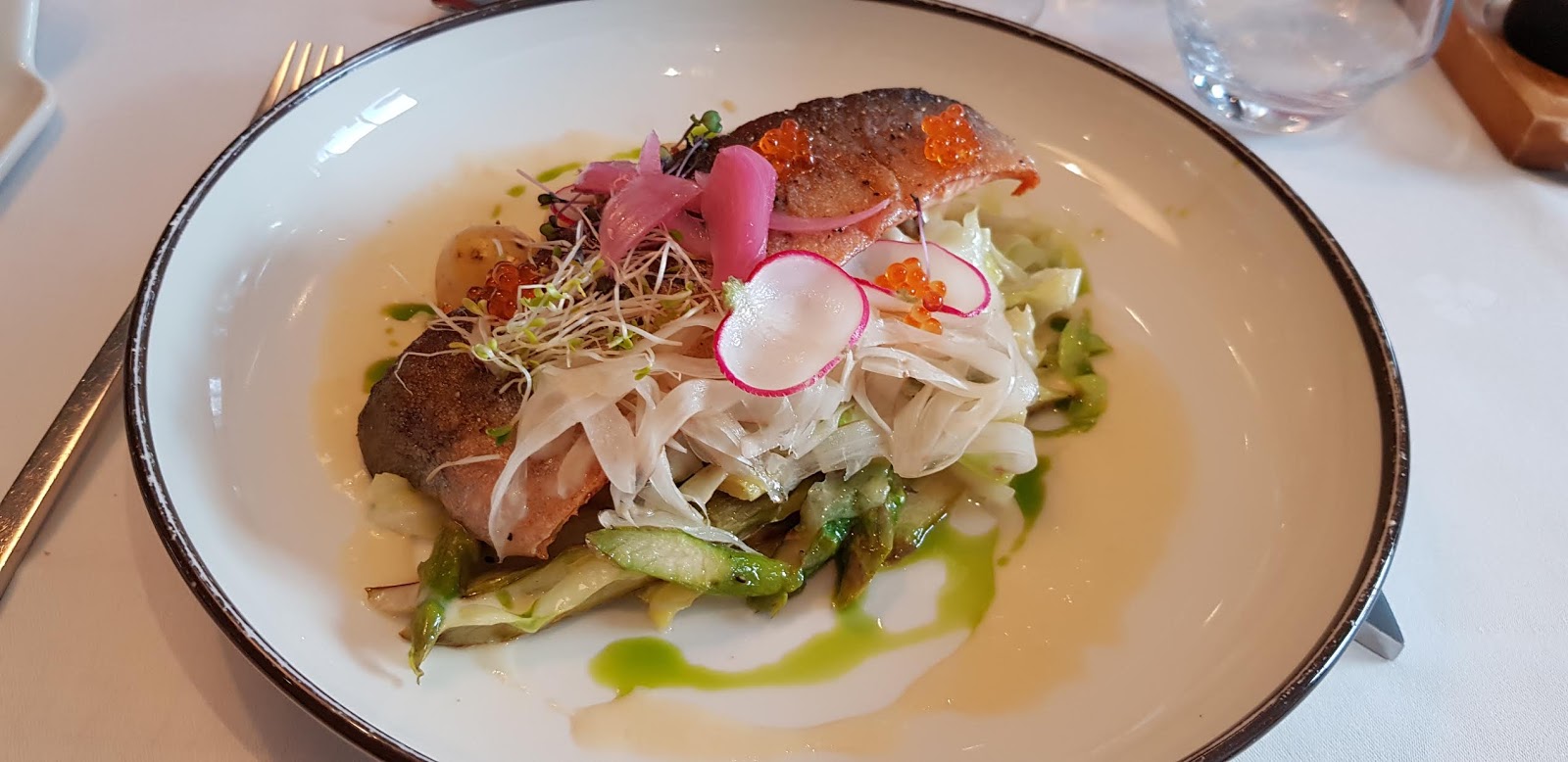
Main - Donna - Arctic Char from Sigerfjord with cabbage, asparagus, raw marinated fennel and white wine sauce.

The Artic Char is only found in Arctic waters and was one of the first fish to populate Norwegian waters after the last Ice Age. Through its lifecycle, it migrates from fresh water to sea water, giving the meat a unique taste, texture and colour.  While most of you are sleeping, we dock at Sortland every time we pass by and pick up fresh Arctic Char from Sigerfjord.  The water systems of Vesterålen, with their cold, deep waters and rivers, are perfect for these diadromous fish.

While we wait for our meal, we get a chance to look around. The ambiance is discreet and very tasteful - timber abounds including the lightshades and carvings of driftwood on show. Starched white tablecloths and really nice cutlery and glassware set the standard.


Dessert - Maria - Plum and Rhubarb Tarte with vanilla ice cream from Gangstad Gård
Up here in the north, winter is a long, dark and cold affair. Naturally, any sign of winter's end, no matter how small and discrete it may be, is welcome. Rhubarb is one of those fortuitous bringers of good news. When small, pinkish-coloured rhubarb starts to sprout in the garden, just as the snow melts away, things speed up.  Before you know it, the first harvest is possible and a home-made pie, tarte,marmalade or 'krem' can be enjoyed, that is if you don't choose to freeze them to enjoy them during the dark season as a sweet reminder of a long-lost summer. Another advantage of rhubarb is that it is full of vitamins and minerals.


Dessert - Donna - Chocolate Terrine with white chocolate creme made from Nýr from Grøndalen Gård
Nýr is made from cultured, organic whole-milk from well-treated cows (owned by the family of Grøndalen Olsen, who have received prizes for their focus on animal welfare and who claim that the cows are humourous, whatever they mean by that!)  The production is traditional. Cultured and pasteurised milk is carefully heated up and then left to drain on large filtration sheets.  When the consistency has become somewhat firm and creamy, the Nýr is ready. The result is a low-fat, sugar-free cream cheese with a high level of healthy protein. Hurtigruten is proud to say that we can base our terrine on such a sustainable and leading locally sourced product.

The meal was everything that is sounds and then some. We drank a Pinot Grigio from Veneto region (Italy) and finished with Norwegian coffee. Sublime.

And before we left tonight, we made sure to book in for the King Crab dinner in two days time!

Friday, August 16, 2019

Oslo - where the Vikings once ruled

All night long, we were lulled with a muted rythmic rumble. Turns out that there is a very regular tram line that runs under our window. They run every 2 minutes during the day and not much less even into the wee hours of the morning.  The triple glazing must be excellent, as we are not disturbed at all. In fact, it is quite soothing.

Well Oslo is a bit of a surprise. Brunch this morning is fabulous coffee (oh, how I have missed you) and the lightest, plumpest cinnamon scrolls that look like a double carrick knot. Its cool but not cold and without any breeze.  As we sit enjoying our food, we here sirens and then a protest march in the near distance.  Great. Not. I guess that being a little on edge is becoming the new norm for travellers. Don't worry. Not close enough to cause any concern.

The public transport is amazing. This morning Donna got out the guide book and spent an hour or so cross referencing the transport map and the locational map to identify which trams and buses would get us to places such as the Opera House, the main railway station and the Vikingskipsene - our major destination for today.
And before we go any further, I just want to note that Donna has absolutely NO sense of direction.  Google maps sending us the long way around or not (as it does), she still has no natural sense of direction. Thankfully, I do! And thankfully Donna is a whiz at working out the connections.

We pick up the bus outside our building.  This is the former main Post Office - a beautiful building that covers an entire city block, it now houses apartments, shops, offices etc.  The bus stop is on one stage of the block and the tram stop on the other side of the building. So the bus stop is at the front door and the tram at the back!  On to Bus no 30 we head out. 
We have not been able to find out how or where to buy a ticket and are hoping that we can buy them on the bus. And yes we can, but only with cash, which I had bought prior to leaving Australia. But the bus driver could not make the change needed and so told us to sit directly behind him in case an inspector got on.  Everyone just boards the buses, you do not need to show your ticket, there is no tapping and I am guessing that there would be plenty of locals who ride the transport for free, taking a chance on not seeing an inspector who can demand to see your paper ticket or your electronic ticket on your phone.

A 21 minute bus trip through part of the historic areas, past a number of the embassies and consulates and through (obviously well-to-do) residential areas and eventually into some rural settings, takes us up into one of the ridges and finally to the Vikingskipsene. You can recognise it by all tourist buses parked outside! And yet there are not too many people here.  As we go in, once Donna has divested herself of her backpack and bought our entry tickets at a very reasonable AUD $33 for the two of us, we learn that this morning there were three cruise ship groups in and they had to hold people waiting outside because the museum had reached capacity.

THIS is a museum and a half.  The building is quite austere, painted all white inside.  This allows the pitch-black of the Viking ships to stand out in stark contrast. Each of the three main ships is housed in a wing off the small foyer, entry desk and souvenir shop.
They are mind-blowing!


Obviously restored, these three boats were only discovered in the 20th century. But all were built in the first century AD. The level of detail and care taken with construction and decoration of not only these main vessels, but all the artefacts found buried with them talk of the pride of the Vikings. 

As we learn more about our earliest ancestors, we learn more of the prowess and skill they had. 
No longer can we believe anything that we knew of the barbaric thugs we knew of as children.  These are sophisticated people with complex class structures and a true sense of adventure.  We sit through a really well done visual presentation of Viking history that showed the peoples they had dealt with across the globe as well as highlighting the natural features of their home lands.  I comment to Donna, that I wonder who was that first brave person who thought to build a boat and launch into the treacherous northern waters. I would have had heart attack after heart attack if it were me in one of the slight (looking) boats as it tossed and heaved in the swell depicted.


The Norwegians are obviously proud of their Viking heritage - and rightly so!!

Our wander back in history done, we catch yet another bus where the driver cannot make the change (and yet it appears to be a common event as we were not the only tourists to be caught out). We quiz him on where to buy the tickets and he says online (been there, tried that one unsuccessfully) or many shops such as 7-eleven - yes, the same chain as at home!  (Small world). We make our way down to the very modern Opera House and nearby find the main tourist office and the Olso Sentralstasion and in the harbour close to the Opera House are two enormous cruise ships. 


While there, Donna went in to the tourist office to purchase bus tickets for tomorrow and we see some unique art pieces. The 'trees' are found in the children's play area and the 'foot' sculpture (which looks totally different in side view as the space between the toes and the body of the foot is open) is on the concourse.

Tickets bought, we head turn for the apartment searching as we go for a restaurant and find ourselves at the Cafe Cathedral in front of the Cathedral where we order Baked Salmon - Fresh Norwegian salmon with fennel salad with dill, orange and apple.  Served with potatoes, asparagus and white wine sauce and (the best ever) Fish Soup - Our famous creamy fish soup with shrimps, salmon and vegetables. Served with bread.

Finished with a cheese plate, a pinot grigio and pear cider. Oh what a night, and a meal.

Another day dawns soon and bed beckons.  Chat soon all.


Saturday, March 3, 2018

Dunedin - a city for all tastes

Another foggy morning, but by 9:30 am the sun is burning it off.  We are high on a hill with the Catholic Church directly opposite- funny about that - the Mick's always seemed to manage to snaffle the best high spots in towns - perhaps 'nearer my god to thee?!!

First stop of the day - Cadbury World!  Our guide for the morning is Christie who is definitely on some kind of upper.  For the sixteen of us she is hyped and happy and high on chocolate.  Everything she says and does has a bubbly 'high five' feel about it.  She leads us through the process of turning cacao to cocoa and then to chocolate including filling our goody bags with all things chocolate. We go through the 'breakfast room' where we can help ourselves to liquid chocolate, adding such things as pretzels, coconut, sprinkles, popcorn and oreo bits. Not really my idea of breakfast but for some of them - wow!

We climb halfway up one of the storage silos (the purple one) and watch one tonne of liquid chocolate fall from a height further up down to the base of the silo!


Near the end of the tour we learn that the factory in Dunedin will close in three months.  I wonder whether this will be her downer?  But no, she is very philosophical about it.

After finishing our visit to the Chocolate caverns with a coffee, we set out to find some of the amazing Street Art that Dunedin is known for.  

We find the first dozen or so pieces and then realise that we are within a cooee of the Chinese Garden and take a detour from the hot summer sun into the serene coolness of the garden.  This is a sanctuary in the city - a green space in the concrete and brick and bitumen!

As we move through the gardens with the wind moving through the willow trees, we spy the Tea House and sit down for a Rose tea (Michael) and a peppermint tea for me.  Coupled them with a selection of buns and dumplings - just a very light snack.  The teas were just what we needed!


From here we head over to the stunning Dunedin Railway Station that everyone had told us to make sure we checked out. This building is a homage to a bygone era of grace and beauty.  

The entire main entrance is tiled, from the small mosaic tiles on the floor to amazing vitreous ceramic tiles on the walls.  There are 3D tile surrounds to the ticket windows and across the top of the ground floor under the mezzanine floor with its cast iron balustrade and stunning stained glass windows.  

Designed by George Troup and opened in 1906, it demonstrates a commitment to quality and pride in workmanship - stunningly beautiful, there are no other words to use.

We visit the Art exhibition upstairs where we have missed out on buying a Green Man art piece (but I have a contact for the artist) and buy a stunning had painted silk scarf for half the price of any other one we have seen in NZ!  Winner!

As the day is closing fast, we head to Toitu - Otago Settlers Museum.  Sited between the railway and the Chinese Garden in a re-purposed warehouse with a stunning new entry building added.  

The people of NZ know how to do a museum.  The layout, the connections and the collections are stunning with enough hands on and interactive displays that mean that the non-touch displays are easily protected. We end up with only about 90 minutes to explore a space that you could spend a day in.  

There are lots of story-telling from the Maori, white settlers and the Chinese perspectives.  The displays take you from the arrival of the Polynesians right through to the new technologies of today and everything in between.

After the Museum closes at 5 pm, we hit the streets to find some more examples of the street art before we stop for some early dinner at a pub chain CBK where I was offered a Plum Cider by Stuart - wasn't too sure I would like it, so he gave me a tot to taste.  Man - move over apple - this Plum Cider by Good George Brewing has plenty of tart and plenty of flavour and none of the over-sweetness of many of the new fruit ciders.

 Michael has a Seafood Chowder and I settle in with Steamed Bao Buns - one each with smoked beef, fish and spicy chicken. Delish.  And Stuart has given us the premium address to view Dunedin from on high for a great view day and night - we'll check it out tomorrow.

And as we arrive back at our accommodation, something wicked this way comes - another sea fog is creeping very quickly, very silently in from the coast. 


Thursday, March 1, 2018

You take the high road, we're travelling the coast road . . .

The unit is warm and the bed warmer.  Michael is never a morning person and now on holidays, is happy to lie in.  Tomorrow will be a different story though - we need to be gone from here by 7 am to get to the Cathedral Cave in low tide - more about that later.


We head in to have a look around Balclutha and get fuel before we strike out to the west along the Southern Scenic Route.  This is a town of some 4,000 souls that swells to many more in the summer months.  It is known for its concrete span bridge that was built in the 1930's after the previous timber one washed away in a flood - kind of familiar story to someone from Maryborough! The Clutha River is the largest river in New Zealand by volume of water and the country's second longest.  The town is the main service centre for the surrounding pastoral lands.

Yesterday, we travelled in to Balclutha on the more northern national highway as the coastal road is longer, and we knew that we did not have time to make the most of it. So today we turn back from whence we came, albeit on a totally different road. And a bit like many of the coastal roads in Australia, they do not always hug the coast, and there are times when we must travel 9-22 kms down to the coastal car parks to access more fragile areas before returning the same way to re-join the scenic route. That long white cloud is evident again
today, bringing with it rain.


We travel through towns with alluring names such as Owaka (with it's Teapot Home), Caberfeidh, MacLennan,  Papatowai and Chaslands where we stop for lunch at the highly recommended Whistling Frog Cafe which is an icon in the Caitlins area of 'outstanding natural beauty'before heading through Niagara and Waikawa to Curio Bay. Our meals were delicious - Michael had the Beefsteak and Cheese Pie while I had the Chicken Caesar Sandwich.

We make stops at Pūrākaunui Falls, getting caught on the road up behind a farmer moving his sheep. The four sheep dogs kept running back to his window for instruction!

Matai Falls, the Florence Hill Lookout, pass Lake Wilkie and the Tautuku estuary and drive through Chaslands and Waikawa taking photos all the way before we arrive at Curio Bay.  

This is the home to the Tumu Toka CurioScape, to Hector's dolphins/papakanua, Yellow-eyed penguins/hoioho and fur seals and sea lions.  But today it is windy and drizzling in to rain and none are to be seen.  A hedgehog, introduced to control garden slugs and now considered a threat to the native fauna, was the only animal venturing out!  The ranger told Michael that it is very unusual to see them during the day.

The Tumu Toka CurioScape is excellent and explains the geological and geographical changes that have occurred over the millenia, to the backdrop of the Maori legends and stories.  After watching it, Michael takes a walk in the rain down to the petrified forest bed - the only place in the world where a petrified forest is found next to a living one!

The rain is continuing and getting heavier, so we decide to head back east to our accommodation. But before we head in fr the night there is a final spot to visit.  Nugget Point is the site of a lighthouse that guards ships in the region from meeting their doom at The Nuggets which are right in front of it.  Rugged and beautiful, this is also treacherous with the local Department of Conservation warning sign including the sage words "keep children safe".  All it would take on this route would be one inquisitive little one under a barrier, and a slip would see them swimming with the dolphins in the waters far below.

And our last stop for the night is at The Point Cafe and Bar at Kaka Point for dinner.
Again, highly recommended by Karla, the food is fabulous even if we do have a very noisy and base group of four behind us. When one tells another to shush, the petulant reply is"Knew we shoulda gone to the pub!"

Nevertheless, the food was sublime  my Seafood Chowder starter was thick and creamy with a generous helping of seafoods - some of which I left for Michael whose Salt and Pepper Calamari looked nice.  Michael enjoyed his Moroccan Chicken and I again chose Blue Cod - this time pan-fried with vegetables.  Delicious.

 Tomorrow we move on to Dunedin.