Showing posts with label history. Show all posts

Saturday, September 7, 2019

We have a new friend - barmaid Howrie!

Writing the blog sober can sometimes be a little of a chore.
Writing the blog while pissed as a fart is  . . .  a challenge.
So I didn't try to write the blog last night - hence me writing this morning!


The day started out well enough - with breakfast as we planned a day sightseeing in Göteborg.  Now Göteborg is a very walkable city.  It is predominantly flat and right on the coast with a significant harbour, with a few canals leading from the harbour in to the City.


The Scandic Crown Hotel is inner city - just beyond the Central Rail Station. The concierge at the desk here provides some advice on getting right in to the historic areas.  Walk around the station and through Nordstan, a 'Westfield style' shopping mall right in the centre of the CBD.  would you believe that in the month that we have been in Europe, this is the first shopping centre that we have been in.  And you will all be proud of us - despite all the 'Sale' signs in windows, we bought nothing!  To get to the historic areas of the City, we need to get beyond Nordstan, and the fastest way to do it is through it.

On the other side, we come out in an area of narrow cobbled streets radiating in a grid pattern out from the significant Gustaf Adolf’s Square facing the Rådhuset (Town Hall) with a canal running along one side - complete with picture pretty bridges lined with flower pots.

Our first building visit is in to The German Church which its also called Christinae Church. Named after Queen Christina, it was inaugurated in 1748, and used by he German and Dutch congregation in Gothenburg. While there are some ornate decorations, in the chandeliers and the windows, predominantly it is simple and basic and filled with light.


Crossing the canal brings us into closer quarters, with narrower streets, many of them pedestrianised so we don't need to be watching for vehicles quite so diligently.  It gives us a chance to look at doorways and rooflines and into the minutae of daily life here in Göteborg.


We are now close to the main canal and the city park and notice the spire for the Domkyrkan - the Cathedral.  We had a little difficulty getting in initially, turns out they are preparing for a radio broadcast on today, Sunday 8 September.  The original church on this site was consecrated in 1633 and following two fires, this final Cathedral was built in 1815. It is plainer than many we have seen.

We are headed to the Saluhallen, the Market Hall in Göteborg. This is the largest indoor market, and significantly nicer that the two outdoor markets we have seen thus far today.  When you enter in through the double doors,your senses are assailed in the very best of ways.  There are foods of all descriptions - smallgoods, cheeses, fruit and vegetables, sweets and nuts, meats, home-made pastas, cooked meals.  Only one fishmonger - and really they only had prawns and salmons plus sauces and salads.  Turns out that the City of Göteborg has its own fish markets down near the harbour.


Back into the sunshine - it is warm and lovely until the sun disappears behind a cloud and the wind picks up!  Across the next canal towards Kungsparken (Kings Park) we see further evidence of the regal presence in the city of the past.
At this point, Donna tells me we are not too far from the Haga district, the oldest quarter.  "How far is not far?"  "Only about 1.5 kms"  "Too far", was my response! Time to put the tram tickets we have bought to use.  Soon to the tram we go to visit the Haga district.  The first thing that we tend to notice are the rooflines - and that includes the spires and towers of the various churches.  There is no reason that the Haga should be any different!
At first we cannot get in to the Church as there is a service in progress.  Turns out the service is a wedding.  

I join the locals taking the sun, sitting in the beautiful little park adjacent to the church while Donna takes a walk down to see how close she can get to the Fish Markets we could see from the tram stop.  Like many other cities, there are significant road works being undertaken here and this means long detours around said works!
She comes back via some of the traditional half timbered houses that exist only in the Haga district now.  And like the main city area, some of the cobbled streets have been closed to traffic to allow safe access by pedestrians and bikes and cycles.

The bells were ringing (for me and my girl) as the newly wedded couple leave the church.  We come up to the doors as one of the church officials comes to the door, telling us we can only have five minutes as they are closing the church.  Quite a number of people follow us in! Church done, we head off to find one of the best examples of restored buildings in this area. We find a couple, unsure of which is the exact building in a row that all demonstrate some special features.

Our day is done.  My feet are done.
So it is back to the tram and back to the Scandic Crown.
After walking just over 5km (tram rides extra) we deserve a drink.

Howrie, bar tender of the day, helps us to make sure that we celebrate appropriately!
A few drinks later, we ask for Cointreau on ice.  She has never served Cointreau before and has to search the register to find the button!!
Its about now that she delivers a smallgoods tray to us.  Not sure if it was in recognition of our patronage or to ensure we eat something as we drink!  Who cares, was delicious.
She tells us that Göteborg can get as low as minus 20 degrees in winter and that in a heavy snow, the whole public transport network closes down.
She also tells us that limes are the most expensive fruit - even more so than mangoes,and that she would give anything to have a lime tree in her yard.  Turns out they sell at about 3 for 70 SEK.  That makes them about $3 each!

An early night follows - we needed it!

Wednesday, September 4, 2019

What lies beneath

Today's post actually begins last night.  Donna, wanting to walk off dinner, took the camera for a stroll and came back with some lovely night shots.  Over a small bridge just below us on the isle of Skeppsholem is an old bridge that joins a smaller islet on which Kastellholmen is found. In the soft light of night, this beautiful building shines.  The castle was planned as part of Stockholm's defense and had two predecessors:


  • One used in the 1660s when the Navy just moved to the islets; and 
  • one from 1746, blown up through an accident in its ammunition factory in 1845. 
The three-tongue war flag has been hoisted at Kastellholmen since the 1660s and perhaps even earlier. At the end of the 1660s a small octagonal castle with flagpole was built on the roof. From here, passing ships were greeted with flag and cannon salutes. The castle later came to be used as a powder cellar, storage room and ammunition factory, but the flagging from its roof continued.The Swedish word 'skepp' translates as 'ship'.  Another beautiful photo is of a rigged ship - the af Chapman.  There are lots of such boats moored around here, and not many modern launches.  Turns out that this one is now a youth hostel and restaurants.The ship was constructed by the Whitehaven Shipbuilding Company, located in the English county of Cumberland, and launched in February or March of 1888. Her original owners the same name in County Meath, Ireland. Her maiden voyage was from Maryport, Cumberland, to Portland, Oregon, and she subsequently made voyages between Europe, Australia and the west coast of North America.  Funny where you find links with home.

But enough of last night.We begin our day juggling accommodation bookings, flights, and train bookings to make sure that we are back in Amsterdam in time to fly home on the 13th.  Hard to believe that we are planning the end of this adventure!

Today we are headed back to another island on the archipelago that is Stockholm - the
island of Djurgården.  This is the same island that we visited yesterday, but today we walk right along the waterfront to the Vasamuseum.
The Vasa Museum has been constructed to house the largest salvaged item in the world - a 17th century warship that capsized and sank in Stockholm 1628.  After 333 years on the sea bed the mighty warship was salvaged and the voyage could continue. Today, Vasa is the world's best preserved 17th century ship.  

In the spring of 1626, under the watchful and impatient eye of  the King the construction of the Vasa is underway and completed in the summer of 1628. The cellar held the naval arsenal and Vasa was moored below the palace when she took her cannon onboard.  Battles were being waged in northern Europe in the summer of 1628.

It was mid-afternoon when at last it was time. After many delays, frustrations with the supply of guns, and a change of captain, the newly fitted out Vasa was anchored below the castle, with its cannon finally on board and the crew manning their stations. The quay was packed with people and the water teemed with small craft carrying people who wanted to watch the mighty war machine slip its moorings and sail from Stockholm.  What started with church services and a festive atmosphere ended in a watery grave. It was the 10th of August 1628, when Vasa, the most powerful warship in the Baltic, foundered in Stockholm harbour before the eyes of a large audience, scant minutes after setting sail for the first time and travelling only about 1,300 metres.

The day after the sinking, an inquest into the disaster was begun. 
Ultimately, no one was blamed and the reason given was poor design (which had been approved by the King!)  Perhaps the most interesting part of the inquest from a technical point of view is an appendix at the end, recording the opinions of a group of professional experts, captains and shipwrights. Without the benefit of calculus or modern naval engineering theory, they correctly identified the forces at work and the cause of the instability. As one of them put it, the ship did not have enough "belly" to carry the high and heavy upperworks.

The ship lay on her side, somewhat forgotten despite searches for the ship over the centuries, at the entrance to Stockholm harbour.  In the early 1950's when the City was looking at constructing a new bridge, research highlighted that what was thought to be rubble from a 1920's blasting turned out to be ballast from the Vasa.  
The seabed home of the Vasa was confirmed on 4 September 1956 (and today is 4 September 63 years later!).  It took another 5 years to plan and prepare for the raising and on Monday, 24 April 1961, thousands of people crowded the shores around Kastellholmsviken, much as they had lined the shore almost 333 years earlier, and the Vasa was brought back into the light.

This is an amazing story both in the building, salvaging and documenting of the stories.  The ship that spans seven storeys high, sank in 3 minutes meaning that the minutae of everyday life aboard such a vessel survived also.  Much of the museum is dedicated to this.  
There is a film that explains the story of the salvaging and lots of detailed exhibits.  What an interesting afternoon!

We finally leave after 5 pm.  The weather is chilly now with an afternoon breeze and we walk the 750m around to the ferry stop to head back to Skeppsholmen.  We have an early light dinner of sliders, salami and cheese, and ready for a bigger day tomorrow on Gamla Stan - the Old City.

Tuesday, September 3, 2019

ABBA - Thank You For The Music

Yesterday allowed us to fully re-charge. A day filled with rest and recovery (although Donna who is not used to sitting still for so long felt it).  We spent a few hours having a look at what there is to see and do in Stockholm and finding accommodation.
Everything in Scandinavia is far more expensive than any other place we have travelled, so accommodation doesn't come cheap.  Since we are paying a premium, it might as well be somewhere nice, and central to everything. 


So this morning we headed back from the Raddison to the Stockholm Airport on the free connection bus because this is the easiest way to connect with the public transport system into the centre of Stockholm.  The express train in to Stockholm City is not included in the public transport and at AUD$50 per person, we don't hink it is cheap.  But with the journey cut to 20 minutes as the speed gets up to 190 kph - couldn't quite catch it as the monitor kept changing.highlighted!


At the main station, we go down to the metro station and get a 72 hour all-public-transport pass for the same price as our trip this morning AUD$50 each.  Now, we are set. We know that there is no transport right to the door of our hotel today, so succumb and take a taxi so we can divest ourselves of our luggage.  The taxi driver complains of the amount of roadworks, but we assure him that there is no more than most other cities.  He moans about the Green Party, who hold the balance of power and are influencing the investment in environmentally friendly transport modes that will restrict vehicles in part of the City.  Sorry, just can't agree with him. It was nice to get a couple of photos of the inner city as we were driving to the hotel.  I hope to get clearer shots over the next couple of days.

We finally reach the hotel where we will spend the next couple of days - the stunning Hotel Skeppsholem set just up from the waterfront on the island of Skeppsholem.  The Hotel has a long and colourful history. Originally built in 1699-1702 with the purpose of housing the Royal Marines of Karl XII. Since Sweden’s financial situation of the time was poor, most of the building material came from ruined castles on the countryside. The buildings, known to locals as “The Long Row”, was never used for the soldiers as intended, as most of them never made it home from the wars. They were therefore left uninhabited until 1710, when the city started using them as a hospice for poor people infected with the plague. 

Years later after renovation, the buildings became offices and storehouses for the Navy, and also housing for military employees. The Martial Court was accommodated here too. In the 1900’s most of the space was turned into apartments for Navy staff, mostly officers and their families, and in the 2000’s it was once again adapted to be used as administrative offices. It is fascinating and lovely. We arrive in the sunshine with lots of people sitting in the garden.

Our room is not yet ready, but that is okay as the hotel will gladly hold our luggage.  So off we head down the path and then out along the quayside walkway to the ferry terminal.  We are off to see the ABBA museum that I had booked tickets for while we travelled in to the City on the train this morning.

So, one cannot come to Stockholm and NOT go to the ABBA museum.  Not sure where to start.

For those who know me, I am an ABBA tragic from way back.  I'll never forget the day when a teenage Gen was horrified when she found me singing to Fernando in one of the band's later incarnations.  She didn't know at that time that the band was universal and timeless!

Because we have pre-purchased our tickets, we can skip the line at the door and waltz straight on in.
We end up spending more than 4 hours here.  It is filled with the stories and memorabilia of the individuals and their personal lives before,during and after the ABBA phenomena, the band and their hits and tours, the stage play and the two movies.  It included interactive sections where you could try mixing the songs, auditioning for a supposed opportunity - and no, I am NOT putting that up here, nor the photo shoot of me as the various band members - suffice to say those are the pics that horror movies are based upon!

There is nothing that is not covered.
The costumes, the props, the newsreels, the platinum records - everything.  From the foursome's childhoods to the current day.
It is a wonderful tribute that allows so many people to re-live their teen years.  And the story of the Australian link to their fame is well

So as the day is drawing to a close, and the weather starting to chill for the night, we head back across the bay to our island and our hotel.
Dinner is served until 10 pm, but with a full hotel, the best we can manage is 6:45 pm.  So we take it.  The restaurant here not only services the hotel, but locals also, and is very well known here.  Restaurant Långa Raden caters to discerning diners (and the bus tour groups lodging here).  The food is typically Swedish with a modern twist.  Donna and I decide that we can only do two courses and opt for a main and dessert.  The food is fabulous.

Mains - Donna
Hängmörad svensk ryggbiff med kryddsmör, tomatsallad och rödvinssky 
Dry aged Swedish sirloin steak, spice butter, tomato salad and red wine jus  
Maria
Köttbullar med potatispuré, pressgurka, lingon och gräddsås  
Meatballs with potato purée, pickled cucumber and lingon berries and cream sauce  

Desserts - Donna
Hallonyoghurtglass med kolabrownie och maränger 
Raspberry and yoghurt ice cream, caramell brownie and meringues
Maria
Vit chokladpastej med citrusmarinerade jordgubbar och smultronsorbet 
White chocolate cake with lemon marinated strawberries and wild strawberry sorbet

Those desserts were 'died and gone to heaven delicious'!
 
Back in the room as we are putting our gear away, Donna comes across the purchases that you can make on the room menu - the smalls you might have forgotten - socks, jocks, nickers and tights (small to extra large- one in each size) - now THAT is class!!
Donna then did a Michael and went out to take some night shots - we will share them tomorrow.

Tomorrow we are heading into the Old Town.


Wednesday, February 28, 2018

Is this really summer - a cracker of a day!

At the Victoria Railway Hotel we awake to a 7⁰ morning.  With the forecast high of 21⁰ we are hoping for nice weather.
There is no street parking at the hotel so last night we park in the Council multi-store car park next to the hotel.  Only about 6 cars in there overnight. And when we checked out this morning before 9, there were probably less than 20. Seems strange as it is within a block of the start of the CBD.


We head off to take a few shots of the town area - and maybe our Mary would like this piece of public art that is adjacent to the Courthouse.
There are lots of memorial statues and the parks are stunning, but the commercial side of Invercargill is very depressed. 

Quite a bit of street art which we suspect is mirrored by body art given the number of tattoo parlours.  That and jewellery shops - go figure.

We head over to Invercargill's Queens Park which houses the Southland Museum
We kick start the morning with a light brunch in the Cafe.  The museumis another amazing collection of historic and contemporary displays including two that we spend quite a bit of time in - the Southlands War - WWI through the memories and memorabilia of local families; and Beyond the Roaring 40's which celebrates those stoic people who explored the subantarctic islands. There are so many amazing artefacts on display including a snow sled that is intact. This display is balanced with another that celebrates the region's maritime history.

I am amazed at the top third of the lighthouse that sits on Dog Island. The precision and beauty is stunning.  Made of brass and prismatic glass that is in parts more than an inch think, and in other areas fine enough that you would think a sneeze would shatter it!


It is these exhibits that really capture our interest and we spend a good few hours exploring and marvelling at the ingenuity and tenacity of the early explorers of this southern land.  

With a quick visit to see 'Henry' the 120+ year old Tuatara. Facing extinction, the Museum's successful breeding program is ensuring the very survival of this rather unique reptile.  They do not mature to reproductive age until they are about 70.  Just think about that - a 120 year old horny male!!!  You can read more of Henry at their website.

It is after midday when we leave and that was reluctantly.  We head over to the Bill Richard's Transport Museum.  This is another goldmine for Michael to explore and as we want to get to Bluff and have lunch, I give him a one-hour deadline.  I'll let him tell you about what he saw:

This museum and the one I saw at Wanaka are as different as chalk and cheese. The Bill Richard's Transport Museum is indeed a sight to behold, apart from being housed under one massive roof the exhibits are in pristine condition and most are in running order.

The first section of the museum is dedicated to Ford automobiles, which is a chronological history starting from Henry Ford's first vehicle through to the Ford racing stable. Every conceivable Ford motor car is on display and gleaming. It can be likened to admiring the exhibits in a dealers floor plan. The floors are of highly polished concrete which virtually mirror the exhibits.

Moving into the next section is an array of heavy vehicles. Trucks of different types are represented, and not only Ford. Single chassis trucks, buses and prime movers including Leyland, Albion, Packard, Le France and a rare 1911 Stewart, just to name a few. I was thrilled to find examples which my late father had driven in the 60's and 70's. These being Leyland 'Octo' and 'Mantador', and a Thames 'Trader' all looking resplendent in their respective liveries.

Moving on as time was getting away, I entered another section dedicated to agriculture, firefighting and earthmoving. Unfortunately, my time here had expired whereby I didn't get the opportunity to view the recreational and general sedans,wagons and saloons. Ce la vie! However,should you visit New Zealand, head to Invercargill and this magnificent museum.

So just after 1 pm we head south to Stirling Point. A quick dash up Bluff Hill gives us amazing views over the Forveaux Strait, the township of Bluff with its fishing port and long jetty - probably as long as the Urangan Pier usually was.  There is also a famous lands end signpost that mirrors the one in the northernmost part of Scotland!
There is a really well known restaurant here - the Oyster Cove - famous for Oysters (der) and we are headed here for lunch.  Even though it has gone after 2 pm, there are still a number of people having lunch, and more continue to arrive as we eat.


Michael started with the Oysters - not Bluff Oysters unfortunately as the season doesn't open until - wait for it - tomorrow! So he has to settle for Pacific Oysters.  Still ever so fresh.  Served with natural Malt vinegar salt, watercress butter, toasted bread.  I had the home baked Thyme & Sea Salt Loaf Spiced red onion-beetroot jam, watercress butter, sweet pepper pesto. HUGE.  Enough for probably four! Hot, buttery and delicious.

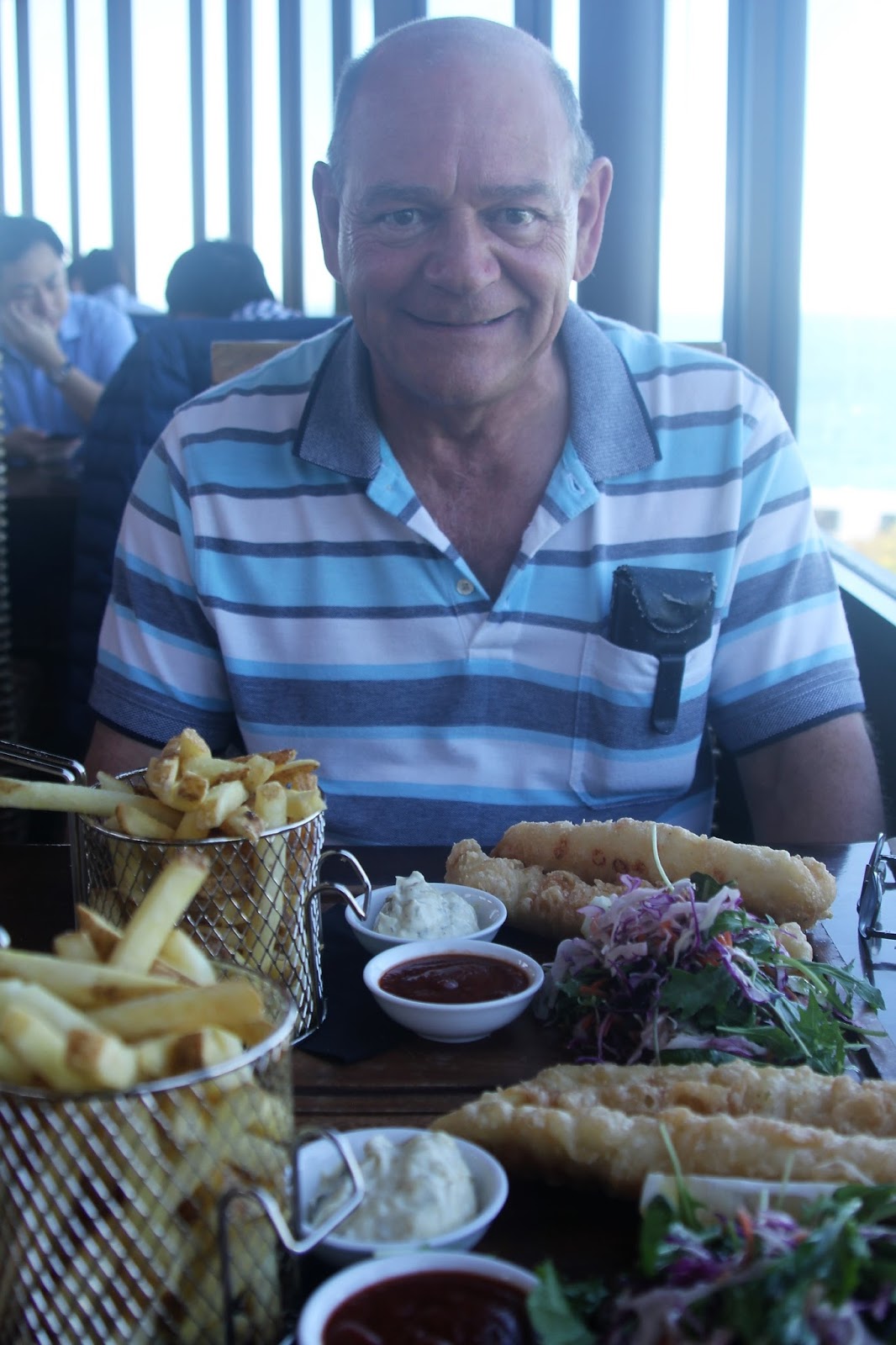
AND we had ordered a main!  We both chose Classic Blue Cod - Crisp lager battered Blue Cod, kiwi slaw, game chip basket, house made tartare, malt vinegar emulsion.  At this point we determine
that this is lunch and dinner.  The food was amazing. The Blue Cod so fresh, white and clear in taste.

Finally done with lunch after 3:30 pm we head down for a selfie at the signpost and then leave to head to Blaclutha for the night.  We are basing ourselves here for the next couple of days while we explore the amazing coastal area known as The Caitlins.

We are staying in a unit on the property called Blair Atholl - yes more links with Scotland, and owned by Jared and Karla McPhee.  Karla is an advisor employed by the local Council and delivery services to small businesses for the state government -really small world isn't
it!!  we are still full from lunch and about 9:30 pm just have a little of the orchard stonefruit we bought in Arrowtown and some cheese and crackers.

All in all, a cracker of a day. Looking forward to tomorrow.

Sunday, February 25, 2018

An unexpected link to Maryborough

Again we sleep longer than we originally planned - one of the perks of being on holidays and in a fab bed!  We had planned to get up at 7:30 am, but Michael has set the alarm for 8:30 - ha ha ha - he never was a morning person!

A quick goodbye to Scooter just after 9:30 sees us head in to spend the morning giving Arrowtown some serious attention.  Scooter is originally from Europe and even she comments on the cost of living here. She and Grant have a small cottage that they are busily renovating and remodelling. Today she says it is valued at $1.4 million. And it is small - two bedrooms only. The airbnb room that we occupied is in a new built in area under the house.

Dating back to the mid 1800s, its main street is filled with the small original stores that graced it in its heydays when gold was being mined.  All of them re-purposed now of course. But still quaint and very twee.


We're off to 'Provisions of Arrowtown' a purveyor of all things local and foodie for breakfast.  Michael orders the big breakfast (of course), while I choose the Buckwheat Pancakes with grilled banana, blueberries and marscapone. And coffees of course. Those pancakes were as light as clouds and Michael's 3 eggs were poached to perfection. We are sitting in a back room, overlooking a Quince tree laden with growing fruits.


Once sated, we amble up the main street, stopping in at most of the shops. Some are surprisingly affordable, others not so - some of the merchants are really trying to make the most out of the many Chinese visiting the area.  And then we pause outside the local Sotheby's office (sure that gives you a hint!).  This property was the cheapest in their window! 

There are gold, jewellery, clothing, woollen goods, souvenirs, artworks shop that are interspersed with lots of eateries all doing a roaring trade.  The really noticeable thing here is that everyone from the young ladies in the Visitor Information Centre, to the sales staff in the shops and the wait staff all treat their visitors with open willing friendliness, whether you are buying or browsing. It is really noticeable and contributes to a wonderful warm feeling all through town. And because everyone is so friendly, all the visitors and smiling. And spending!!  If only we could bottle it and shake it all over home.


Arrowtown had its birth in the 1860s when the push to mine gold from the Arrow River was at its peak.  The original buildings in the main street have continued to evolve into the retail and service offerings of today.  And just like in Australia, where there was gold, came the Chinese.  The first orientals in the area didn't assimilate and created their own little village in the back streets towards the river and much to the annoyance of the European traders, the Chinese even set up their own shops.


Once the gold mining stopped being commercial, the town faded into the backdrop, meaning that there are still more than 70 historic sites remaining. In the 1950s there was a resurgence of interest in the area as a holiday destination. It is less than an hour to the summer friendly Lake Wanaka and even closer to the winter ski fields.

We were lucky to be wandering around today as the local farmers market was on in the local park. Cheeses, salmon, cured meats, fresh fruits, baked goodies - a foodies heaven. But we were also unlucky. We were putting some purchases in the car when I put the keys down to move a bottle of water. Promptly shut the boot and the car automatically locked. With the keys still inside.  A bad design flaw in the Ford Focus if you ask me. An hour later and $160 poorer, the local AA man has us back in the car.


And now to the link with Maryborough.  Sister (now Saint) Mary McKillop came to Arrowtown 20 years after she had set up the first catholic school in Maryborough, where she also set up a school for the local children.  Funny the things that link us across the waters, isn't it.

And locally, Irene S and Ann C both asked whether the lolly shop still exists.  We can happily report that yes it does, and it is still doing a roaring trade of old favourites and new offerings.

It is now early afternoon and we hit the road to head for Queenstown - about 25 minutes away.  And while the day was a cool summer day in Arrowtown, as we get closer to Queenstown, the weather also is closing in with lots of clouds again rolling down the mountainsides.  Donna had said that one of the must does here is the Gondola to the top of Bob's Peak.  St Frances is with us again as we get a car park about 100 m from the entry as another can pulls out.  The rain is beginning as we leave the car.  We manage to get into our gondola and up the mountain in just very light rain, so get one reasonable photo on our way up the VERTICAL mountain.  But by the time we peak out at the top, the rain has set in. 

We sit with coffees and wonder at the sanity of people who race the luges in the rain, but even more so, to the mountain bike riders who pay up to $900 for an annual pass to ride the gondolas up just to plunge down the mountain side - the very steep mountain side - even in the rain, and as we are told later, even in the snow!

We hang around for an hour or so hoping for clearer weather, but it is not to be, so we head back to ground zero thinking we might catch a movie - but can't find the cinema, so we head for Mossburn for the night.  A couple of reasons we chose here - it is on the road to Te Anua and Milford Sound, and it happened to have a vacancy - many places are still fully booked. The entire drive along what must be stunning scenery with towering hills and deep gorges along the length of Lake Wakatipu. Today however, through the veil of water they are merely shadows and outlines.  Not fair.

And finally I am gobsmacked at the large number of sheep (and cattle) that they farm per hectare here. Without a word of a lie, there were about 1,000 sheep on a 3 - 4 hectare block.  The rain isn't worrying them, what with their greasy wool coats.  The cattle on the other hand huddle in tight lines at the most protected parts of their paddocks - hides are not so waterproof!

We pull in to the carpark at the Mossburn Railway Hotel to check in and have dinner just before 7pm.  The rain continues and the temperature has plummeted.  The hotel is dry and warm with a roaring fire going. Drinks and dinner ordered and done, we head across the road to their new accommodation units - Wheels and Reels. 
My crumbed Blue Cod was delicious and Michael loved his Fisherman's Basket complete with mussels and scallops!

There is or was another link with home here - up until the 1970s there was a combined rail and road bridge over the Oreti River - very similar (although not as high) as our Dickabram Bridge!

Tomorrow promises to be clear and warm and we are hoping to do a day cruise to  Doubtful Sound - quieter and less crowded than Milford Sound.